

After a few days on the Amalfi Coast we continued our journey through Southern Italy but this time to the island of Sicily. The flight to Catania, Sicily from Naples was a duration of only 1 hour. This was the 4th time we boarded planes on the trip and also the first time we changed planes the most number of times in one single trip. Our main reason for going to Sicily was to see the active volcano , Mount Etna with our own eyes.

Sicily, one of the 20 regions of Italy – is the largest island lying in the centre of the Mediterranean Sea . Its main attraction is Mount Etna, the tallest and largest active volcano in the whole of Europe. So instead of flying to the capital Palermo we flew to Catania, the city that lies at the foot of Etna and which is the base to reach Etna.
In fact, because of it being situated on the northern edge of the African continental plate, the eastern coast of Sicily– along with a few other islands surrounding it – have highly active volcanoes. While Vesuvius had last erupted a few centuries back , Etna was still a very active volcano and had erupted last December in 2018.

The best part of the trip to Sicily was probably seeing Mount Etna from the airplane window. After taking off from Naples, it hardly took us half an hour to view the eastern tip of Sicily from the sky. From high above, the first thing that grabs your attention is the size of Etna. Etna takes up almost half of the island of Sicily-dominating the eastern corner of the island. In my eyes Mount Etna looked like a disproportionately built diorama – a huge mountain on top of a small piece of land –a toy built from play dough.
Entering Catania
The instant I exited the airport and came outside I fell in love with Catania . Stepping out of Catania–Fontanarossa Airport, we were greeted with a rush of cool Mediterranean air and the distant, smoky silhouette of Mount Etna rising on the horizon. The temperature was a few degrees higher than what it was in the rest of Italy. The city felt immediately alive – sunlight bouncing off the dark lava-stone buildings, traffic humming and palm trees swaying lazily along the roads. Catania is a city facing the Ionian Sea, on a plateau , with Mt Etna looming tall and wide like a sentinel and guardian angel, at a distance. It is the second largest city and the 7th largest metropolis on the Italian island of Sicily . Our cab driver Mark, a pleasant, handsome fellow, shared many interesting facts about his beloved town.

According to the historian Plutarch , Catania’s name came from the word Katane meaning ‘grated’, referring to the uneven surface of the land surrounding Etna, upon which Catania stands. During the medieval period it was already called the City of the Elephant , deriving this name from the Liotru or black elephant that stands guard in the Piazza Duomo Square-the center of the city.
The weather was fabulous with the sun shining gloriously over us. Catania looked less like an archaic, tourist -centric place but more like a modern city with all its noisiness and chaos but at the same time, steeped in history with resplendent , baroque style architecture with houses the colour of the volcanic sand from which the city originated ,and mystical with its attachment to Greek folklore.
The best part was that very few people could speak in English, most of the signs being in Italian ,and the whole city had a neighbourly feel to it – as if you could just loiter around and enjoy your surroundings like a local going out for his afternoon stroll .

Catania has been a home to many invaders-Siracusans, Romans, Byzantines, Arabs as well as Normans – and each era has contributed to the overall cultural extravaganza of the city.
Piazza del Duomo
The Piazza del Duomo , as its name suggests , is the heart of the city and the main attraction of the city ; filled with stores, bars and restaurants surrounded by the most important buildings, palaces, churches and the town hall of the city. So a walk around the Piazza is a must. It is not only a regular meeting place for the locals but also a great tourist spot. In the centre of the square is the impressive Catania Cathedral , Palazzo degli Elefanti – now the local municipal building, Fontana Dell’Elefante , and the Fontana Dell’Amenana .
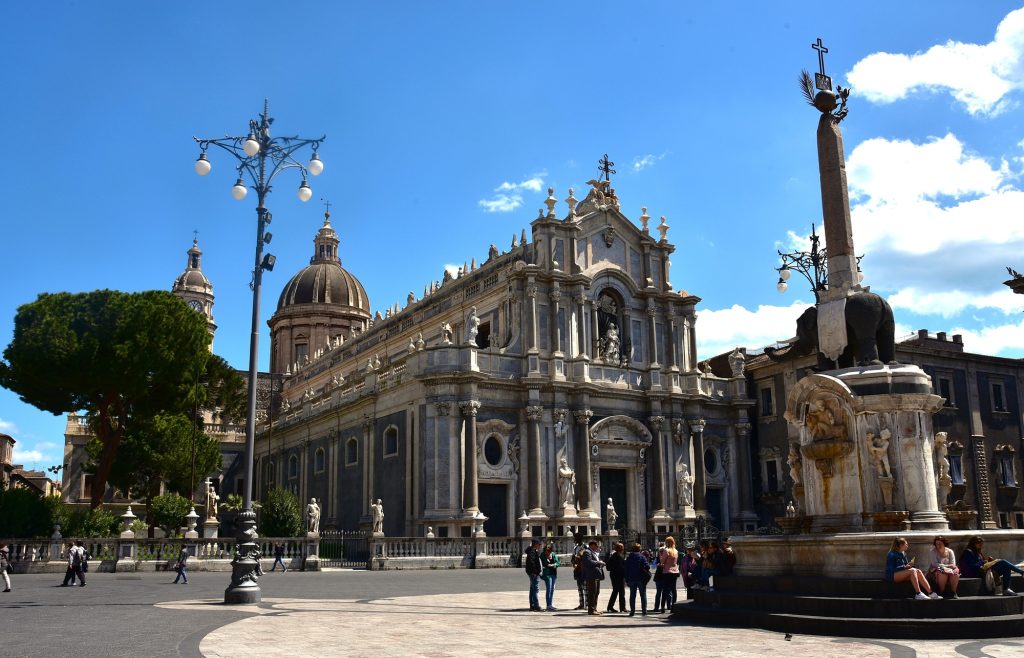
The Catania Cathedral or Duomo di Catania or Cattedrale di Sant’Agata, dedicated to Saint Agatha, is a Roman Catholic cathedral in Catania . Constructed from the grey and white granite of the Corinthian region , the cathedral is a splendid example of Baroque architecture. Though originally constructed in 1078 over the ruins of the Roman Baths of Achille – the columns on the lower level belonged, in fact, to the original ancient structure – the cathedral has been destroyed and reconstructed many times due to the innumerous earthquakes caused by Etna.

The Fontana Dell’Elefante , the statue of an elephant, also carved from basalt, lovingly called the Liotru– refering to Hannibal the Great -one of history’s most brilliant military commanders, best known for challenging the might of Roman Republic during the Second Punic War. It is located right in front of St. Agatha’s Cathedral and points its trunk to the it as if to pay homage to St.Agata. The Elephant itself is quite mysterious as no one really knows why, when and how it became the symbol of Catania. Some say it has magical powers and protects Sicily from the eruptions of Etna; some say its origin goes all the way back to an actual elephant that fought off dangerous wild animals as the city was founded. During the 9th through 11th century Muslim rule of Sicily, Catania was already known in Arabic as Madinat al-fīl or the City of the Elephant. The statue is towered over by a huge Egyptian obelisk, which according to local folklore possesses magical powers.
Major Attractions of Catania
Apart from these few immediate attractions located in the Duomo Centre, there are numerous other attractions located all over the city. Here’s a list of some:
Palazzo Biscari
Historical Monastery San Benedetto
The Achillee Thermal Baths
The Spas of Indirizzo, of Rotonda
The Roman Amphitheatre
Saint. Gaetano alle Grotte
Tomb of S.Euplio,
Ingrottamento dell’Amenano
The Roman Hypogeum
The Well of Gammazita
Saint. Agata la Vetere
The Baths of the Gladiators at St. Agata al Carcere
Bonajuto Chapel
San Nicolò l’Arena
Ursino Castle

Our BnB
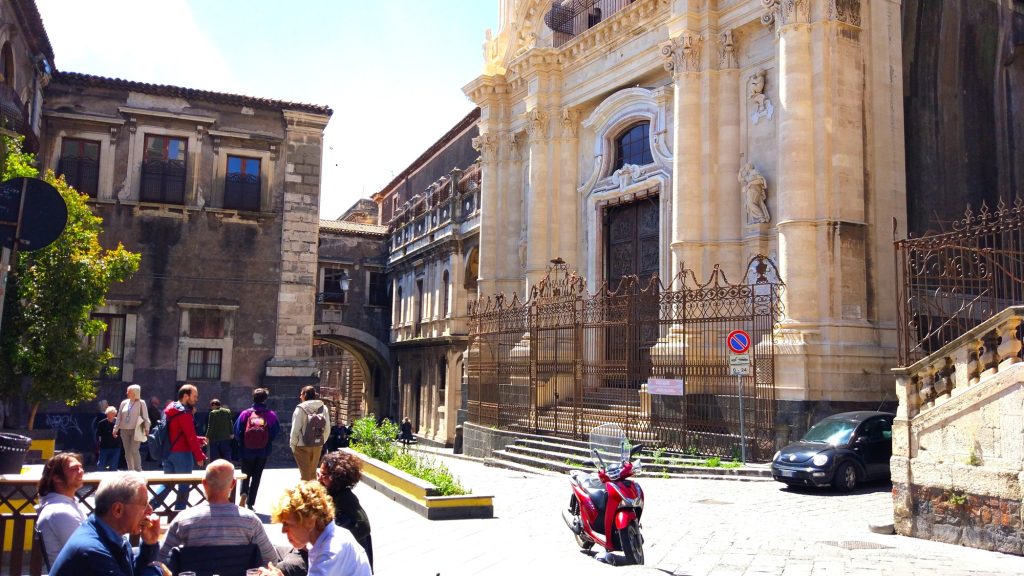
Our beautiful BnB was a gated structure just like the one we had stayed at in Rome but the courtyard was larger and brighter, filled with orange and lemon trees. Boasting of a magnificent location-the via Crociferi – which is a quiet little alley, just a stone’s throw away from the Piazza ,the heart of Catania. Adjacent to our property was an amazing mixture of Baroque buildings and churches along with Trattorias and Restaurants ,all of which took us back to a bygone century .There was also an open bar next to our BnB, which would come alive at night.
There were so many things to see in Catania that it would have taken more than a whole day to explore , but we had reached Catania late, around 1 pm and our main target for the day was to visit Aci Trezza and Aci Castello, a drive along the Catania coastline which takes about 20 minutes to reach . Both Aci Trezza and Aci Castello have another lore connected to Greek mythology – that of the story of the Cyclops. Since we had already seen so many churches and castles on our trip we chose to skip the Catania city trip which one can easily do via the Big Bus Tour.

As soon as we had dropped our luggage we went to explore the Piazza and check out options on how to reach Aci Trezza . It was the end of our journey and we had become a little lax on the planning part. All this travelling from city to city had turned us into pros in navigating bus and metro routes, so instead of taking the Big Bus we decided to take a local bus to Aci Trezza and Aci Castello. This was quite a bold step because we could neither understand nor read the language. We had an amazing lunch of Pizza Bianca – an oval shaped white pizza which had a cream cheese base and cheese shavings on top but had no tomato sauce or other toppings. It was simply delish.
As you wander through the streets of Catania, your mind drifts to symbols and stories tied to the island – the Trinacria ,the Saracens , pages and scenes from The Godfather by Mario Puzo and Martin Scorcese, and, of course, the irresistible pull of Sicilian food.

In many shops I found this peculiar looking image, undoubtedly, the head of Medusa with her snake-haired head and golden wings ,but with three running legs and three ears of wheat surrounding her head. Naturally I was curious about this avatar of Medusa.
Medusa or Gorgo , in Greek mythology, was one of the three monstrous Gorgons ( a creature of the underworld), generally described as winged human females with living venomous snakes in place of hair. Those who gazed into her eyes would turn to stone.
Well now,firstly ,I was confused as to why a monster would be so popular in Sicily and secondly ,why was her head surrounded by running legs and ears of wheat ? The Medusa I had known till then didn’t have all these features.
After some inquiry I found out that she was called Trinacria or Triskelion . But unlike the Greek Medusa ,the Sicilian Trinacria didn’t turn the island’s inhabitants or the guiltless visitors into stone. Instead, the Trinacria represented the Goddess Athena of ancient Greek mythology, the Patron Goddess of the island ; the three running legs suggested the racing of time in the cycle of nature ; and the ears of wheat symbolized the extraordinary fertility of the island of Sicily.
Trinacria was the symbol of Sicily. There’s a fascinating story surrounding the birth of Sicily and its three-legged symbol, which I found online.
‘A long time ago, three nymphs danced all over the world. They stopped where nature was most luxuriant and collected lovely stones, juicy pieces of fruit and handfuls of fertile soil. One day they reached a region with a wonderful clear blue sky and they fell in love with the place. Their dance became even more graceful and they decided to throw into the sea everything they had collected around the planet. The water shone and produced an incredible rainbow. From the waves, a new land surfaced that was splendid, fragrant and colorful. The new island had the shape of a triangle, whose three capes were exactly under the feet of the nymphs.’
This is the legendary story of the birth of the Sicily.
There were also a lot of memorabilia related to the Saracens – Arabs who ruled over Sicily in the Middle Ages ,from 831 to 1091 AD.

Then again there were heads of Moors and Sicilian women , crowned and elaborately decorated , known as Teste di Moro. These heads are usually used as planters, wall décor or souvenirs. They come from a famous Sicilian legend: A local woman fell in love with a Moorish man. When she discovered he had a wife back home, she killed him . She used his head as a flower pot and her basil grew beautifully in it . Neighbours , impressed, began making ceramic versions-the result of which is today’s Teste di Moro.
But the best knickknacks were related to the ‘Godfather’- the book by Mario Puzo as well as the Scorcese films starring Marlon Brando and Al Pacino – a major part of both related to Sicily.


After roaming around the streets and alleys of Catania we eventually found the bus stop from where the local bus to Aci Trezza left . After some waiting the bus arrived and we found seats next to an extremely helpful Catanian gentleman who turned out to be God-sent – but I’ll explain about this in a bit !
Plying by the Ionian coastline, Samit and I disputed over where to get down first –Aci Trezza , the last stop on the route or Aci Castello , the one before. Logically one should see the last place first then do a reverse and see the one before but I was a little worried about catching the return bus – since it was the last bus of the day. So we settled for Aci Castello first then Aci Trezza.

Just 10 km north of Catania, Aci Trezza is a charming coastal village known for its striking lava rock formations rising out of the sea. Offshore stand three tall sea stacks, accompanied by several smaller ones and the tiny Lachea Island – all shaped by ancient eruptions of Mount Etna. Steeped in Greek mythology, these rocks are said to be the very stones hurled at Odysseus by the one-eyed giant Polyphemus. It’s no surprise that these dramatic formations are the true highlight of the town.

This is one delightful bed-time story full of adventure and intrigue. But will come to that soon.
Aci Castello‘s story , on the other hand is more prosaic. It is a castle which was built by the Normans in 1076 upon the foundations of a 7th-century Byzantine fortification. The town of Aci Castello is built around the castle and is another charming port town.
In the bus an interesting two way conversation was going on between Samit and the smiling and helpful Catanian gentleman, where obviously nobody could understand each other’s language. The gentleman, clearly alien to English, spoke in his native Sicilian dialect , whereas Samit tried hard to impress him with a conversation consisting of a fusion of English and a handful of Italian words learnt from reading ‘The Godfather’ . But seeing their animated faces it seemed like a conversation between two long lost friends!

All throughout the journey our friend tried to help us understand our route and how to reach Aci Trezza and Aci Castello – but in vain. The only part we understood is when we actually reached Aci Castello and he suddenly started shouting Aci Castello to us , making us jump out of the bus in a flurry. We turned back to see our friend who waved at us with a satisfactory smile on his face, possibly happy to be able to assist us.

Aci Castello wasn’t far from the bus stand, and we reached it within minutes. It revealed itself as a quaint, little 11th century fortress built of black lava stone, perched dramatically on a jagged lava cliff above the Ionian Sea. From its vantage point, it overlooked rugged rocks and the charming offshore lava islets. From every angle, it almost looked as if it has been sliced in half – it was that compact, and every bit an ancient castle in the truest sense!

The surrounding views were breathtaking with the sun shining brilliantly over the deep azure sea. There was a little piazza or square in front of the castle with bougainvilleas in bloom, the statue of a mermaid and wrought-iron benches to sit on and enjoy the view. Some people were patiently angling from the lava bed of rocks.

After loitering around the small harbor and the little square for a while. Not bothered about the history of the castle, we simply enjoyed the surroundings ; we started climbing quite a flight of stairs to reach the top – taking photos on our way. The views of both the Ionian sea, the coastline and the town of Aci Castello from the top were gorgeous. The rocks of Aci Trezza were also visible at a distance.

There was no crowd and we had the castle almost to ourselves. The entrance fee was only 3 euros. There was a lovely garden on the top and some stairs led to the sea. There was also a small well-kept Civic museum in the castle with artifacts dating back to the Neolithic period, displaying local archaeology, volcanic rocks, fossils and artifacts that told the story of the area and Mount Etna. The reason for the castle being so small was that it was never meant to be a royal residence or a sprawling fortress but it was to act as a lookout and defensive point along the coast. The narrow lava rock it sits on also limited how large it could be.
We soon left this ancient castle in search of Aci Trezza, the Cyclops’ land. Seeing Aci Trezza from the top of Aci Castello made it seem so near , we thought we would be able to reach it in a few minutes. But the walk turned out to be more complicated than we had thought – a seemingly endless walk, interspersed with asking help from locals who were all very helpful but incomprehensible due to the language barrier. The main road was swarmed with by-lanes and not having any sign boards or other indicators to the place didn’t help as well . We’d enter an alley and find a dead end each time.
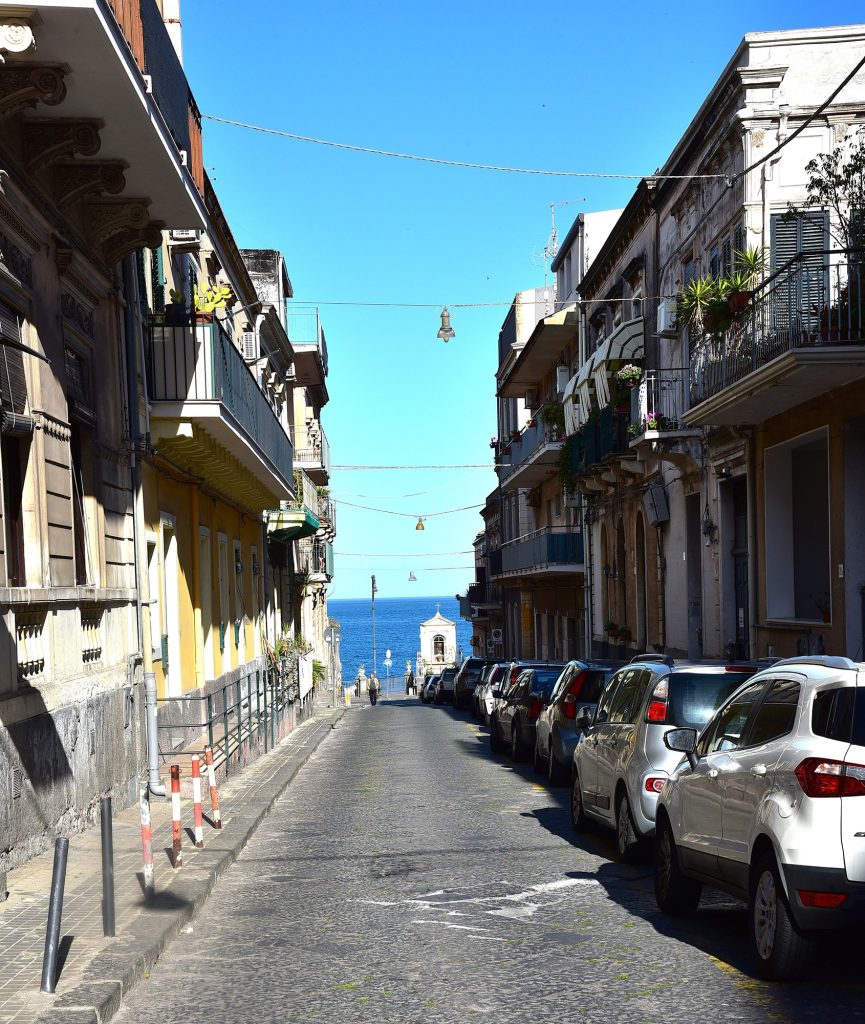
After almost giving up hope of finding our desired destination and also worried whether we could even catch the bus, we saw our savior gentleman-the very same gentleman who had accompanied us on our bus ride – sitting lazily on a bench doing nothing else in the world as if waiting there only for us! I animatedly pointed in his direction shouting out in glee! As soon as he saw us he pointed towards the alley right in front of him – indicating that that was the road to Aci Trezza. He also sort of sign-languaged us to be quick because the last return bus to Catania would leave soon – the bus was standing right there. We thanked him profusely and found our way to Aci Trezza. He was truly God-sent!
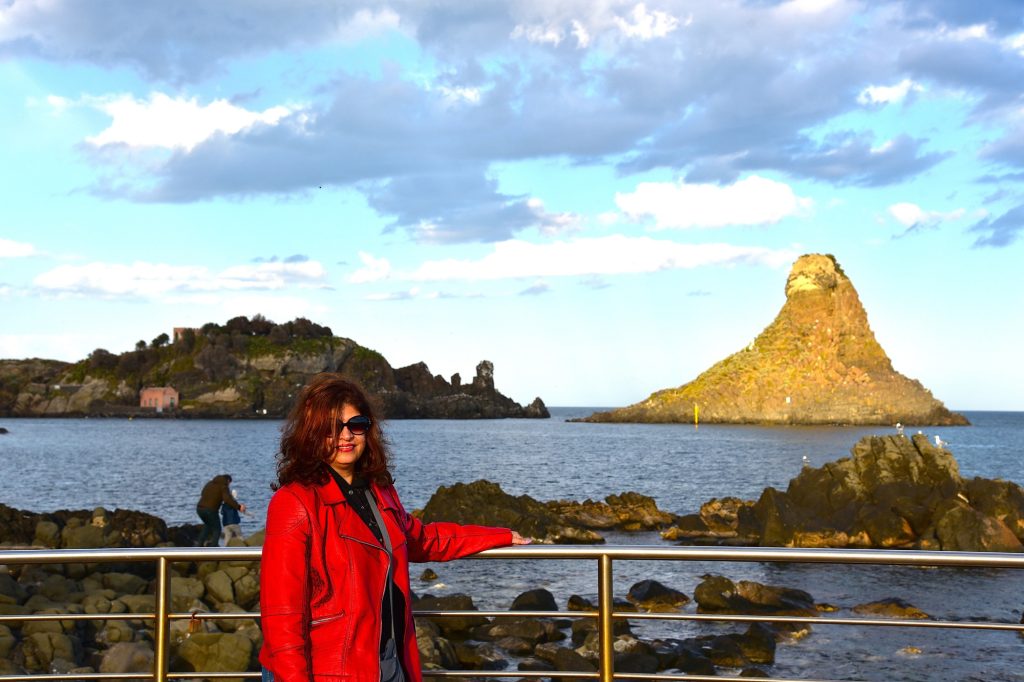
Known as the Isoles dei Ciclopi Faraglioni , Aci Trezza was quaint and mesmerizing . We could see the eight, sharp, picturesque basalt rocks consisting of the three tall, column-shaped stacks , the tinier ones and the Lachlea Island or the Homeric Goat’s Island – all standing like sentinel giants in the sea. Scattered around in the water were more black lava rocks of different sizes and shapes. Though the seabed was chock-a-block with innumerous lava stones ,the water itself was calm and crystal clear . There was no sandy beach, but there were rocky platforms, naturally formed lava piers ,which allowed easy access for swimming and sunbathing. The locals call them lidos and it was about €10 for all day access plus umbrella and lounger. The added colour came from the traditional fishing boats scattered on the sea.

As I have mentioned earlier, according to local legend, these great stones were the ones thrown at Odysseus by the one-eyed Cyclop ,Polyphemus ,mentioned in ‘The Odyssey’ by the Greek poet Homer. Odysseus, the Greek warrior, and his band of soldiers, had just finished fighting the Trojan War and were making the long journey back to their homeland Ithaca in Greece. Along the way, they had many dangerous adventures and encounters. The encounter with the fearsome Cyclops was one of the most memorable of these adventures.

The Story of Odysseus and the Cyclops Polyphemus
During that journey, they became shipwrecked on an island (the present day Lachlea island orHomeric Goat’s island). After they arrived on the island, they decided to seek shelter in an eerie cave. In the cave, they were surprised to find plenty of sheep , which , being hungry , they ate to their heart’s content. But soon they realized that this particular cave was the home of the Cyclops known as Polyphemus, who was the son of the sea god, Poseidon.

The larger-than-usual-sized Polyphemus was a fearsome creature, so when he found them eating his sheep , he decided to prevent the crew from leaving the cave by blocking its entrance and he started to eat them. Odysseus knew that he had to escape from the cave as soon as possible. He gave the Cyclops a dose of really strong wine so that he would fall asleep. The men created a very sharp staff , blinded Polyphemus in his one eye so that he would be powerless and then ran away towards the sea.
The wounded Cyclops chased Odysseus and his gang but by the time the Cyclops could reach them, they were already in the waters and all Polyphemus could do was throw stones at them ; which of course were the very same stones we saw in front of our eyes in the Ionian sea at Aci Trezza!
We stood there for some time marveling at this natural wonder , reminiscing on ancient Greek legends and at the same time watching the sun go down, basking in the dying sun’s rays. There were a few nice cocktail bars selling Sicilian wines, many restaurants, all serving largely fish based dishes and cafes serving granita with brioche ; but there weren’t many tourist shops. The whole atmosphere was cosy and relaxed.

After some time we headed back towards the bus stand. Our friendly gentleman was still in deep conversation with other locals. As soon as they saw us they greeted us with beaming , welcoming smiles .The gentleman boarded the bus with us and chatted with us all the way back to Catania !
Next day was our exciting trip to Mount Etna!


