
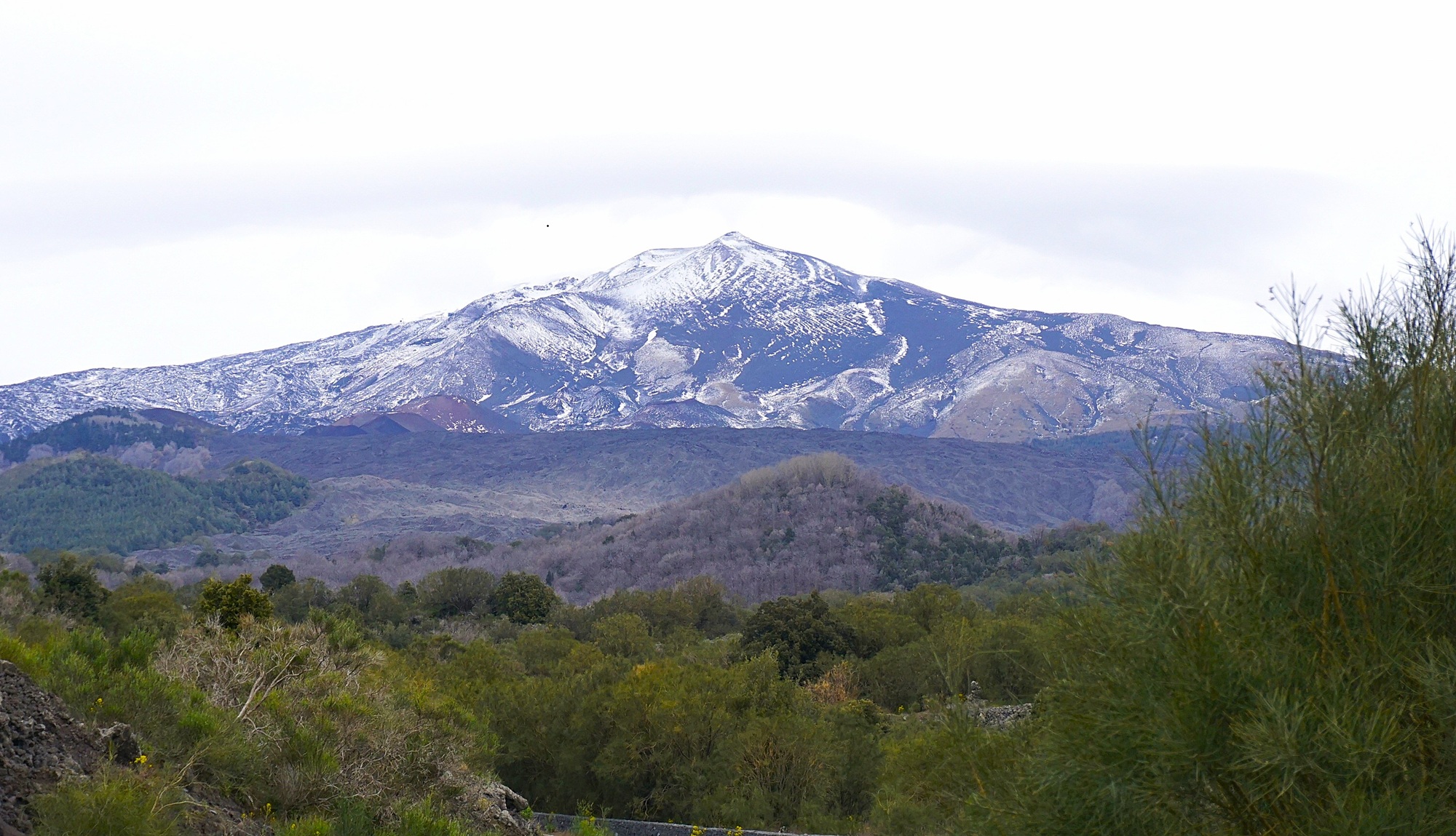
Next day we were all excited about getting to the top of Mount Etna. The reason for this was that we were about to see an active volcano for the first time.
Our Journey
We started our trip very early in the morning. It was slightly cloudy when we left to catch the tour van to Etna from Via Crociferi right in front of our BnB. The street was empty, quiet and peaceful, so different from the hustle bustle of the previous evening. The only shop open was the tiny coffee shop next to our gate ,where we sat with coffee and croissant – the lovely lady ,the owner of the cafeteria fussing over us with warm, unhurried kindness.

Usually we always plan our own trips and never take the help of tour guides but since there was only one day to cover so many activities on Etna and having very little time to research, Samit had asked our BnB coordinator –a bright and chirpy young lady- to organize a guided tour to Etna.
Our guide turned out to be a young, vivacious, and eloquent Sicilian woman – multilingual and only a few years older than our daughter, Titir. Even our fellow travellers reflected the global pull of Mount Etna – a mix of French, Chilean, and Vietnamese visitors, all brought together by the shared excitement of exploring this remarkable volcano.
Soon we left the beautiful city of Catania and ambled into the country side. Etna was looming large in front of us. Etna’s positioning is so strategic and presence so imposing that you can see it from any angle in the region .

Etna’s Eruptions
Mount Etna had been particularly busy in 2021.
As I write this article – almost 5 years after we had visited , Etna has erupted more than 50 times throughout the year – as if it’s in a constant state of activity ! In fact, faint wisps of smoke were nearly always visible , drifting from its various craters – sometimes seen from Catania ,sometimes only from the summit itself.
Mount Etna is literally above the city of Catania and is at the heart of the Etna Regional Park . This extraordinary nature reserve, has been included in 2013 as a World Heritage site by UNESCO , as being one of the ‘most active and emblematic volcanoes in the world’.
Located on the east coast of Sicily ,in the city of Catania with the city of Messina on the other side of the volcano , Mount Etna is a strato-volcano – a volcano built by layers of lava flows, ash and blocks of unmelted stone.

Etna covers an area of 1,190 sq.kms with a basal circumference of 140 km. This makes it by far the largest of the three active volcanoes in Italy. It is about two and a half times taller in height than the next largest, Mount Vesuvius.
Different kinds of eruptions occur on Etna.
Summit and Flank Eruptions
It could be a summit eruption consisting of persistent explosive eruptions, sometimes with minor lava emissions. Etna has four craters at its summit: the central ones, called Bocca Nuova and Voragine ; the Northeast crater ; and the newest Southeast crater – formed by an eruption in 1978.
Or it could be flank eruptions originating from fissures that open on the volcano’s flanks which have more than 300 vents ranging in size from small holes in the ground to large craters hundreds of metres across. These type of eruptions typically have higher effusion rates and are less frequent .

Summit eruptions can be highly explosive and spectacular but rarely threaten the inhabited areas around the volcano. In contrast, flank eruptions can occur down to a few hundred metres altitude, close to or even well within the inhabited areas.
How Etna Got its Name
There are many interpretations of the name Etna . According to one theory , the word Etna is from the Greek ‘aitho’, meaning ‘I burn’; others think that it is derived from the Phoenician word ‘attuna’ meaning ‘furnace’ or ‘chimney.
The whole world knows this active volcano by the name of Etna but the locals lovingly call it Muncibeddu’ in Sicilian and ‘Mongibello’ or ‘Montebello’ in Italian – meaning ‘beautiful mountain’. According to one hypothesis, the term Mongibello comes from the Latin ‘Mulciber’ meaning ‘ one who placates the fire – one of the Latin names of the Roman, blacksmithing god Vulcan.

Today the name Mongibello indicates the top of Etna : the area of the two central craters, the south-eastern crater and the north-eastern crater.
Different Lores behind Mount Etna
There are countless stories surrounding Mount Etna , many rooted in Greek mythology. Its frequent and often spectacular eruptions made the volcano a source of fascination in classical myth and local folklore. In an effort to explain its unpredictable nature, ancient beliefs imagined gods and giants from Greek and Roman legends living beneath the mountain, their movements and tempers thought to control its fiery outbursts.
According to both Greek and Roman mythology, the god of fire and metalwork – Vulcan, known as Hephaestus in Greek lore – was believed to have his forge beneath Mount Etna. Deep within the mountain, he was said to work alongside the Cyclopes, the legendary one-eyed giants.
Myths also tell of Vulcan taming Adranus, a fiery spirit associated with the mountain. The Cyclopes, meanwhile, were believed to have their own forge here, crafting powerful weapons – most famously the thunderbolts wielded by Zeus.

[to know more about the myth of Odysseus and Polyphemus the Cyclops , read our blog on Catania]
Then there’s the story of Aeolus, the king of the winds, who is said to have imprisoned the winds in the caves of Etna.
Another lore is about the wrath of the giant, Enceladus, who rebelled against the gods and was killed and burnt in Etna .
Those who are interested in Greek lore will be familiar with the story of Typhon, the monster and Zeus ,the god of the sky and thunder, and also the king of gods who ruled from Mount Olympus in Greece. This story has been vividly narrated by the ancient , Greek dramatist Aeschylus in his ‘Prometheus Bound‘’.
In Greek mythology, the monster Typhon, one of the deadliest creatures , a monstrous serpentine giant , a fire-breathing dragon who had one hundred heads that never slept ,was known as the “father of all monsters” .

The goddess Gaeia, the personification of Earth ,the mother of all creation, created Typhon to punish Zeus for imprisoning her Titan children in Tartarus – a deep abyss used as a dungeon of torment and suffering for the wicked , and as the prison for the Titans .
Typhon confronted Zeus so that the Titans would gain supremacy over the universe but after a fierce battle between the two, Zeus finally defeated Typhon with the help of his thunderbolts and trapped him under Mount Etna.
According to legend, the anger of the monster Typhon vents through the earthquakes and eruptions of Mt. Etna from time to time, reminding us of its very presence.
Thus, shaped not only by lava but by legend, Mount Etna stands as far more than a natural wonder. The Greek myths of gods, giants, and underground forges give the volcano a deeper identity, transforming it into a powerful cultural symbol and enduring icon of Sicily, where nature and mythology are forever intertwined.
The early morning drive was a comfort to the soul. The road was flanked with orchards and grapevines on both sides ; the sky though cloudy wasn’t dull . We could see Etna growing larger before our eyes and its presence became more powerful .
A store house of information, our cute guide Julia gave a non–stop commentary on various tidbits related to Etna, taking turns, in different languages –Spanish, French ,English and Italian .
Different Accounts of the Eruptions
Research has shown that the people of Catania and its surroundings had witnessed innumerous eruptions throughout the decades. Volcanic activity first took place at Etna about 500,000 years ago, with eruptions occurring beneath the sea off the ancient coastline of Sicily.
The Roman poet Virgil gave what was probably a first-hand description of an eruption in ‘The Aeneid’ . The ancient poet Hesiod spoke of Etna’s eruptions. The Greek poet Pindar, in his Olympian Odes and Pythian Odes, referred to a famous eruption of 475 BCE.

An ancient eruption in 396 BCE kept the Carthaginian army from attacking Catania. From 1500 BCE to 1669 CE there are records of 71 eruptions. Between 1669 and 1900, 26 more eruptions were reported .
During the 20th century there were eruptions in 1908, 1910, 1911, 1918, 1923, 1928, 1942, 1947, 1949, 1950–51, and 1971.
In the early 21st century a major eruption began in July 2001 and lasted several weeks.
Other significant early 21st-century volcanic activity included the Strombolian eruptions of 2002–03, 2007, 2015, 2017, 2019, and 2020. Strombolian eruptions involve moderate bursts of expanding gases that eject clots of incandescent lava in cyclical or nearly continuous small eruptions.

In 2021 Etna had erupted almost 50 times. It started on 16th of February and the last one was on 29th of August. Etna has erupted so much in 2021 that it has grown about 30 meters in height in just six months time, and the southeastern crater is now the tallest part of the volcano.
In the years since our visit, Mount Etna has erupted dozens of times – well over 70 eruptive episodes between 2021 and 2026 – reinforcing its reputation as one of the most relentlessly active volcanoes on earth.
Lava Cave
Our first stop on the tour was a lava flow cave on the flanks of Etna. Julia handed out our gear – a helmet with a torch attached to it and a walking stick. It had started to turn colder than it was in Catania and we put on our jackets . The entrance to the cave was beside the road but we had to go deeper underground to access it.
It was pitch-dark inside and we could hardly see anything without the torch. I had seen caves in Slovenia and Slovakia – huge caves , spreading miles and miles, with lighting arrangements to see clearly inside, but this cave was left untouched by man–made elements . You could touch the walls, hear the sound of water dripping from them and feel the chill of trapped , cold air. It was a tiny cave with an uneven floor and a tunnel which went further into the back . The echo of the hushed voice of the guide along with the sense of not knowing what was in front of you created an eerie ambience.

Julia gave a detailed explanation of what a lava flow cave is and how it is formed.
A lava cave, or lava tube, forms when low-viscosity lava flows and its outer surface cools and hardens into a crust. As the eruption wanes, this crust thickens into a solid roof while molten lava continues to flow beneath it, carving out a tunnel-like passage.
Once the lava supply stops, the molten rock drains away, leaving behind a hollow tube. These caves are generally safe to explore when they are old and fully cooled, though sections can sometimes collapse during the cooling process..

Rifugio Sapienza
After spending some time inside the cave our next stop was Rifugio Sapienza or Sapienza Refuge – the main starting point for those heading up to the summit of Mount Etna .
Etna is flocked by thousands of visitors every year. The areas near the summit can be accessed both from the southern and the northern sides of Mount Etna. Both of them offer spectacular paths to climb to the main crater.
The most common route is from the Southern Face or the Nicolosi Side , through the road leading to Sapienza Refuge ski area, which is 20 km away from Nicolosi, a commune 12 kms north-west of Catania. Sapienza Refuge lies at an elevation of around 1910 metre. From the Refuge, a cableway runs uphill to an elevation of 2500 m, from where the crater area at 3300 m is accessible.
The starting point at the Northern Face or the Linguaglossa Side is Piano Provenzana which is 19 km away from Linguaglossa ,another town on the foothills of Etna.

There is also the Ferrovia Circumetnea – Round-Etna railway – a narrow-gauge railway that runs around the volcano in a 110-km long semi-circle starting in Catania and ending in Riposto 28 km north of Catania.
It was an easy drive up to Sapienza Refuge. While Julia went to get our tickets for the cable car ride to the summit which is at 3300 mt we sat down to have breakfast at the Rifugio Sapienza canteen. This is where I had my first experience of Sicilian Cannoli (Cannoli are Italian pastries consisting of tube-shaped shells of fried pastry dough, filled with a sweet, creamy filling usually containing ricotta, mascarpone or whipped cream , sprinkled with powdered sugar to sweeten it ) and Arancini – but will come to that later.
The usual way to reach the top is either take a cable car from Sapienza Refuge and then a 4X4 jeep from the cable car station ; or else hike ; but visitors can’t hike without a qualified guide familiar with the route. The hike takes about 1 and a half hours . But visitors are allowed to hike around without a guide up to 2900 mts.

Julia returned with unfortunate news that the cable car was closed due to extreme volcanic activity taking place at the summit. That meant nobody could go to the summit that day because it was dangerous. But there was no reason to be disheartened .There were many craters around Sapienza Refuge.
The Silvestri Craters
It was really cold and cloudy here , Sapienza being on a moderately high altitude of 1910 mt from sea level ; and was it only Samit and me who could also feel the slight lack of oxygen at that level ? Julia took us to see the two oldest craters –the Silvestri craters –both, according to Google, ‘an easy and free’ 1 km walk from Rifugio Sapienza. The two craters – Silvestri Inferiore (lower) and Silvestri Superiore (upper)—were formed during the 1892 eruption and sat like twin scars on the mountainside.

How do I describe the Lower Silvestri Crater ? From below it looked like a giant mole hill , the path to the top smooth and mainly consisting of a unique mixture of smooth , black volcanic ash and rust-red rock soil, sometimes covered in green velvet moss. Maybe for seasoned trekkers , reaching the craters would have been easy but I was definitely worn out. The hike up was strenuous , particularly because it was extremely steep (for me) winding over loose volcanic gravel , with no breaks ; the oxygen level being low and on top of all that the freezing wind was blowing and howling like a mad man , eager to throw us down into the valley below !!
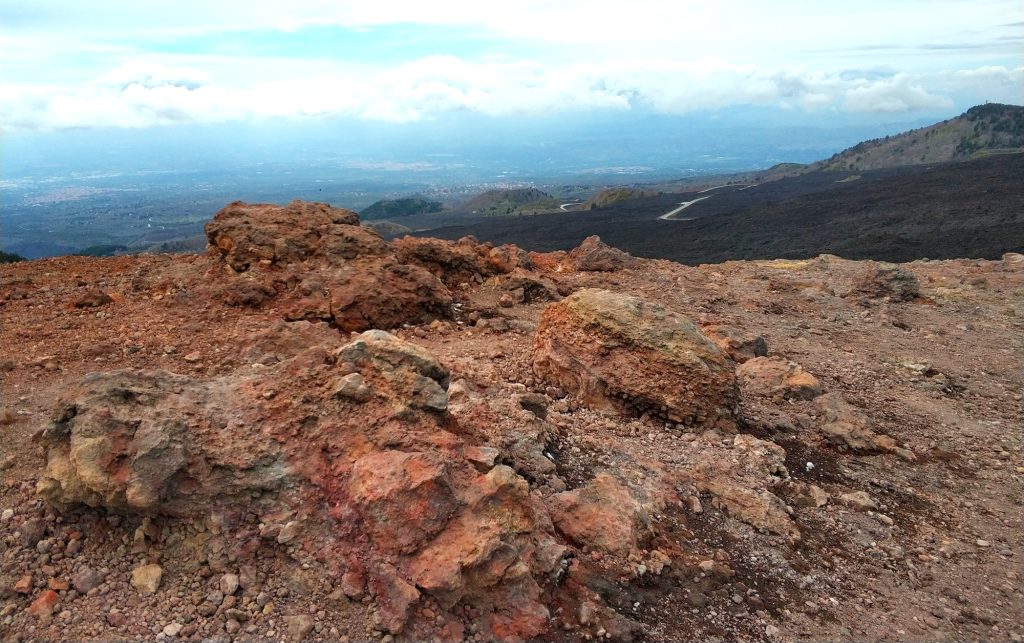
The Extreme Experience!
After a lot of huffing and puffing I finally reached the top of the crater on Mount Etna. Looking down, it felt like standing at the edge of a gigantic bowl of dusty, smoky earth. It was quite impressive in itself, but I think what truly heightened the moment was the realization that we were standing on top of Mount Etna. In spite of all the difficulty, reaching the rim of the upper crater was the highlight. You can walk right along the edge, peering into a wide, silent hollow lined with layers of hardened lava and ash. There’s no dramatic lava here now—just stillness, wind and the stark beauty of a landscape shaped by fire. Looking in front created a sense of awe but turning back toward the plunging depths , with strong winds trying to force us downward, was a different story altogether. That dizzying drop, combined with the force of the wind, left me feeling distinctly uneasy..
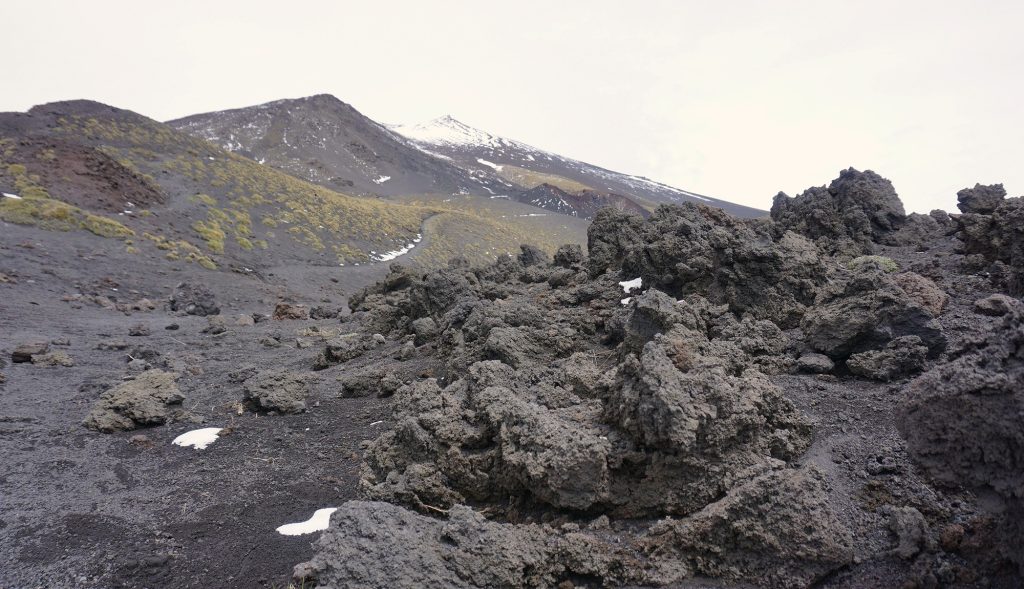
After hiking up one crater, Samit and I ,with our rheumatic, old bones, had had enough and called it a day. Titir ,our daughter was enthusiastic enough to climb the second ,higher ,tougher Silvestri crater. She had already gone down into the first crater bowl and was eager to conquer the second. So the rest of the group started climbing towards the second crater and Samit and I headed down towards the restaurant near the bus stop. We sat there with some Sicilian wine enjoying the view outside.

The group, along with Titir came back almost an hour later, happy from all that exploring. It was time to leave Mount Etna. Though I couldn’t climb much I enjoyed the place. The craters were gorgeous, the views from the top were breathtaking – you could see Catania and the Ionian sea at a distance.

Our trip to Etna didn’t end just here. Before leaving the foothills Julia took us on a short food and wine tasting tour.
Food and Wine Tasting
From Julia we came to know how the mineral-rich volcanic ashes of Etna had turned Sicily into a rich and fertile country. The drive past the beautiful countryside was evidence to that. The fertile landscape created by this active volcano has produced a large quantity of agricultural land, a beautiful national park close to cities like Catania and Taormina , some of the best wines in the world and delicious , fabulous food .


We were taken to a gift shop displaying and selling distinct ,mouth-watering produce belonging only to that region. We tasted pistachios and sauces made from them, different flavoured honey and honey creams, and wines accompanied with bread and olive oil.
Sicily is famous for its pistachios –green gold – as it is lovingly called. The honey – made from orange nectar, eucalyptus and wild flower- is like no other honey I had tasted before. The honey cream was simply to die for. All these tidbits filled our bellies and it was almost as good as having lunch.


Famous Sicilian Food
We came back to Catania and asked Julia to drop us at the Piazza Duomo. Samit went back to the BnB but Titir and I loitered around there for a while , did some souvenir shopping and tried out some Granita and some more Arancini . Here I have to mention about these popular Sicilian dishes.
Arancini is a delicious, crispy, deep fried, triangular shaped, Sicilian ball of rice. It has either a meat sauce or ragu, tomato sauce, peas and mozzarella cheese filling and a crunchy breadcrumb coating.
According to Wikipedia , ‘Granita is a semi-frozen dessert made from sugar, water and various flavorings. It is related to sorbet and Italian ice; however, in most of Sicily, it has a smoother, more crystalline texture; the smoother types are produced in a gelato machine, while the coarser varieties are frozen with only occasional agitation, then scraped or shaved to produce separated crystals. Although its texture varies from coarse to smooth, it is always different from that of ice cream, which is creamier, and from that of sorbet, which is more compact; this makes granita distinct and unique.’

The trip to Mount Etna turned out quite pleasant .We had to return to Dubai the next morning , so after loitering a little more Titir and I returned to our BNb for a good night’s sleep.


