
Though this trip is part of our Amalfi Coast tour, the narrative should start from the time we arrived in Naples and should also include our visit to the ruins of Pompeii, since Pompeii is also part of South – west Italy.
Our journey to Pompeii
We had a super comfortable, super-deluxe train journey from Rome to Naples. After 12 days of travelling by bus and metro in the metropolitan cities of Paris , Barcelona and Rome we had planned to rent a car and enjoy the rest of our trip at a leisurely pace at the Amalfi coast and Catania, Sicily.

So with an immense feeling of satisfaction that we would be able to end our trip the way we usually do – drive around – we approached the car rental. But our instant sense of relief turned into an instant sense of horror! Samit had forgotten to bring his driving license! So we stood there for a while , dumbfounded, racking our brains about what to do next. Obviously there was a major, 360 degree change of plans. Since we had to now travel by bus or ferry , which again was time bound , we had to omit places which would have been easier to access by car but difficult by bus.
But before that we had to reach Pompeii which was on our itinerary for the day. We went back to the train station looking up trains and found one which left for Pompeii in an hour. What we eventually boarded was a jam-packed local train which took one and a half hours to reach and which stopped at almost 10-12 stations before reaching the Pompeii Scavi Station .So what was supposed to be a pleasant 20 minute trip with all the luggage snugly kept in the car dickie, turned out to be a nightmare, with us running to board and struggling inside an over-crowded local train stopping at every possible excuse, with three large suitcases and hand luggage ,.

After reaching Pompeii we had to store our luggage somewhere. Not sure how far we had to drag our luggage, we picked the first option we found- a place next to the train station which charged quite a lot ; also on top of that we had to drag the luggage down a flight of steep stairs to the locker room given to us. We hadn’t done any research about luggage storage and later found out that there was a storage room at the main entrance of the Pompeii Archeological Park ; not only was the room free of charge but also easily accessible.
We were famished from all this stressful activity from the morning till noon, which had drained most of our energy – so before entering the park we sat to have a lunch of pasta and lasagna at a restaurant next to the station . By the time we entered the park it was already 2 in the afternoon. During all this time Samit had contacted our host Francesco of the BnB we were staying in and he graciously came to our rescue by offering to pick us up and take us to the BnB. He was to come around 5 so we had only a few hours to explore the ruins. Though deplete of energy, we entered into the ruins through the side gate.

The famous ruins of Pompeii are located in the Campagna region of Naples , Italy. There is no dearth of ruins in Italy ; whichever city or town you go to, you’ll always find a plethora of archeological wonders in every corner ; but Pompeii and its neighouring town Herculaneum holds a special status.
History of Pompeii
Pompeii is a UNESCO World Heritage Site and is one of the most popular tourist attractions in Italy and deserves a little background information.

Pompeii was a much sought-out, prosperous city situated 23kms south of Naples and at the base of Mount Vesuvius , a powerful, active volcano. It was first occupied by Greek settlers in the 8th century B.C and then by the Romans in the 2nd century B.C. But by the turn of the first century A.D, due its proximity both to the mountains as well as the Bay of Naples and also due to the rich agricultural land surrounding it, Pompeii had turned into a successful resort for the affluent and distinguished citizens of Rome . By 79 AD, Pompeii had a population of 20,000.
In 79 AD tragedy struck. Pompeii, , Herculaneum and many other neighbouring towns and villages were buried under around 20 ft of volcanic ash and pumice due to a massive eruption of Mount Vesuvius . The history of the place and the dramatic nature of the eruption has been fuel for many books and movies throughout the ages.
I had first learnt about Pompeii when I was in school , from the book ‘The Last Days of Pompeii’ ‘ written by Edward Bulwer-Lytton.

The question which arises is – why would the people of Pompeii build such a great civilization next to a volcano capable of wiping out everything in its path? True that the South–eastern part of Italy had always been-and still is- prone to earthquakes. The Vesuvius volcano is part of a volcanic stretch that falls on the divide between the African and Eurasian tectonic plates on the Italian peninsula and had been erupting for thousands of years even before Pompeii came into existence.
Mount Vesuvius
The Vesuvius has erupted almost 50 times. The earliest known eruption was in 1780 BC, and another massive eruption had struck in 63 AD which had caused much damage to both Pompeii and Herculaneum – just 17 years before the one that destroyed Pompeii. So it seems the people of the region had grown accustomed to such earthquakes and eruptions , not considering them dangerous enough to wipe out a whole civilization.

But the eruption of 79AD came as a death blow to the whole city. The eruption, which would have been a magnitude of 7.5 on the Richter scale , lasted for two days. Mount Vesuvius showered volcanic debris – fragments of ash and pumice – over the city of Pompeii. Buildings were destroyed, the population was crushed and the city was buried to a depth of more than 20 feet beneath a blanket of ash and pumice, causing the roofs of many houses to fall. The next day, pyroclastic material and gases consisting of high speed, dense, and blisteringly hot ash clouds, demolished wholly or partly all structures in their path, incinerating or asphyxiating those residents who had not been killed by falling debris – altering the landscape, including the coastline .

Pliny the Younger, a lawyer, author, and magistrate of Ancient Rome, had actually witnessed the eruption and has given a vivid description in two letters written to his friend , the historian Tacitus. Pliny the Younger, who watched the eruption from Naples, compared this “cloud of unusual size and appearance” to a pine tree that “rose to a great height on a sort of trunk and then split off into branches”. Today, geologists refer to this type of volcano as a ‘Plinean’ eruption.
The impact of the volcano was so sudden that most of the remains of Pompeii have been perfectly preserved for more than 19 centuries beneath layers and layers of ash and stone. The ruins that we see now were first discovered in the 16th century by the Italian architect Domenico Fontana who worked on St. Peter’s Basilica and other famous buildings of Rome and Naples.

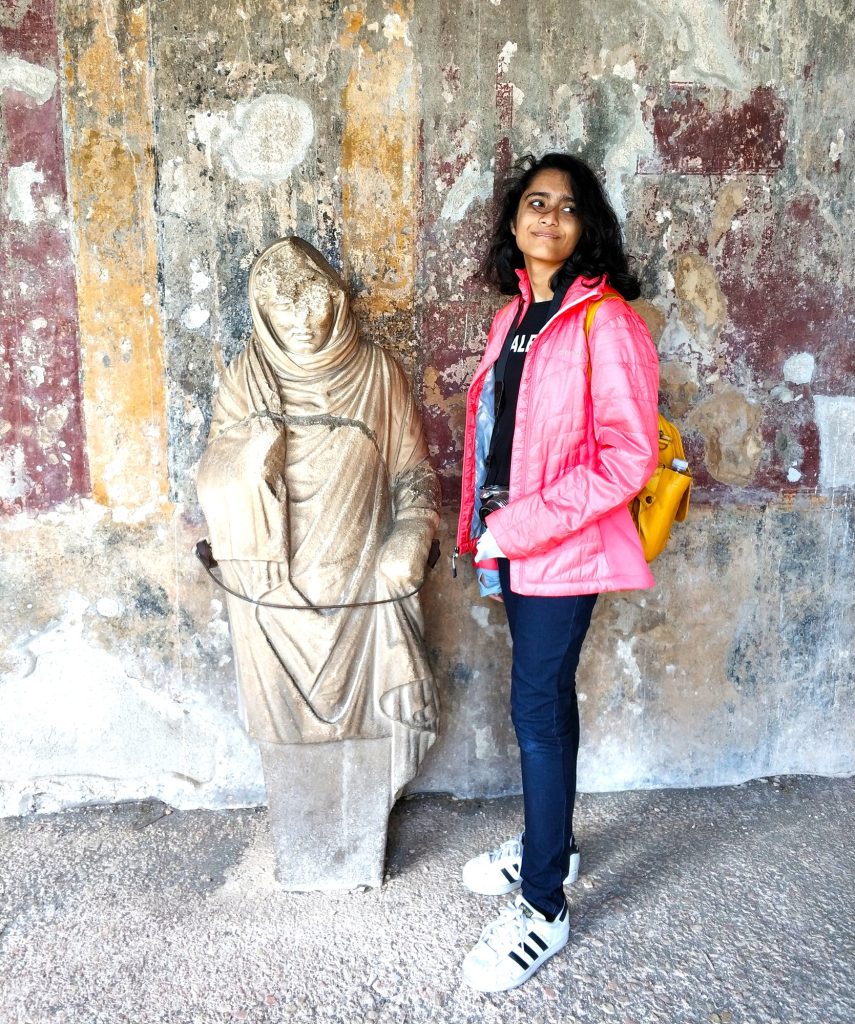

The discovery was a revelation to a whole world that was astonished by a sophisticated Greco-Roman city frozen in time. The excavated city offered a unique, detailed picture of everyday life of its inhabitants.
The buildings in Pompeii

The Forum
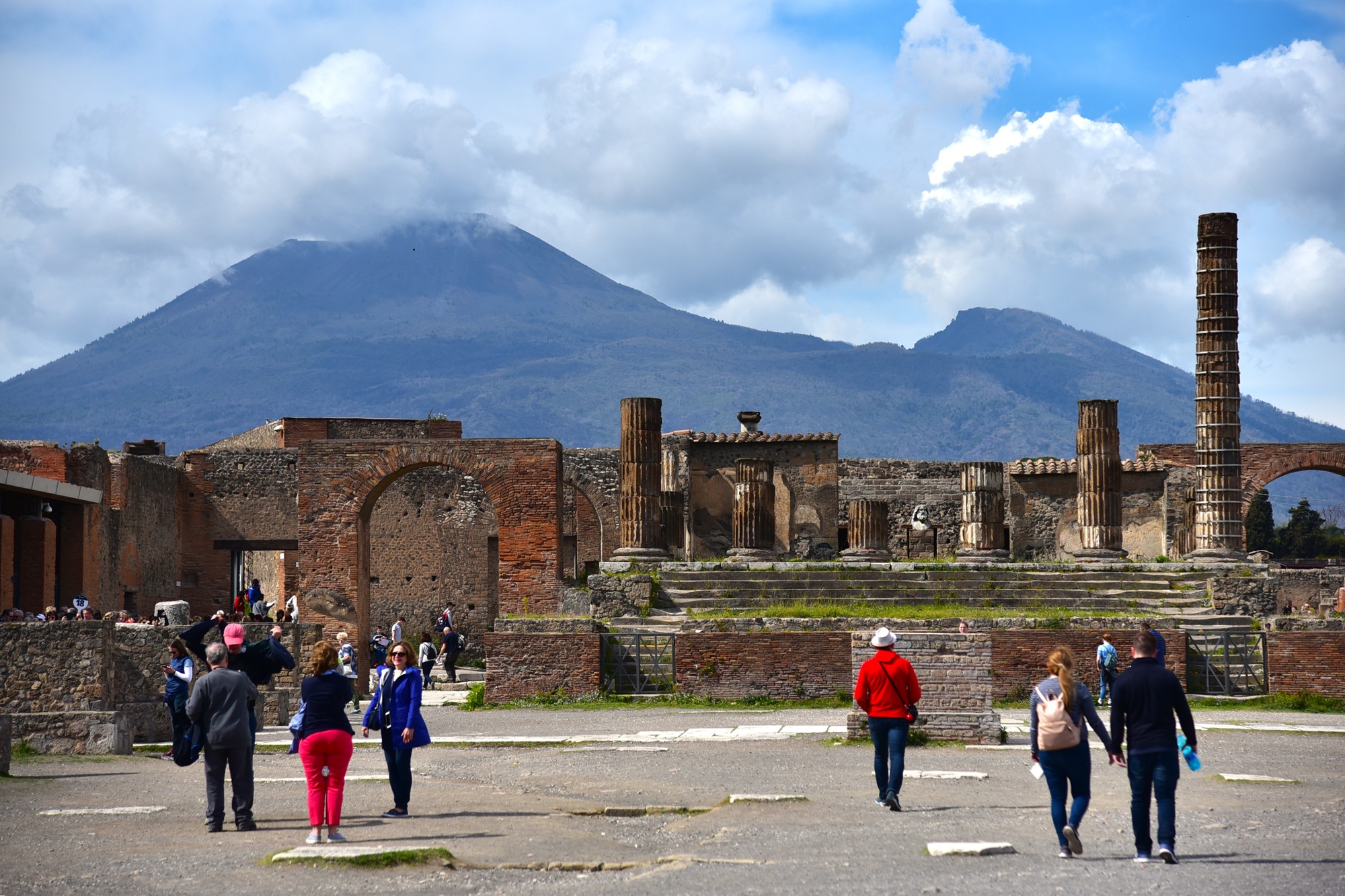
We entered through the Marina gate and first came to a huge open space which used to be the Forum – with the gigantic statue of a Centaur in the middle. The Forum was the centre of the city’s religious, economic, social and civic life ; it was a large rectangular area surrounded by a two-story colonnaded portico.
On the northern end of the Forum was the temple dedicated to the Capitoline triad of deities: Jupiter, Juno, and Minerva.

The southern end of the Forum, was the meeting place of the city council and the offices of the magistrates of the city.
To the east was the Triangular Forum with the Macellum, or large provision market, the Temple of Vespasian and the large Basilica, the most architecturally significant building in the city. Across from the Basilica was the Temple of Apollo, another old temple in the city.
The Triangular Forum was also the site of the Doric Temple, the oldest temple in Pompeii.

To the west of the Triangular Forum was the Temple of Venus Pompeiana, patron deity of Pompeii.
A small theatre (Odeon), a large theatre (Grand Theatre) , the Temple of Isis , the enormous Amphitheatre and the Palaestra or gymnasium with a central natatorium or swimming pool -still in pretty good condition – are all situated on the east side of Pompeii.
The Main Streets
So much was saved from the past – public buildings, private houses, businesses and shops, public baths and gardens. The city of Pompeii was shaped irregularly because it was built on a prehistoric lava flow. The main streets were paved with large, worn basalt stones, smoothed over centuries by carts and footsteps. On either side ran raised sidewalks, slightly elevated to keep pedestrians above rainwater and street runoff. Across the roads, large stepping stones allowed people to cross without getting wet, while still leaving space for cart wheels to pass through. The gaps between the sidewalks and road also allowed for drainage . At regular intervals, public fountains adorned with carved stone faces poured a constant stream of fresh water into basins, their overflow running into the streets. All of this was an integral part of Pompeii’s urban design.

Lining the streets were the remains of buildings, marked by tall stone doorframes and boundary walls. These once opened into homes, shops, and workshops, turning the street into a lively commercial and residential corridor. Today, visitors walk the same path, bringing scale and life back into the ancient setting.
The masonry was a combination of brickwork and diamond-patterned stone known as opus reticulatum. The small, square stones set diagonally created a distinctive net-like pattern, framed by horizontal bands of brick – both decorative and structural.
Rectangular window openings sat within the walls of most buildings. The contrast between materials – rough volcanic stone, neatly arranged tufa blocks and thin brick layers, typical of Pompeii’s houses and shops -revealed how Roman builders combined strength with visual order.

The Baths
Many public Baths –simple as well as luxurious-were scattered throughout the city : the Stabian Baths , the Forum Baths and the Central Baths ; a well-made aqueduct supplied water to the public baths, to more than 25 street fountains, and to many private houses (domus) and businesses. Separate sections for men and women, changing rooms, exercise areas and a sequence of hot, warm and cold baths see traces of wall decorations and the ingenious heating system that once circulated warm air beneath the floors. Located near the city’s bustling center, the Forum Baths were smaller but more refined – likely catering to the elite and busy citizens nearby. The ceilings here were particularly striking, adorned with intricate stucco designs that have survived centuries. The Central Baths were still under construction when the eruption had taken place.

The Private Houses
But the most significant discoveries were the hundreds of private homes of both famous figures as well as ordinary people.
The House of the Surgeon
The House of the Surgeon is one of the oldest houses in the city. This modest yet intriguing home gets its name from a remarkable discovery : a collection of surgical instruments found inside. Scalpels, forceps, and probes carefully crafted and surprisingly advanced – reveal that a skilled physician once lived and worked here, treating patients long before modern medicine existed. It is the best-known example of an early atrium built house (a rectangular open patio around which a house is built, basically the central room of a Roman house) during this period. Unlike the grand villas of Pompeii, the house has a simpler layout, with functional rooms rather than lavish decoration.

The House of the Faun
The House of the Faun is one of the grandest and most luxurious homes of ancient Rome, offering a vivid glimpse into elite life. This opulent residence is named after its charming bronze statue of a dancing faun, still poised gracefully in the central atrium. Spanning an entire city block with two atria (chief rooms), four triclinia (dining rooms), and two large peristyle gardens (a row of columns that surround a garden)- a peristyle garden was located in an open courtyard of a house and was usually surrounded by colonnades; various ornamental plants and statues were found in the garden.
Its façade was built of fine-grained gray tufa ( a type of limestone) from Nuceria, the chief building material of this period and the walls were decorated in the First Pompeian, or Incrustation style of painting- a type of fresco made of several layers of damp plaster. What truly sets the house apart are its exquisite mosaics, especially the famous Alexander Mosaic, depicting the dramatic battle between Alexander the Great and Darius III. It is probably a copy of a lost Hellenistic painting.

In fact the frescoes, mosaics and graffiti from Pompeii were a tremendous inspiration for the 17thcentury artists, architects, potters, and even furniture makers in Europe .
The Shops and Garden Sites
Another amazing discovery were the Garden sites . Remains of carbonized food plants , roots, seeds and pollens, have been found from these gardens. Barley, wheat, and millet were all produced along with wine and olive oil, in abundance which reveals the agricultural prosperity of the time.
Even the independent shops of sculptors, toolmakers, and gem cutters, as well as the factories for garum (fish sauce) and lamps, bakeries, fulleries (processing and cleaning plants for wool), grainaries all provide information about so many aspects of social, economic, religious, and political life of the time.

The Termopoliums
In fact archaeologists have recently discovered a vibrantly frescoed termopolium , Latin for hot drinks counter, the ancient equivalent of a hot food and drinks street food shop to Roman passersby. Traces of nearly 2,000-year-old food were found in some of the deep terra cotta jars containing hot food which the shop keeper lowered into a counter with circular holes.
The front of the counter was decorated with brightly coloured frescoes, some depicting animals that were part of the ingredients in the food sold, such as a chicken and two ducks hanging upside down.
Traces of pork, fish, snails and beef had been found in the containers, proof of the great variety of animal products used to prepare dishes.

The Cadavers
But what haunted us the most during our visit were the plastered bodies on display at the site as well as the adjacent museum.
To recreate these preserved bodies plaster was poured into soft cavities in the ash, which were about 30 feet beneath the surface. These cavities were the outlines of bodies, and they retained their forms despite the soft tissue- soft spots that still held the bones of the cadavers decomposing over time. The plaster filled in the spaces formerly occupied by soft tissue. The bodies of Pompeii are even more lifelike than they appear.

Some of the bodies were found in the fetal position which indicates death from asphyxiation while other bodies were found in relatively casual positions which indicate that incredibly high temperatures killed them instantaneously – by what scientists call “extreme cadaveric spasm,” where the body’s muscles instantly contract from extreme dehydration. It was a pretty gruesome sight ,seeing a body dead in a sitting position.
More such preserved bodies can be found in the Garden of the Fugitives – a quiet vineyard that preserves the final moments of those who tried to escape the eruption. Here, plaster casts of victims lie frozen in desperate motion ,some shielding their faces, others huddled together .

Other Notable Buildings
But this was not all .There were numerous other buildings and displays in Pompeii, among them the most notable were :
The Lupanar – a small, two-story building -its name derived from lupa (she-wolf, a slang term for prostitute)-was the city’s most famous brothel. Inside, narrow stone rooms with built-in beds line the corridors, while faded frescoes and graffiti above the doorways depict the services offered.
The Villa of the Mysteries : is another well-preserved villa on the outskirts of Pompeii. Set against peaceful countryside views, it is famed for its stunning frescoes-vivid, life-sized paintings around a room, believed to depict secret initiation rites linked to the cult of Dionysus.

The House of the Vettii : a vividly decorated home with lavish frescoes , rich in color, detail, and storytelling. Mythological scenes cover the walls ; the central courtyard (atrium) and lush garden courtyard are framed by elegant columns, fountains, and statues ; playful cherubs are shown working as wine-makers, goldsmiths and merchants, showcasing the owners’ wealth.

The Amphitheatre : is one of the oldest surviving Roman amphitheatres, built around 70 BC – long before the famous Colosseum. It was a remarkably well-preserved, elliptical building measuring about 135 metres long and 104 metres wide, built of stone and wood. It could hold up to 20,000 spectators .Unlike later amphitheatres, its design is simple yet striking – an oval arena surrounded by tiered stone seating, with grand staircases. Contemporarily, it was known as a spectacula rather than an amphitheatrum, since the latter term was not yet in use at the time.
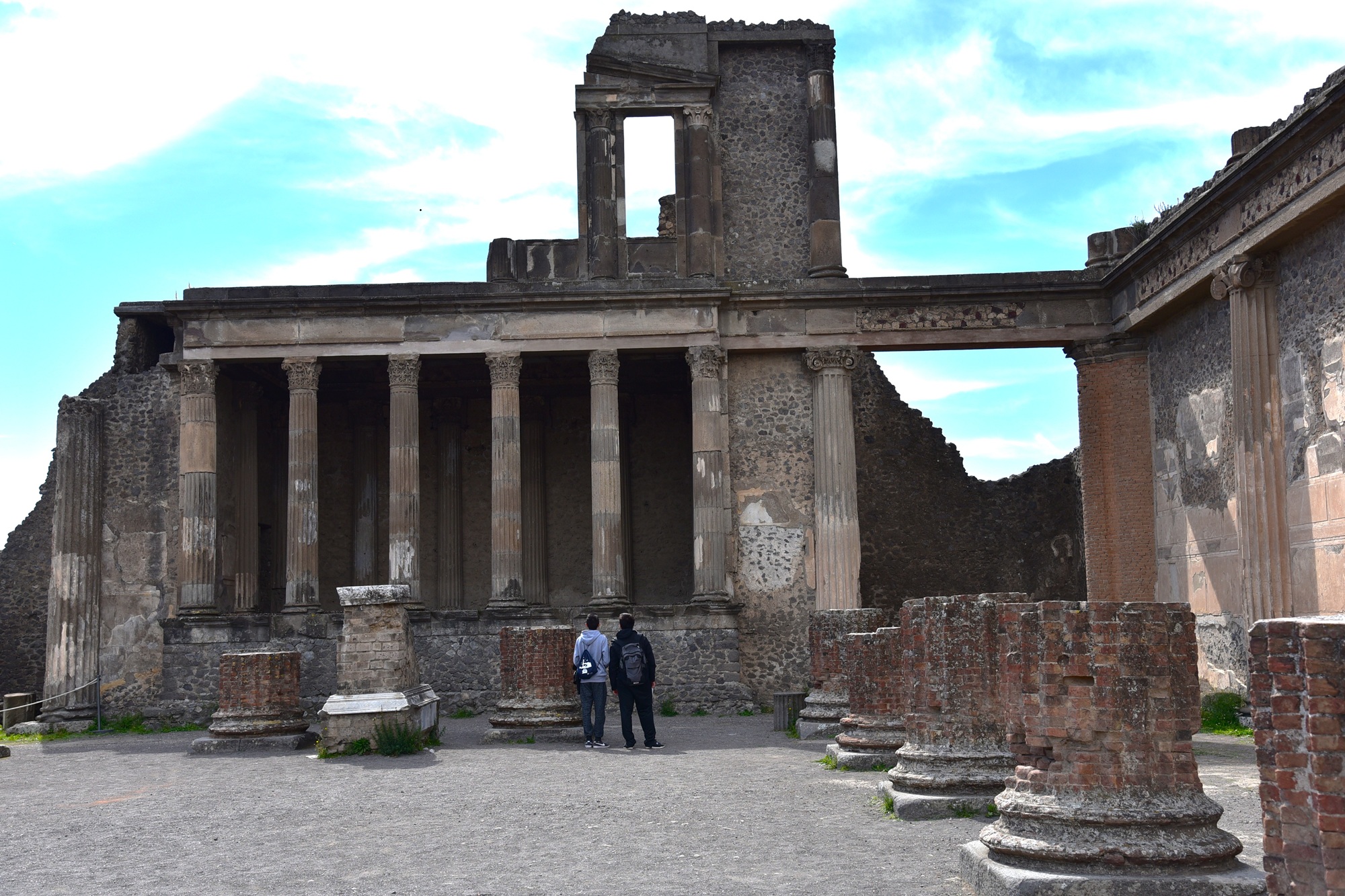
The Great Theatre and the Odeon : The Great Theatre, dramatically set against a natural hillside, could seat around 5,000 spectators. Here, citizens gathered to watch grand performances—tragedies, comedies, and musical dramas inspired by Greek traditions. Its sweeping stone tiers and open-air design created a sense of scale and atmosphere.
Just beside it lied the smaller, more intimate Odeon, an indoor theatre designed for music recitals, poetry readings, and refined performances. With its enclosed structure, it provided excellent acoustics, allowing even the softest notes and verses to reach every listener.

Just beyond the roaring energy of the amphitheatre lied the Palaestra , a vast open-air gymnasium . Step inside, and the scale is immediately striking. This enormous rectangular courtyard , larger than a modern football field , is framed by elegant colonnaded walkways on three sides, their Doric columns casting long, rhythmic shadows across the ground.
At the heart of the Palaestra lies a large swimming pool, once filled with cool water drawn from the city’s aqueduct. But the Palaestra was more than just a gym. It was a place of education and ceremony. Here, members of the collegium iuvenum -Pompeii’s youth association – trained in wrestling, boxing and running , while also absorbing lessons in rhetoric and civic duty. Various ceremonies were also performed here from time to time.

The Temple of Isis -dedicated to the goddess Isis, reveals just how cosmopolitan Pompeii once was. Long before globalization was a word, ideas, beliefs and gods were already traveling across continents. Isis, an Egyptian deity associated with magic, healing, and motherhood, found devoted followers here – especially among women, freed slaves and those seeking hope beyond traditional Roman religion.

After exploring all these magnificent ruins, we came back to the open Forum. In spite of being the shoulder season and the latter end of the day, the place was thronged with people. The Vesuvius looked magnificent in the glowing dusk and the place was serene and peaceful .
The Antiquarium
Before leaving the site we peeped into the small museum – The Antiquarium of Pompeii , which displayed carefully curated artifacts recovered from homes, streets, and villas – everything from delicate fresco fragments and jewellery to everyday objects like cooking utensils and tableware. These were not just exhibits; they were the intimate belongings of people whose lives were frozen in time.

What made the Antiquarium especially compelling was how it told a complete story. Instead of focusing on just the eruption, it traced Pompeii’s journey- from its early beginnings in the Samnite period to its sudden destruction in 79 AD.
One of the most haunting sections was dedicated to the eruption itself. Here, warped objects, charred remains and plaster casts of victims captured the raw human tragedy behind the ruins. We gathered some interesting tidbits about Pompeii and saw a video on how Pompeii was destroyed and later recovered . The museum also used modern multimedia displays to reconstruct buildings and spaces as they once were, helping you imagine vibrant homes, painted walls and bustling courtyards where only ruins stand today. The Antiquarium is the perfect place to begin or end your visit. It transformed Pompeii from a collection of ruins into a living, breathing city.
Our time in Pompeii was over as Fransesco our host had arrived to pick us up. Pompeii isn’t only about the tragedy of the eruption, but about the people who lived there – their routines, their homes and their stories frozen in time. It’s a reminder of how fragile life can be and how history can still feel incredibly close, even after thousands of years.


