Agerola, Positano and Amalfi- an Introduction
There are many firsts about this trip. It’s the first time we actually saw bits of different countries in one go…we had been to Venice, Italy ,Slovenia ,Croatia and Salzburg, Austria as well as Slovakia and Budapest, Hungary in one go but those were more or less part of road trips. This time not only did we actually country hop via plane but also saw only a few distinct landmarks.
Another first in this trip was that ,apart from the Amalfi coast and Mount Etna in Sicily , it was totally city oriented. Usually we opt for the country side and self –drive on our trips to any place but I was adamant on seeing the famous landmarks of the famous cities of Europe. And by famous I meant the ultra- famous like Paris ,Rome and Barcelona. Obviously Samit wasn’t very happy with this choice of places. So to compensate for the ‘missing out’ on fresh country air we sort of managed to squeeze in one day at the Amalfi coast and one day of climbing to the top of Mount Etna in Sicily, on our 15 day Europe trip.
The Amalfi coast is a coast line stretching along the Tyrrhenian Sea in the Gulf of Salerno in Southern Italy. A popular tourist destination, it is a UNESCO World heritage site , and one of the most picturesque and photographed places in Italy, attracting thousands of tourists annually every year. It is famous for its plunging cliffs, abundant nature, innumerous grottos, crystal clear Mediterranean beaches and bays, pastel-shaded dwellings , churches of Moorish –Norman architectural splendor and many such wonderful things. It is a favourite of the chic and the sophisticated ,the A-listers in society.
The Amalfi Coast
Now imagine spending just one day at theAmalfi Coast. People would think why even bother to go like this? The Amalfi Coast is European royalty. You don’t go there for just one day!! At least a minimum of three days should be set aside for a place like this. I mean, come on- celebrities and the uber rich go to spend their holidays there. They laze on the beaches ,fine dine there, stroll up and down and around the quaint alleys of Positano and Praiano, Amalfi andAtrani, Sorrento and Salerno ;they cruise on the Tyrrhenian sea to Capri ,explore the mysterious grottos and caves there ; or they just watch the sunrises and sunsets from the high mountains of Ravello or discover the beautiful villages like Minori and Maiori.
Well we had to settle for middling, by visiting only Positano (compensation- a ferry ride from Amalfi to the beach)and Amalfi-(compensation-viewing the astoundingly beautiful Cathedral of St. Andrew).But overall it didn’t turn out to be as awful a trip as I imagined it would be.
Staying in Agerola
After seeing the ruins of Pompeii our gracious host Francis came to pick us up from the Pompeii Scavi train station. Rooms around Positano and Amalfi being very expensive ,we opted to stay a little higher up in the mountains at a quaint little village called Agerola.
Another reason for staying there was that it was the only place where we could get parking next to our rooms without having to climb up and down through steep ,narrow alleys too much.
Well now the irony was that we didn’t have a car (the reason given in my previous blog on Pompeii;Check here for the dtails) and staying all the way up in the mountains almost an hour’s drive by bus from Amalfi was a good waste of time. But the views from that height more than compensated for everything else.
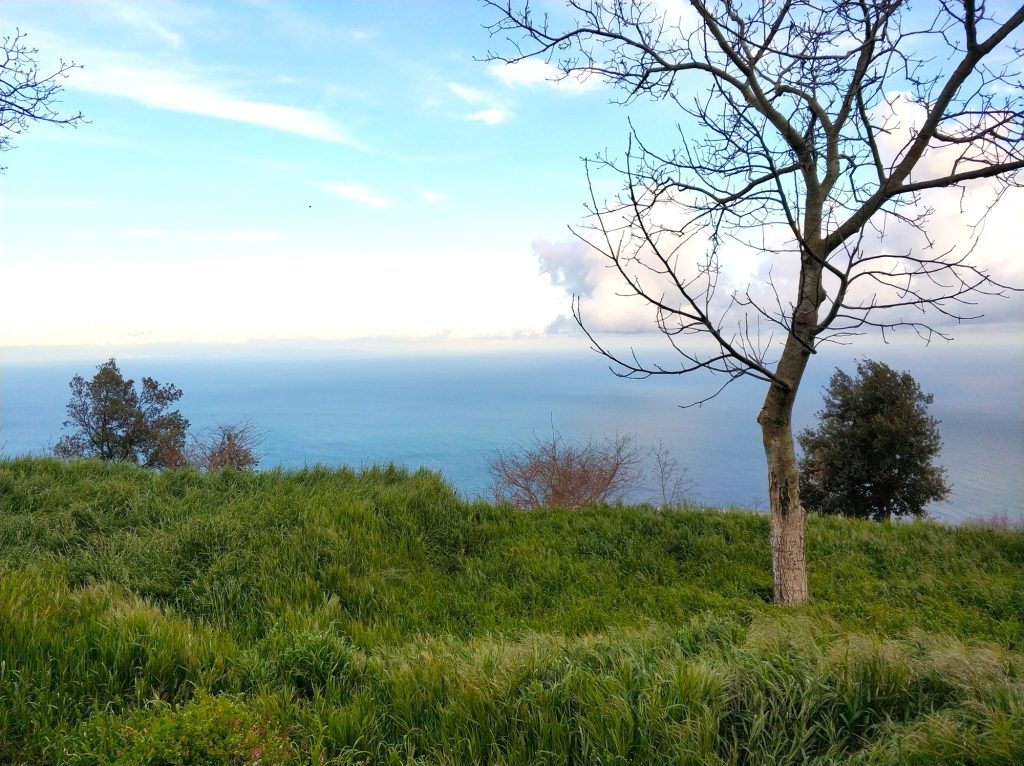
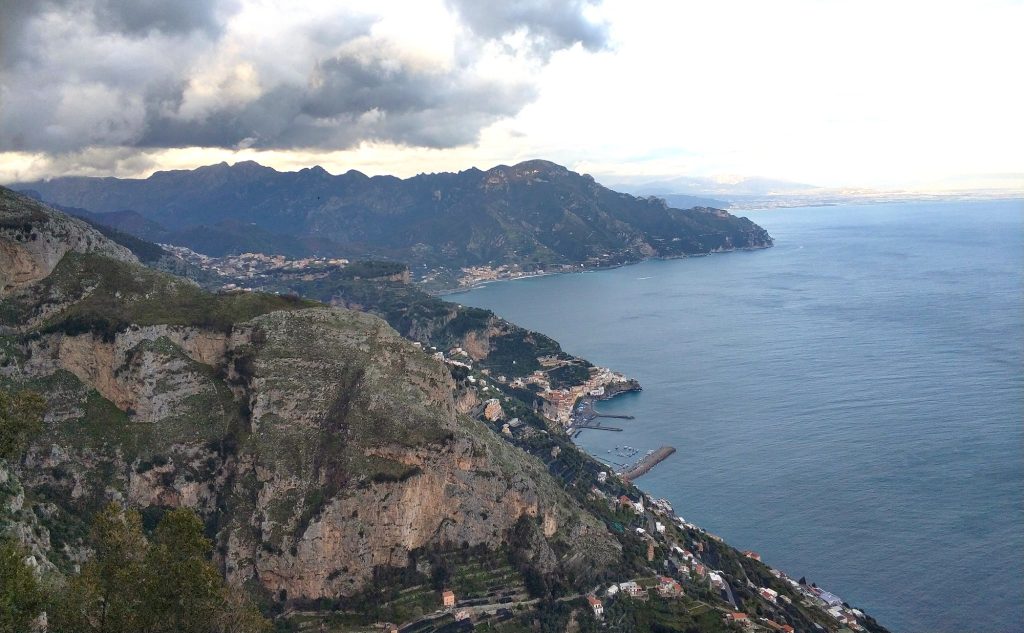
Instead of taking us directly to our BNB, Casa Vacanza Pappacoda , Francis took us on a little tour of Agerola . It was almost sunset and he drove us higher up from our BnB into the mountains. And the view of the Tyrrhenian sea from the cliffs of Agerola was simply spectacular ! And it was shivering cold !!
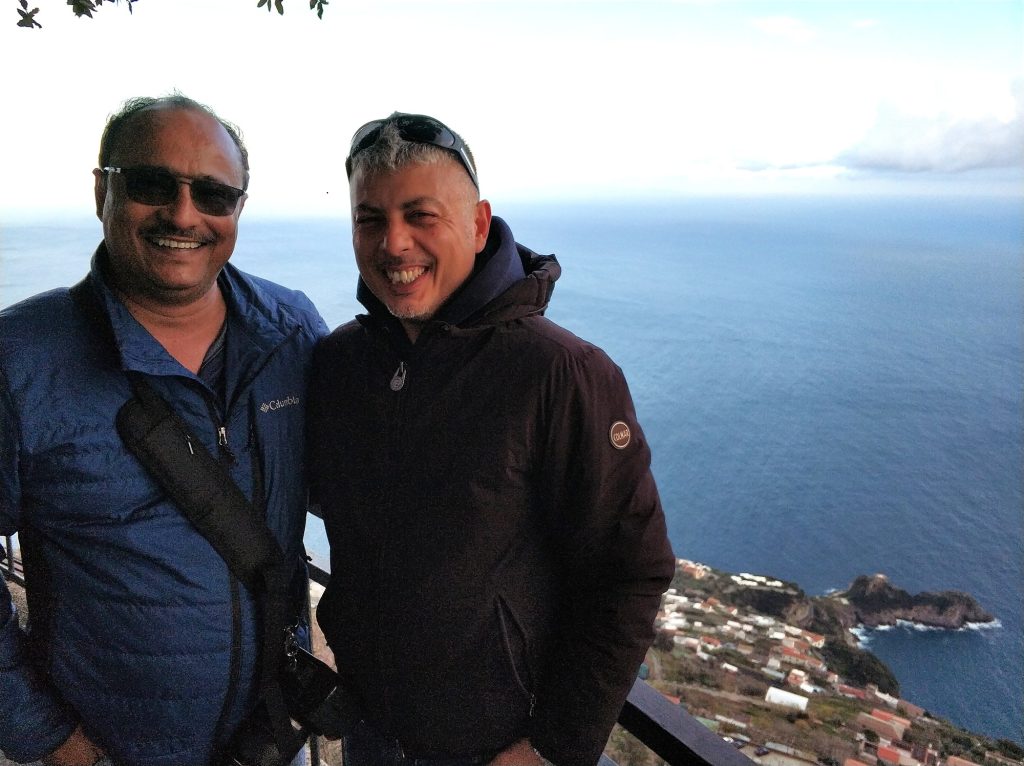
In fact no reason to think less of Agerola just because its not on the coastline. Firstly, it has a stunning mountain landscape added to which is magnificent weather and stunning views of the coast below – also a treat for mountain lovers and hikers with memorable hiking paths into the lush green forests of the Lattari Mountains.
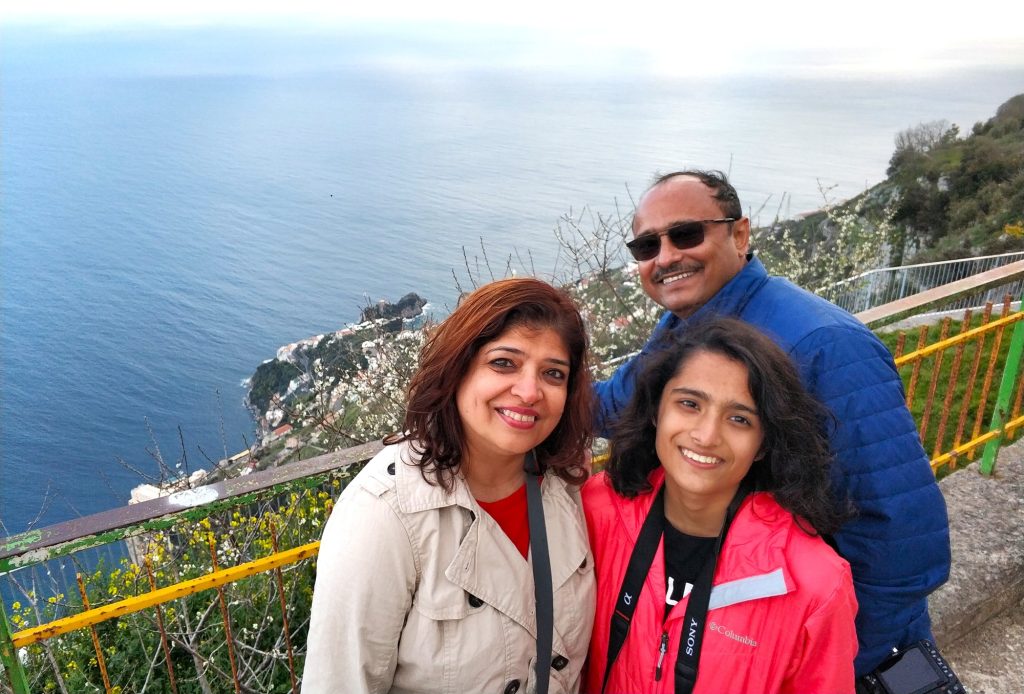
We could see Amalfi and Praiano below –tiny match-box houses jutting out towards the calm ,serene glass-like water of the sea with boats ,the size of ants, lying still in the stiller water. There was no one else except the four of us.
From there he took us to another viewpoint where we could see Praiano and Positano. Tourists usually go to Agerola to trek the Path of the Gods, but we had to leave that from our itinerary due to lack of time. Still shivering from the cold we took in this breathtaking view against the dying sunlight. A beautiful end to a hectic day.
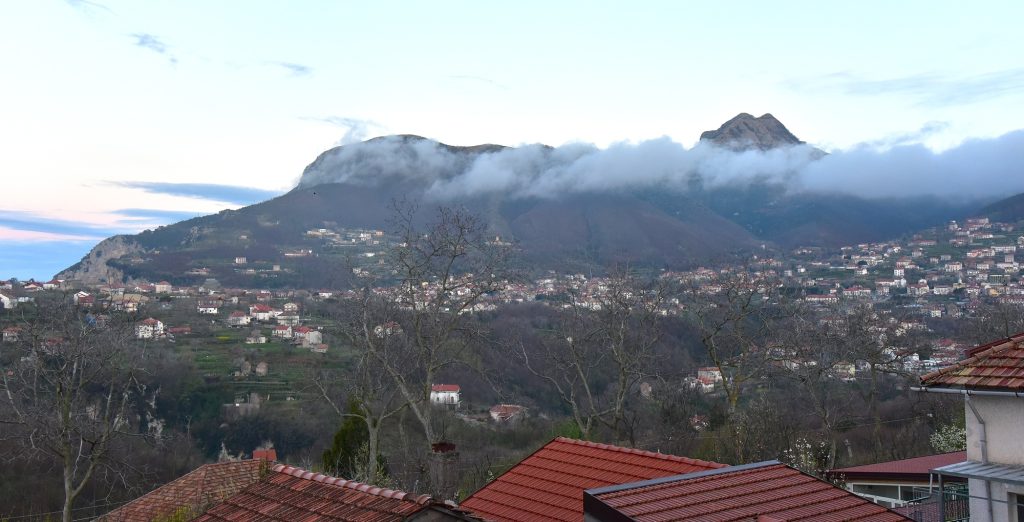
Our host Fransesco took us to our BnB. The best part of our homestay was that in front of the room was a long stretched balcony from where we got an amazing view of the mountains. He brought us a gigantic basket full of goodies which couldn’t have been finished by 10 people in 10 days.
Our evening was spent with Fransesco over a glass of Italian wine ,who helped us with a car-less itinerary. Truly speaking we could never have managed to explore the Coast the next day without his help.
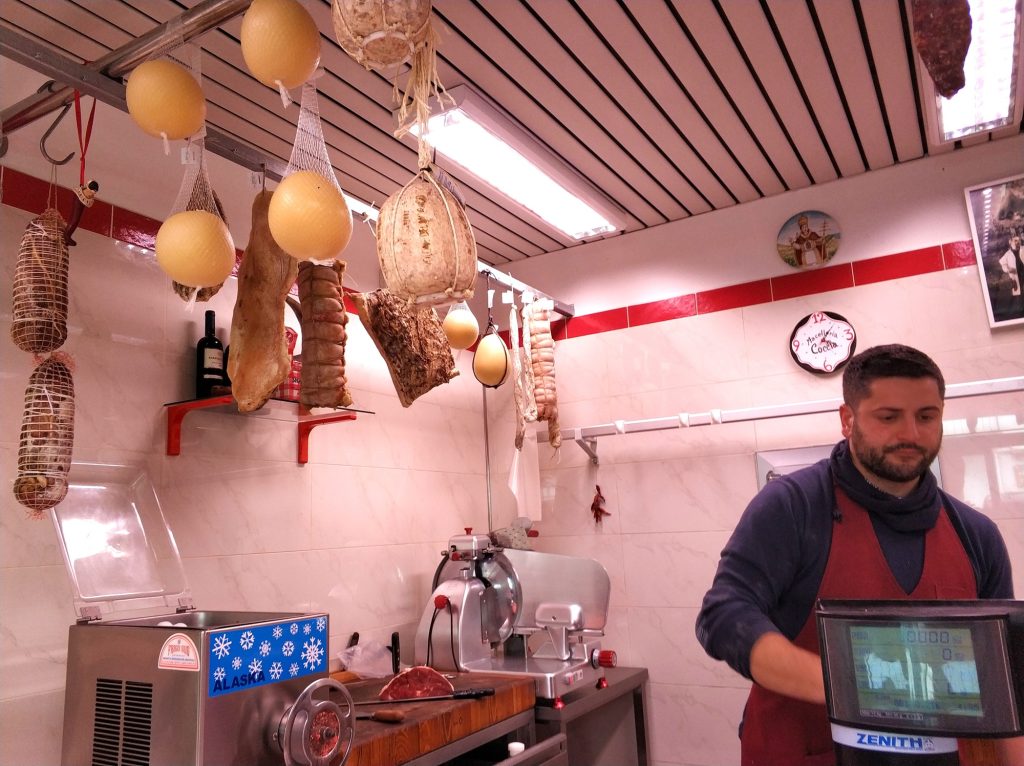
After the next day’s planning we went out for a stroll in the neighbourhood. It was such a delight to walk through a clean , empty street in crowded Italy with nobody else except a few locals. Even the local shops lacked the bustle of supermarkets. They were simple – a grocery, a bakery, a butcher’s shop, a wine shop – all with one or two buyers.
Ferry Ride to Positano
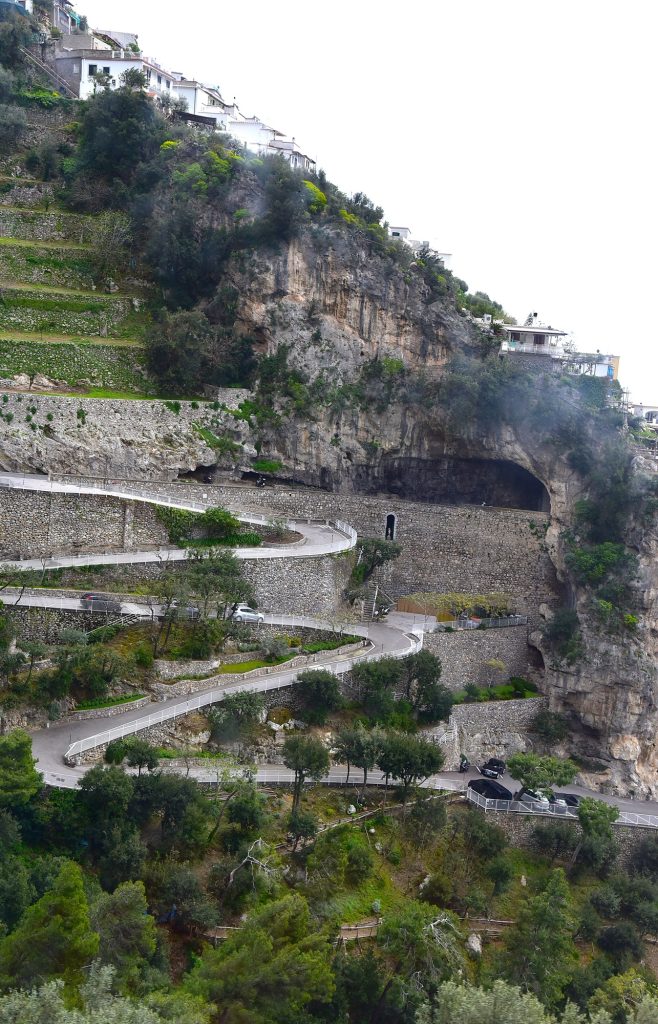
The next morning we had to catch the 8 am bus to reach Amalfi. We walked to the bus stand and stood in a small queue before boarding the bus. The ride was pleasant with a full view of the coast and the sea , houses and cottages with kitchen gardens covered in vines . The road was long and winding with scary, needle point bends ; buses ,cars ,taxis, scooters coming at super fast speed. Italians are notorious for their crazy driving.
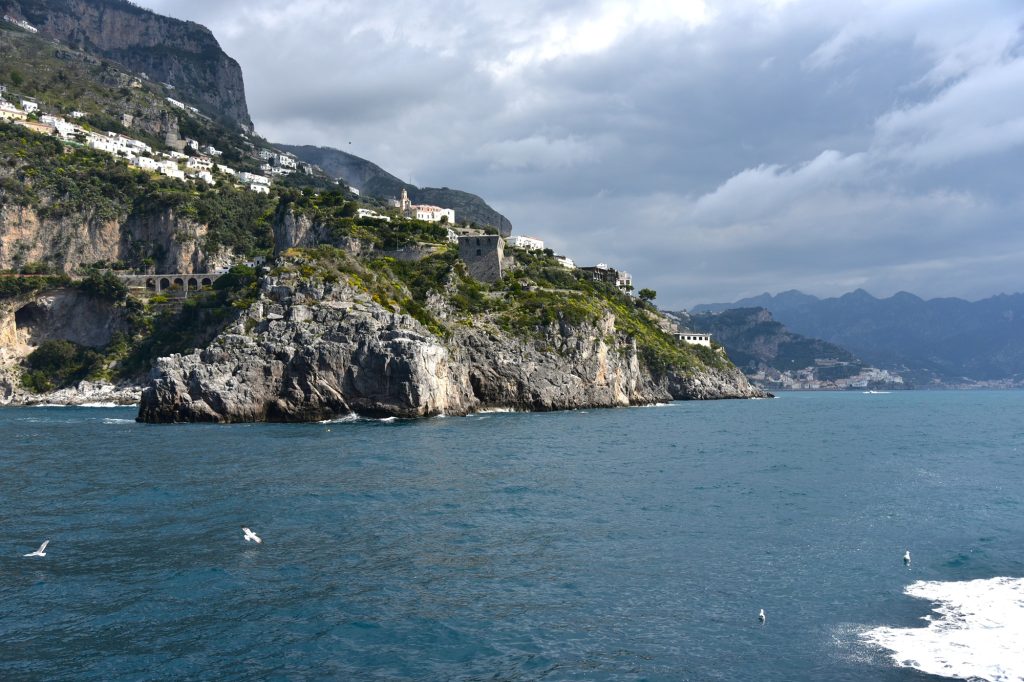
We reached Amalfi town in about 40 minutes . The weather was slightly cloudy but not unpleasant and the sea was choppy. To save time and ourselves from tortuous traffic, we decided to take the ferry ride to Positano then take a bus ride back to Amalfi town. We wanted to go to Capri but no ferries were running due to the rough weather. I’m glad that we took the decision to journey by sea because the ferry ride was glorious.
As the boat pulled away from Amalfi’s harbour, the town quickly shrunk into a cluster of white buildings pressed against the cliffs, crowned by the striking facade of the Amalfi Cathedral. Within minutes ,we were out on open water and the perspective shifted. The coastline revealed itself in a way you simply couldn’t see from the road.
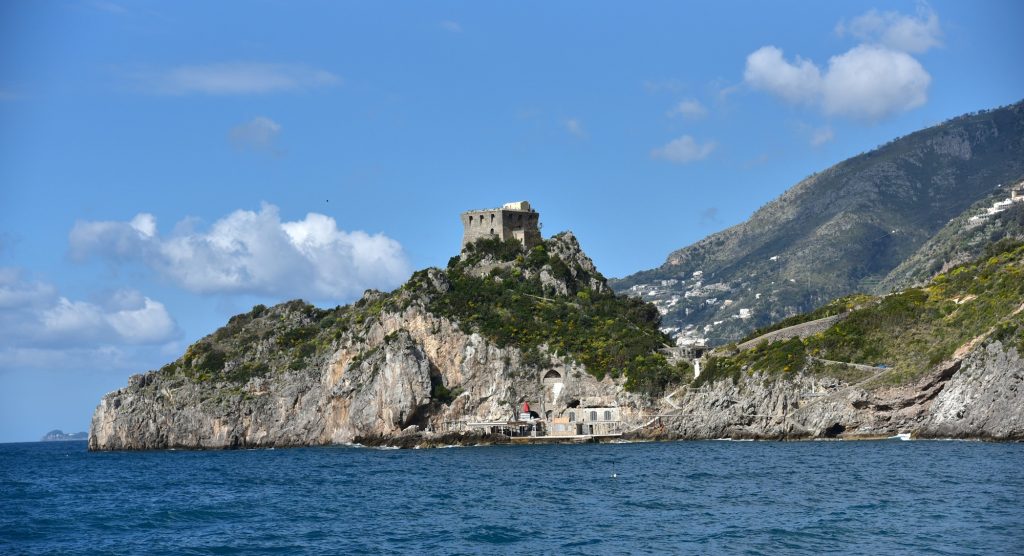
The cliffs rose sharply from the sea, layered with terraces of lemon groves and pastel houses clinging precariously to the rock. We passed stretches where the mountains seem hollowed out, with dark grottoes and arches carved into them and occasional flashes of tiny beaches tucked into coves below.
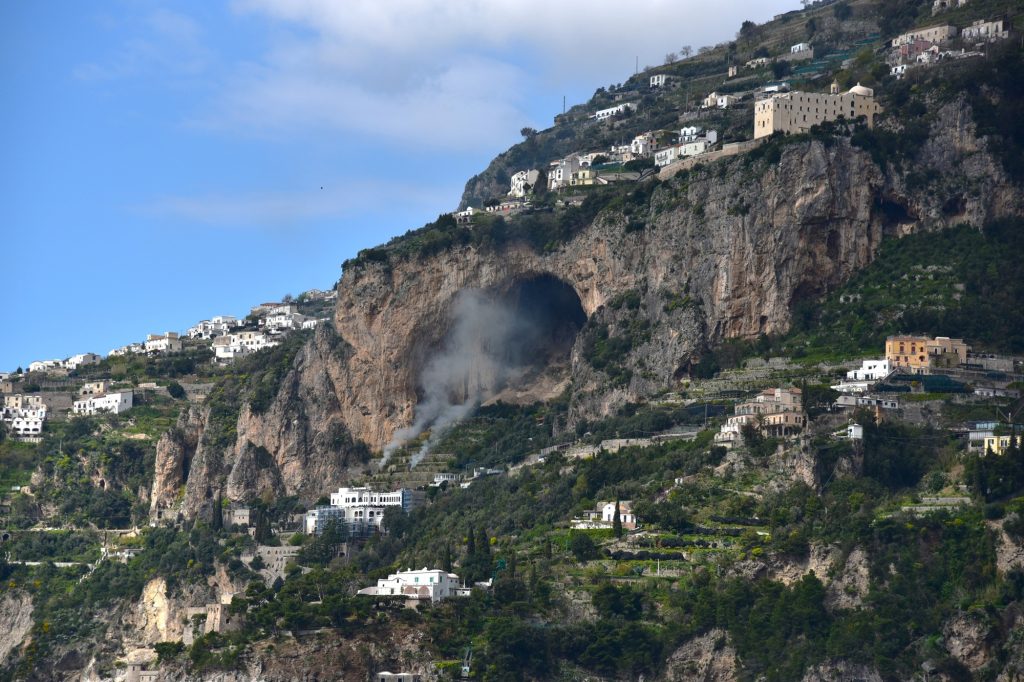
These were the famous karst caves of Amalfi. In this stretch between Amalfi and Positano , especially around Praiano , these caves are often called ‘Grotta‘ formations, and many are partly hidden or visible only from certain angles or from the sea. Unlike famous named caves like the Grotta dello Smeraldo near Conca dei Marini, (which unfortunately was closed due to rough weather-due to which we couldn’t visit) these are more wild and unnamed natural cavities.
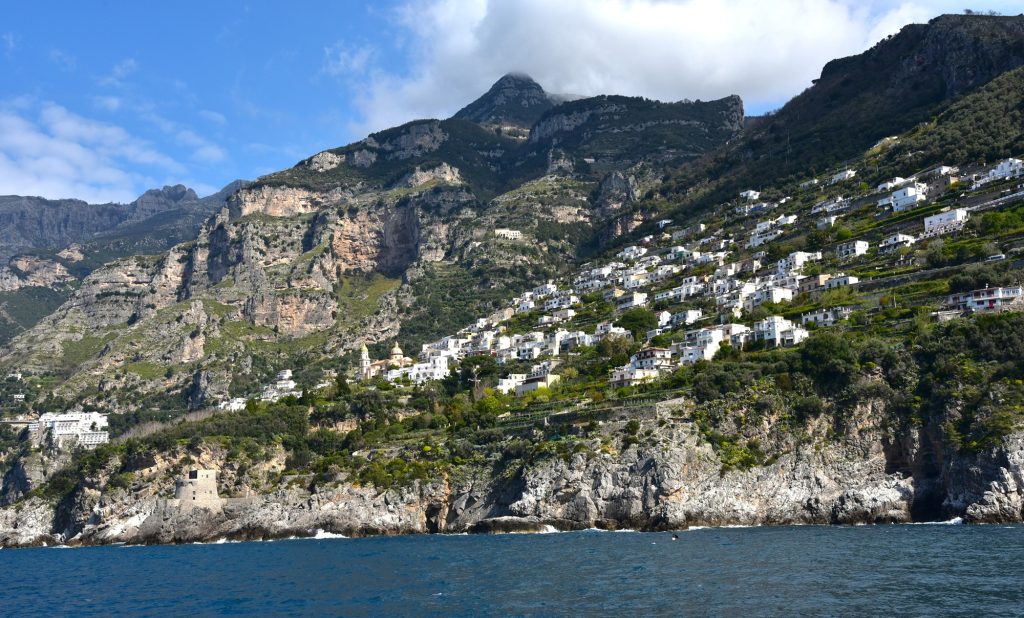
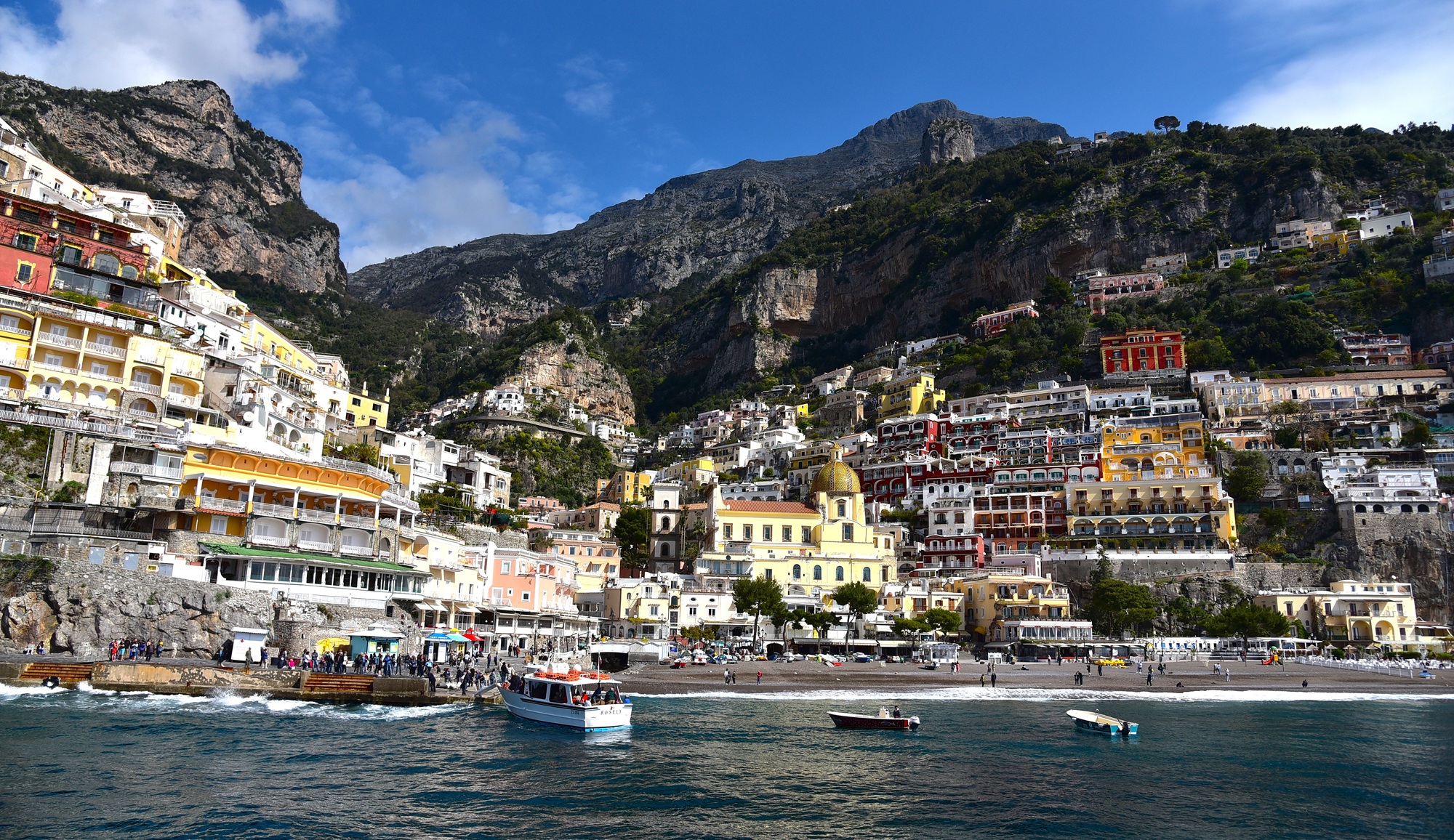
As you approach Positano, the view becomes unmistakable. The town appears almost all at once—a cascade of pastel houses stacked steeply down the mountainside, ending at the dome of the Church of Santa Maria Assunta and the beach below. It’s that classic Amalfi Coast moment—
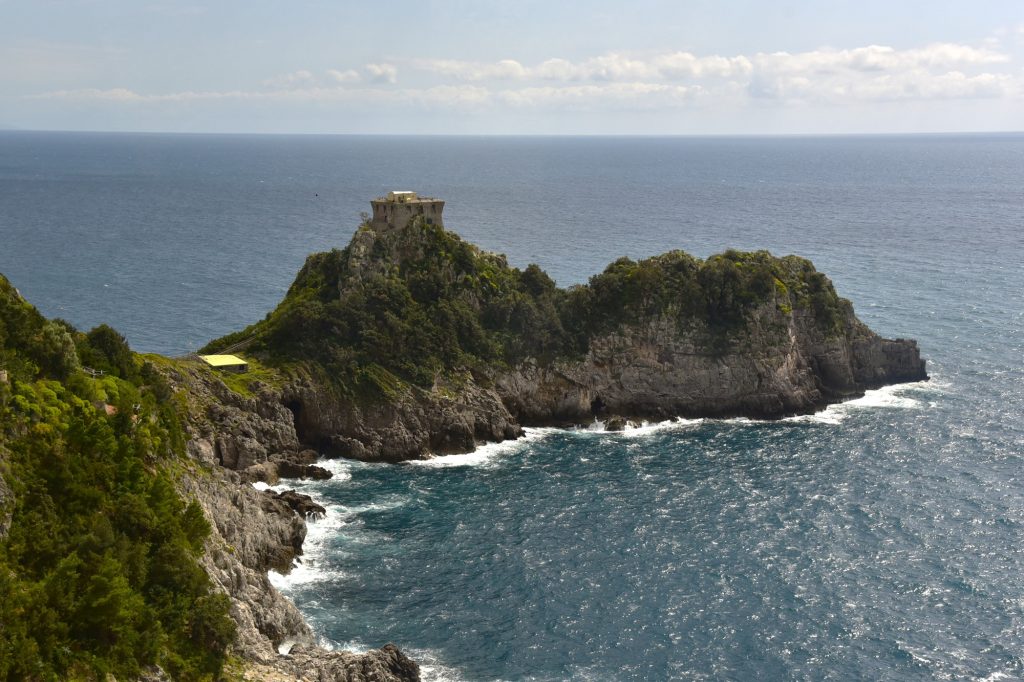
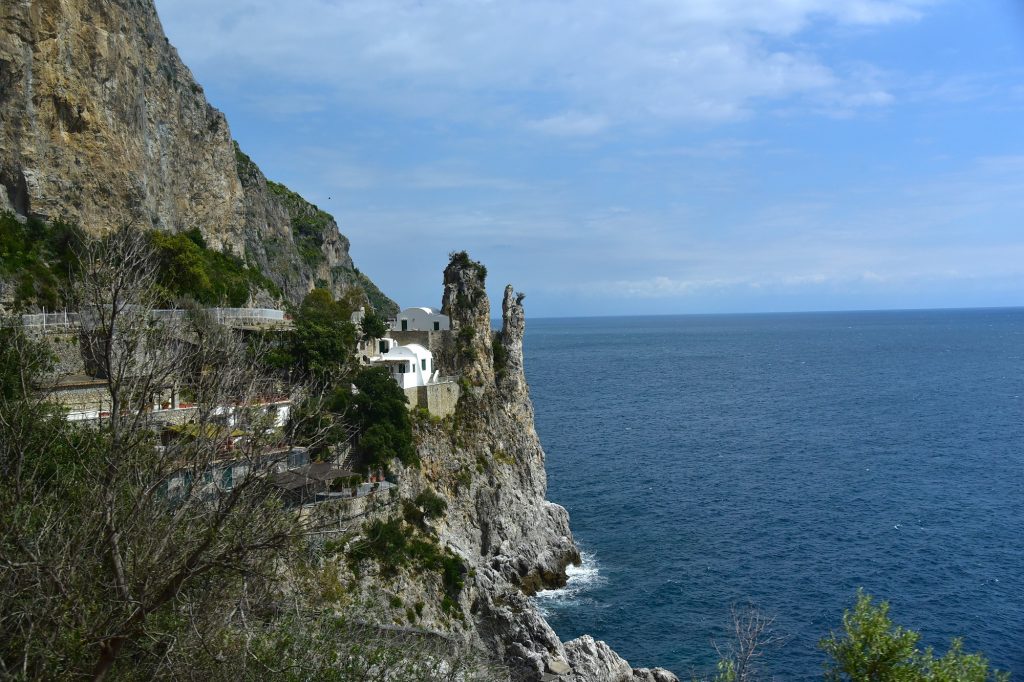
Viewing everything –the cliffs ,the caves , the houses of Praiano ,with a castle jutting out into the sea and rock formations rising up from the same sea ; small towns and villages between Positano and Amalfi ; everything was idyllic.
The It was a short ride –almost 40-45 minutes but it was well-spent.
Positano
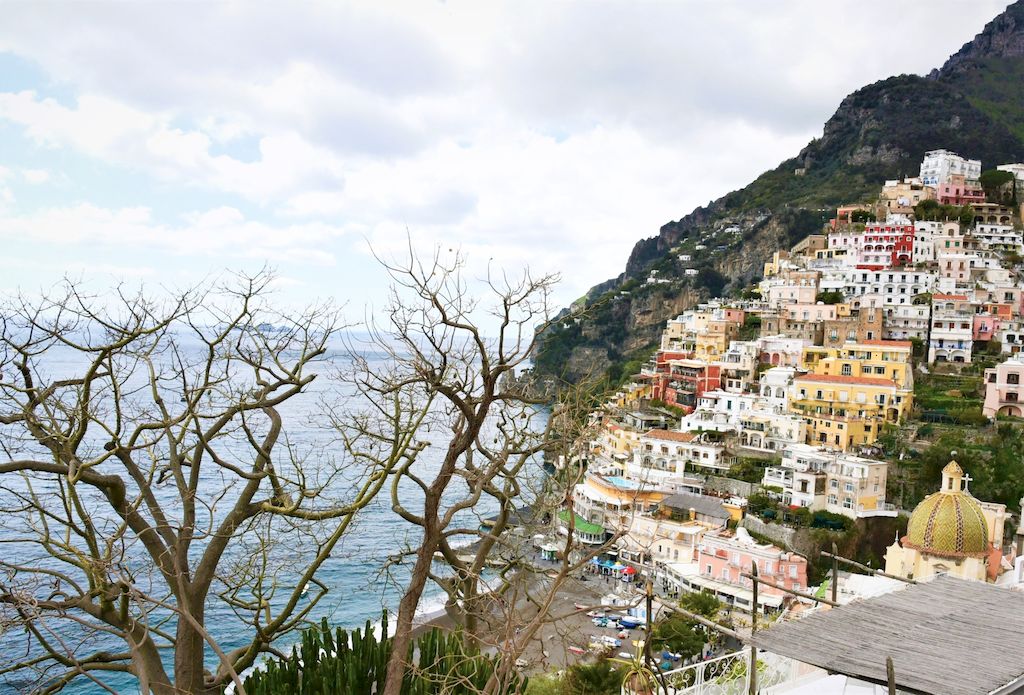
The best part was seeing Positano from the ferry, grow larger and larger from a distance. Positano – the jewel of southern Italy’s iconic Amalfi Coast – crowded with multi-coloured houses like a patchwork quilt , beginning from the top of a mountain and rolling down into the sea like a colourful ladies skirt . Below it was a small disc shaped beach with the shimmering water of the Mediterranean ahead of it and the beautiful , turquoise and emerald mosaic domed church Santa Maria Assunta mushrooming up in the middle, all was a splendor to watch.
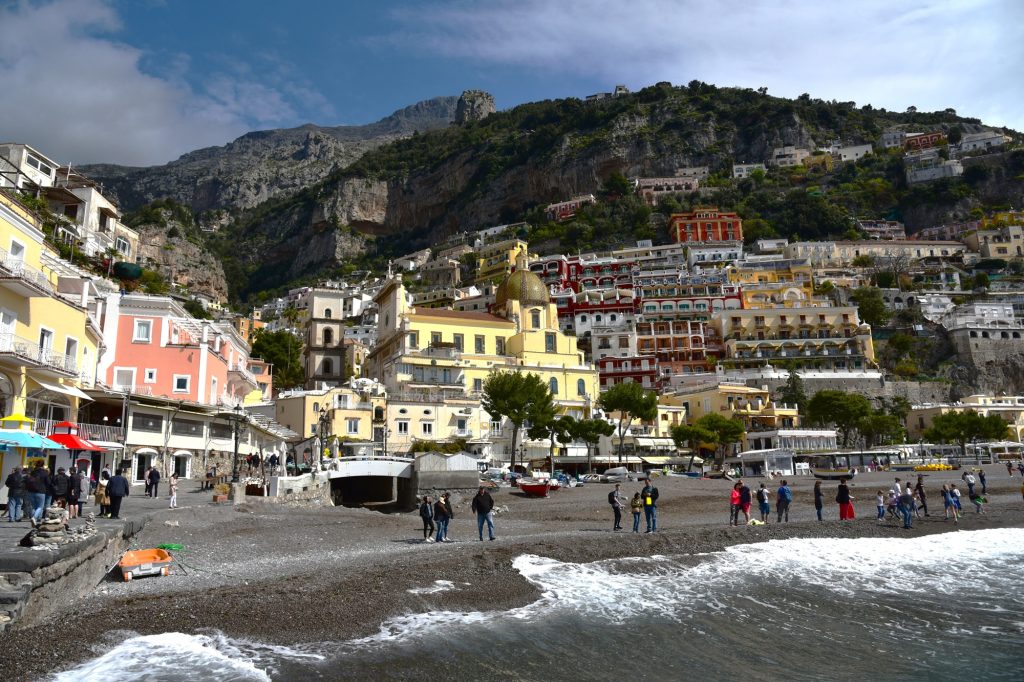
We got down from the ferry to explore the more popular Spiaggia Grande beach and the nearby more relaxing Fornillo beach. It wasn’t summer yet, so the beach wasn’t crowded at all but I wasn’t much impressed by it. It was small compared to the beaches in Iceland and South Africa and narrow with too many restaurants at its doorstep; the sand was also pebbly and grey.
I had seen pictures of the Spiaggia Grande beach during peak summer months and they weren’t very appealing either – beach chairs , sun beds and parasols rubbing against each other, hardly space for people to walk.
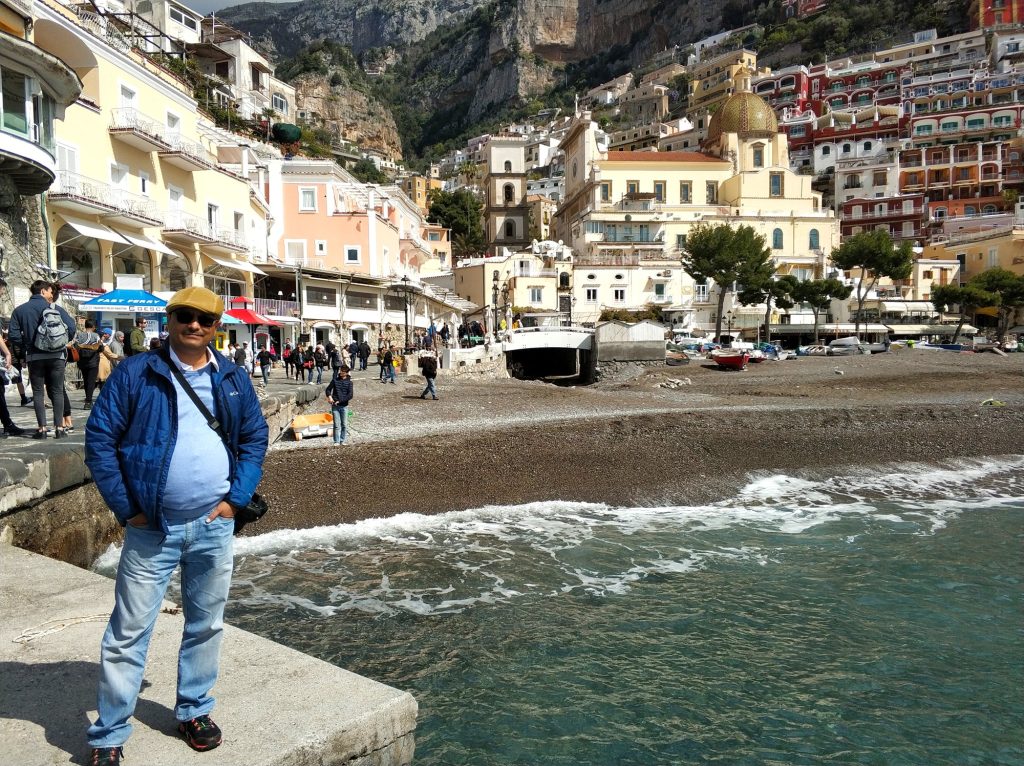
The Tyrrhenian sea was obviously gorgeous with a play of light and shadow caused by intermittent rolling, rain clouds. The beach also seemed to be exclusively used by some of the restaurants, which means you could sit there only if you were eating there.
Still it was one of the most famous beaches in the world. I guess it was the surroundings which added to the overall beauty of the place – precipitous Positano with its chic restaurants and boutiques, juxtaposed with the medieval church, and quaint little houses covered in bougainvillea, wisteria and lemon trees – everything immersing into the sea; all added to the other-worldly charm of the place.
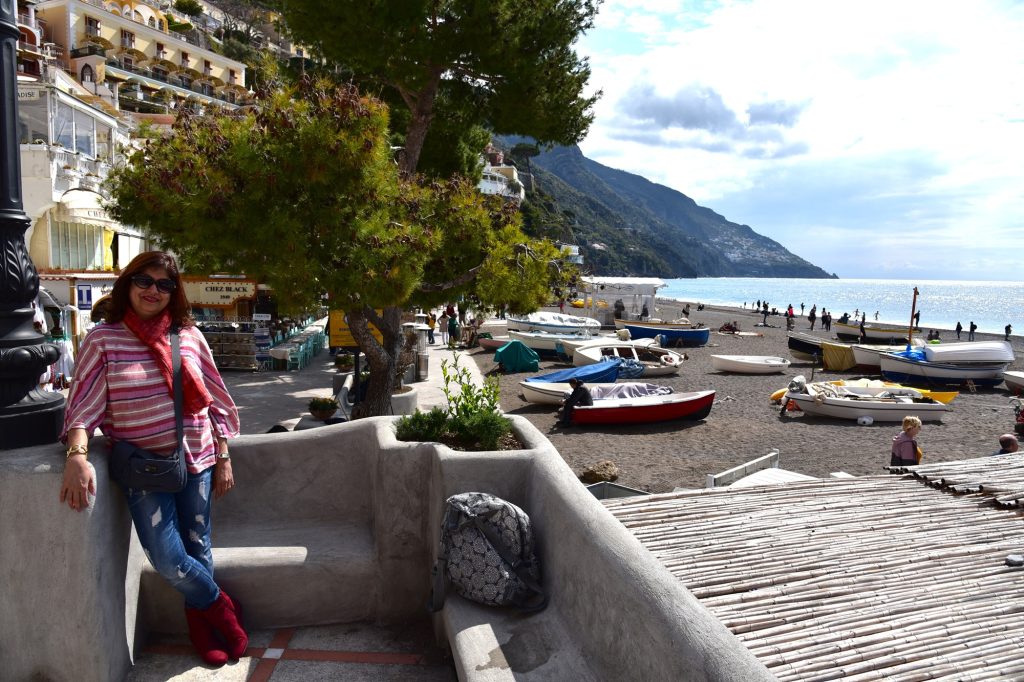
We took a lot of photos, then, being hungry we went in search of food. After all it was supposed to be home to some of Italy’s finest hotels and restaurants. Wanted to eat on the beach with a view of the sea but turned out the closer to the sea you dined, the more expensive it was. There was a hierarchy in eating – the cheapest being self-service, outside, at the back of the restaurant ,with a wall in front of you to deliberately hide the magnificent view of the sea as well as the ambience of the place .All the beachfront restaurants followed this same demeaning rule. We should have ventured further from the beach and up into the town but not sure whether we’d get anything cheaper and also not wanting to waste time behind eating ,we just ate at the first restaurant we came across.
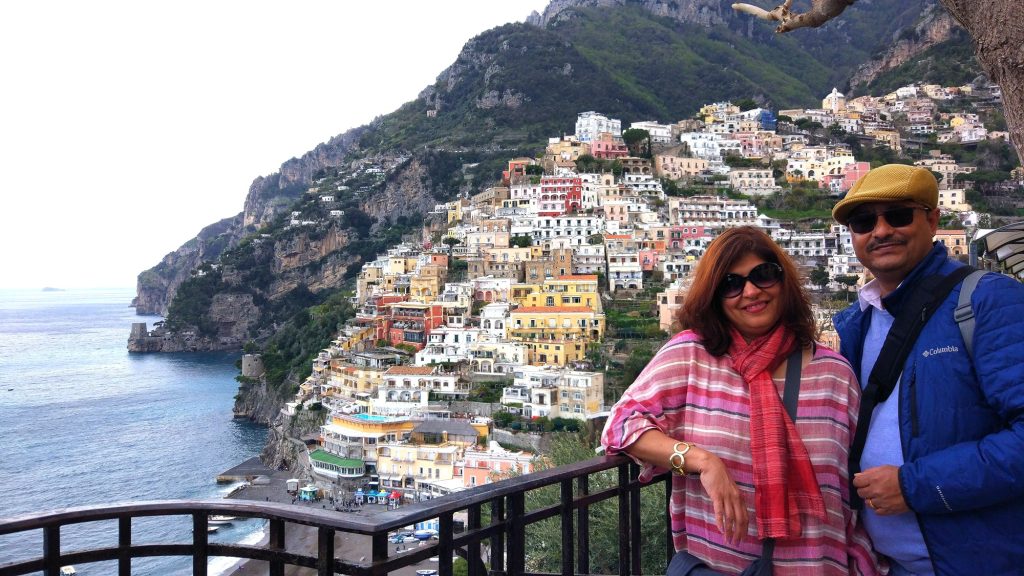
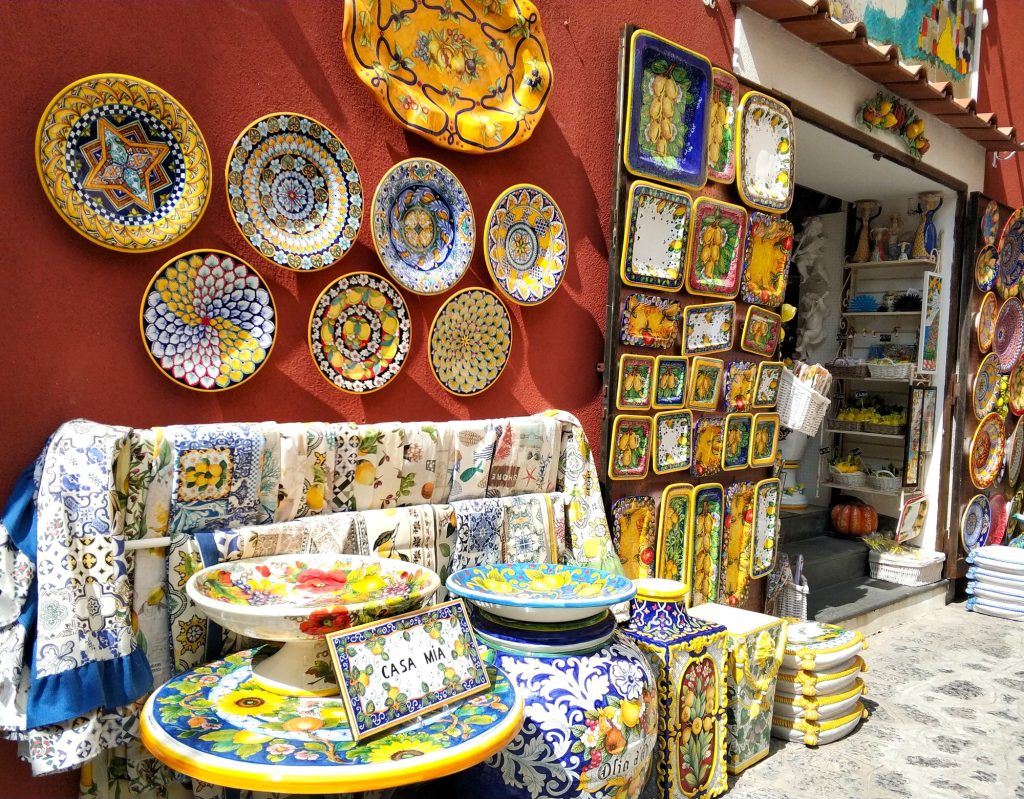
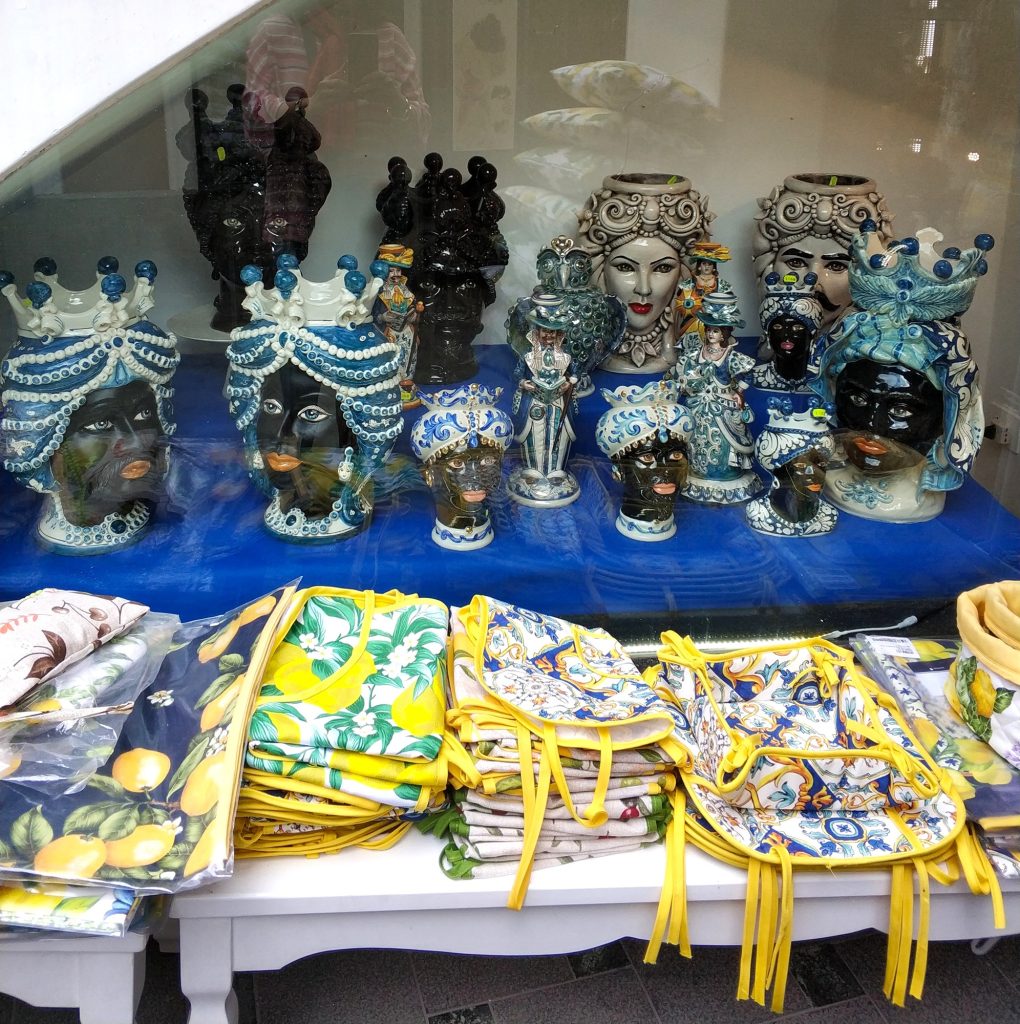
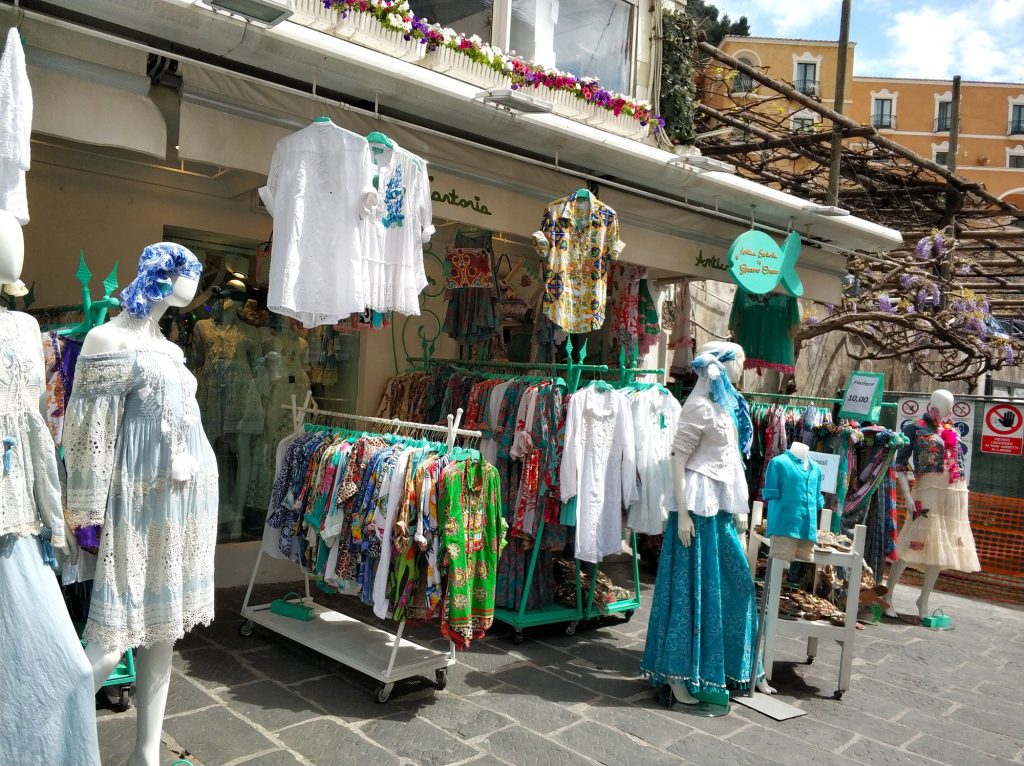
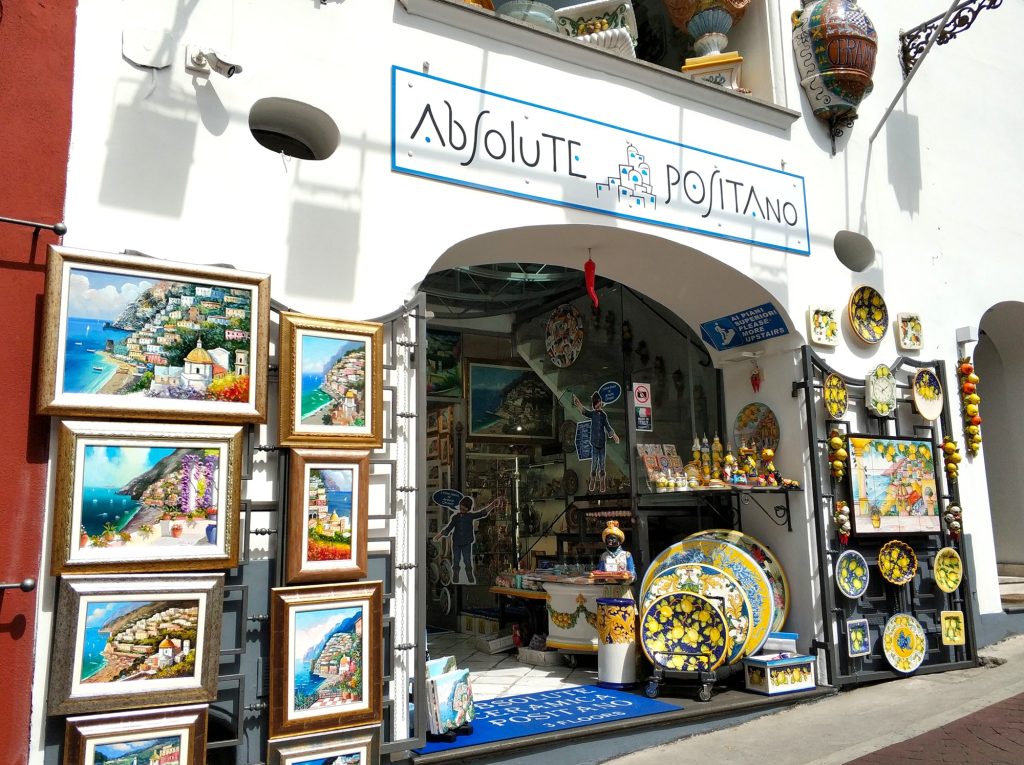
We started climbing up the picturesque alleyways towards the top. There were restaurants, gelato parlours ,lemon juice stalls, shops and boutiques in every corner of our walk, selling trendy , boho-chic jewelry , artwork and clothes in linen -white , cerulean and lemon colored – which inspire fashion designers around the world. Ceramics, specially lemon–themed , planters of Medusa-heads and leather shoes were two other things sold.
Lemons everywhere !
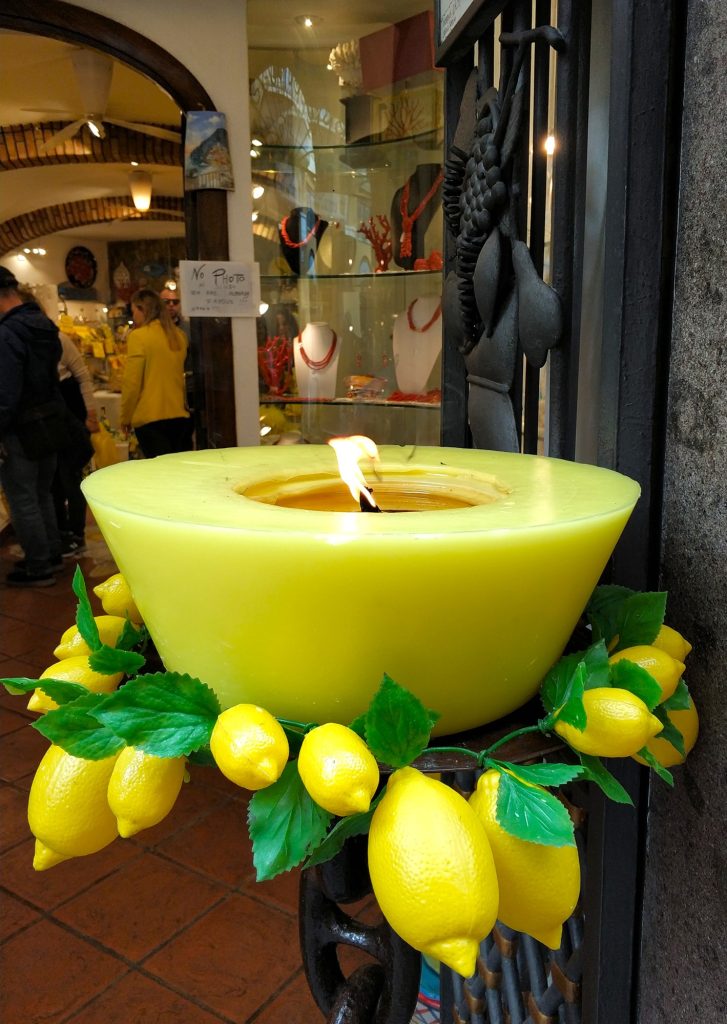
In fact the most eye-catching items sold in abundance were items related to lemons !! You’ll find lemons everywhere: lemon flavoured candies, lemon flavoured chocolates; ceramic cups, bowls and plates and tiles with lemons designed on them; dresses and scarves with lemons embroidered on them; lemon scented candles, perfumes and body care products ; and of course the strong and sweet Limoncello . These people are simply obsessed with lemons. You’ll find fruit stalls everywhere on the way from Sorrento to Salerno with gigantic lemons the size of a football and the juice of these lemons are sumptuous and divine!!
Santa Maria Church : Positano
In the middle of all this was the beautiful turquoise and emerald mosaic domed Santa Maria Assunta church which can be seen from every corner of the town. There is a legend linked to the church and how Positano got its name. In ancient times, a Turkish boat got stuck just off the shores of the Positano we know now. There was a painting of the Virgin Mary on the ship. The captain heard the painting whisper “posa, posa” (‘set me down, set me down’). Hearing this, the Captain – a deeply religious man, threw the painting into the Tyrhennian sea. Miraculously, the ship got free and everyone aboard was saved. The locals built the Santa Maria Assunta church on the spot where the painting had washed ashore. To them it was the spot which the Virgin Mary had chosen as her resting place. As you can understand ,the name Positano had come from the word ‘Posa’.
Soon we came to the cliff nearest to the bus stand. This street was also lined with restaurants, coffee shops and artisan’s workshops on one side and cute little cottages having their own gardens full of lemon trees and wisterias hanging over the sea, on the other side.
All that climbing through nothing but pricey shops had put us off a little and we thought two hours were enough since there was nothing else to see in Positano, but we actually stood there for a long while enjoying the jaw-dropping view of Positano and the Spaggia Grande and the Fornilla beach below. The beauty of Positano is that since every building is on the cliffs, high enough to enjoy the views, you get the sea view and mountain view from all angles. This sort of compensated for the uninspiring walk.
Amalfi Town
The bus to Amalfi arrived soon. We enjoyed our 30 minute drive, drinking in the scenic landscapes on the way. Amalfi had its own unique charm different from Positano but equally interesting, with more of a port town vibe to it. Positano, apart from the view from the sea and from the cliff ,kind of missed the mark for me, but I simply loved Amalfi.
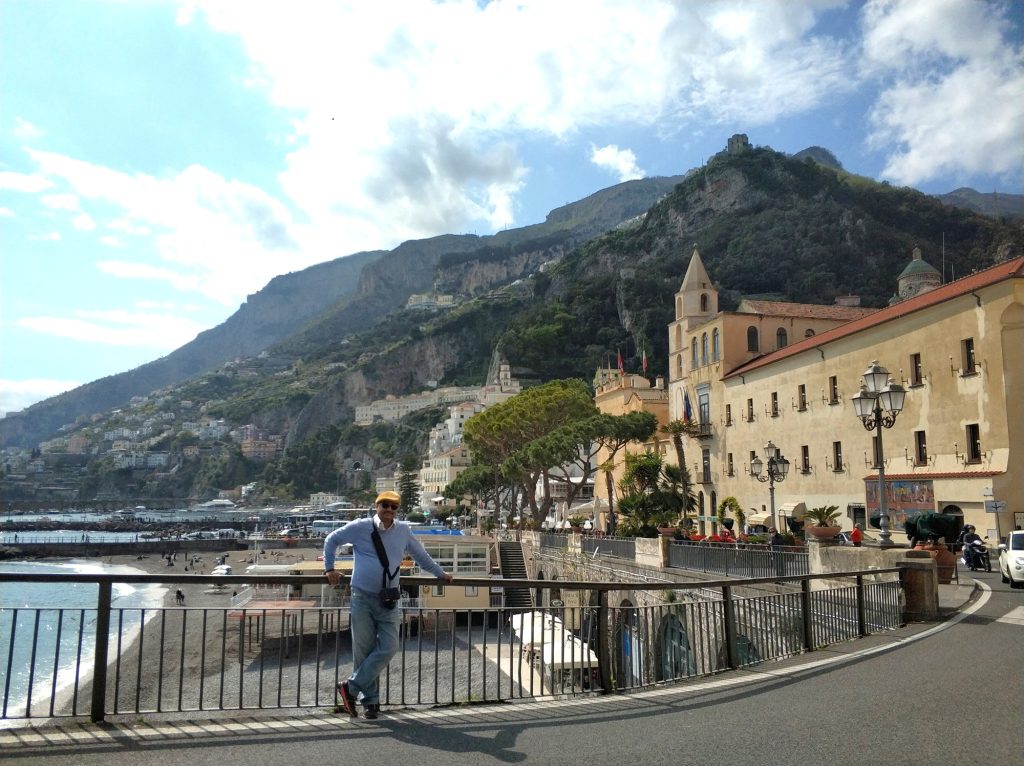
Amalfi is the main town on the Amalfi Coast. It used to be the capital of a powerful maritime republic known as the Duchy of Amalfi which was also an important trading power in the Mediterranean from the 9th to the 13th century AD. It is steeped in history and resplendent with archeological wonders . History buffs can also visit the Arsenal of the Maritime Republic (Gli Arsenali della Repubblica) and Museum of Handmade Paper (Museo della Carta).
We got down from the bus from Positano and headed straight to the port – the same place from where we had boarded the ferry – this time to enjoy the view of the Mediterranean and snap pictures. The clouds had dispersed and the sky was a dazzling azure ; though the beach was equally tiny as that of Positano, the sea in front was a vast carpet of scintillating, ultramarine blue with random vessels scattered on it.
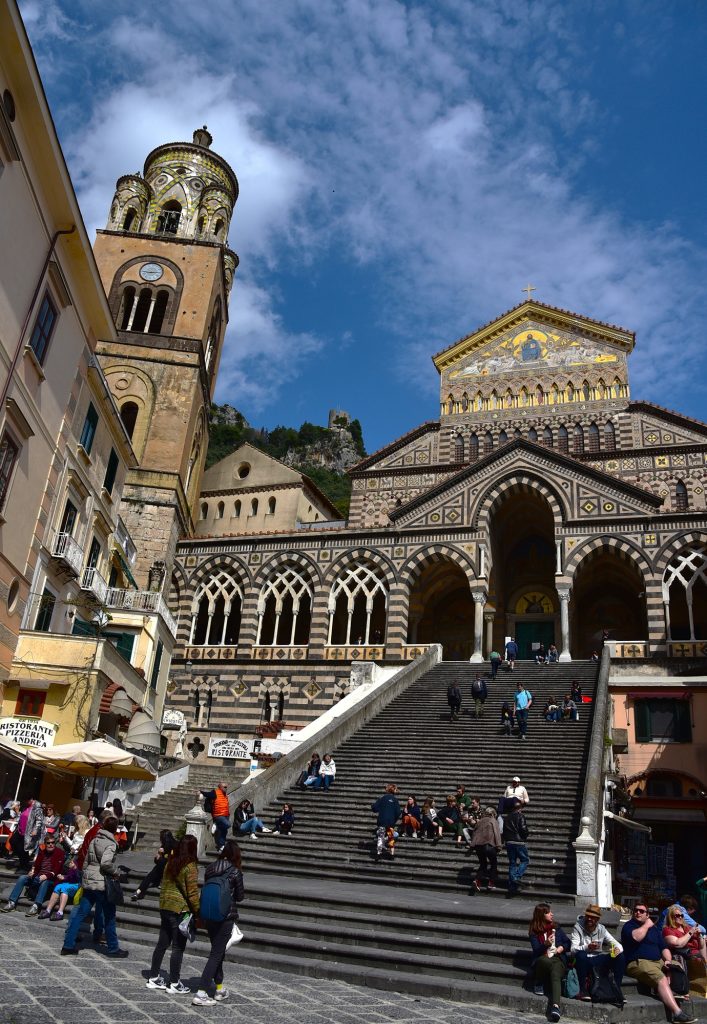
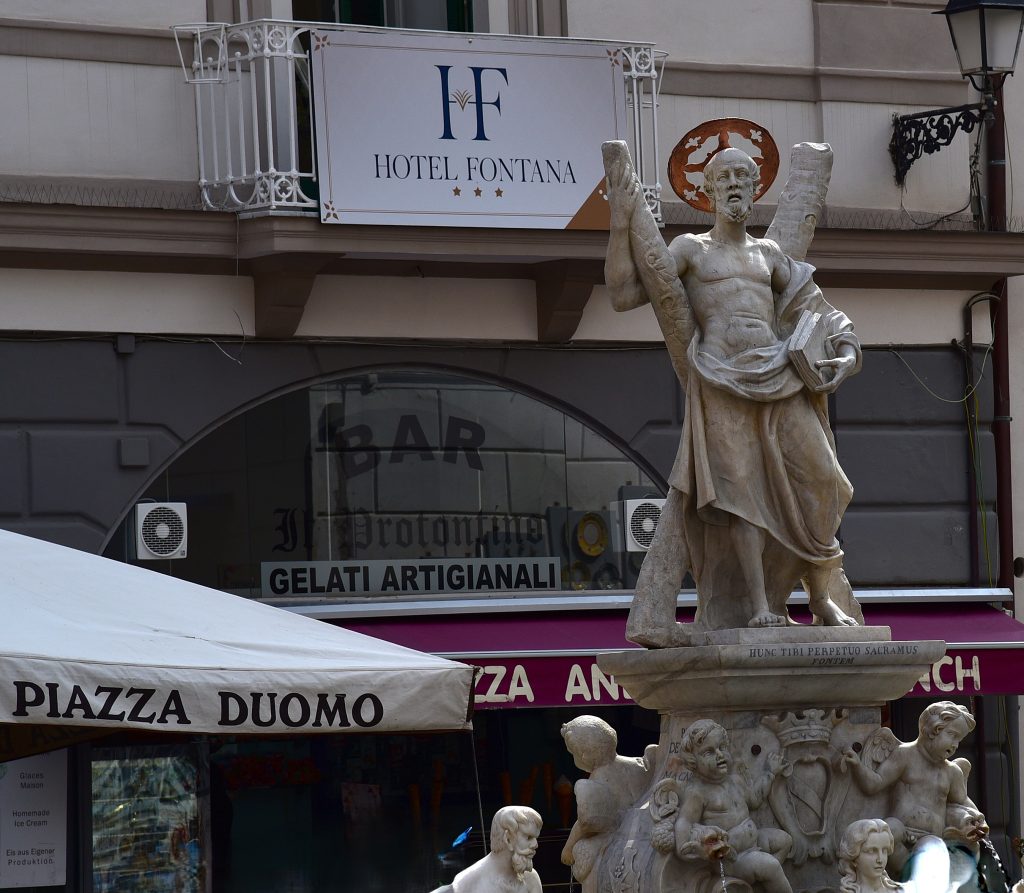
But my main attraction for this place was its church – Saint Andrew’s Cathedral or Cattedrale di Sant’Andrea or Duomo di Amalfi, one of the most beautiful churches I have ever seen . The church is perched at the top of a long, sweeping staircase that dominates the main piazza – 16 flights of stairs – a little like the Spanish stairs in Rome but far more imposing. It overlooks the Piazza Duomo (which is cathedral in Italian) , the heart of Amalfi and feels less like a building and more like a grand theatrical entrance into the town’s history.
You leave the port ,enter a narrow alley,walk a few steps ,then lo and behold, towering over you is the cathedral. The only sensible thing to do was to sit at its stairs and gaze at it in wonder. Its beauty made everything around it pale in comparison. The first thing that catches your eye is its striking façade – an intricate blend of Arab-Norman, Gothic, and Byzantine influences. Bold stripes, delicate arches and a riot of colors create a visual richness that reflects Amalfi’s past as a powerful maritime republic. The bell tower, with its Moorish details and tiled dome, stands tall beside it, adding to the cathedral’s exotic charm.
The cathedral dates back to the 11th century; its interior is bedecked in the late Baroque style with gilded ceilings and ornate chapels while the façade of the cathedral is adorned with various paintings of saints, including a large fresco of Saint Andrew – the patron saint of Amalfi , the Apostle, whose relics are kept inside the Duomo. Climbing the steps, you begin to appreciate the scale and presence of the structure. At the top, bronze doors – cast in Constantinople centuries ago – lead you into a cool, dim interior.
Like many around me I sat on those magnificent steps and soaked up my surroundings. Though equally crowded and touristy as Positano, the centre of Amalfi had an altogether different level of energy – bustling and languid at the same time. It lacked the glitz and glamour of Positano but possessed an effulgent charm redolent of bygone times – a vibe I was getting sitting there aimlessly.
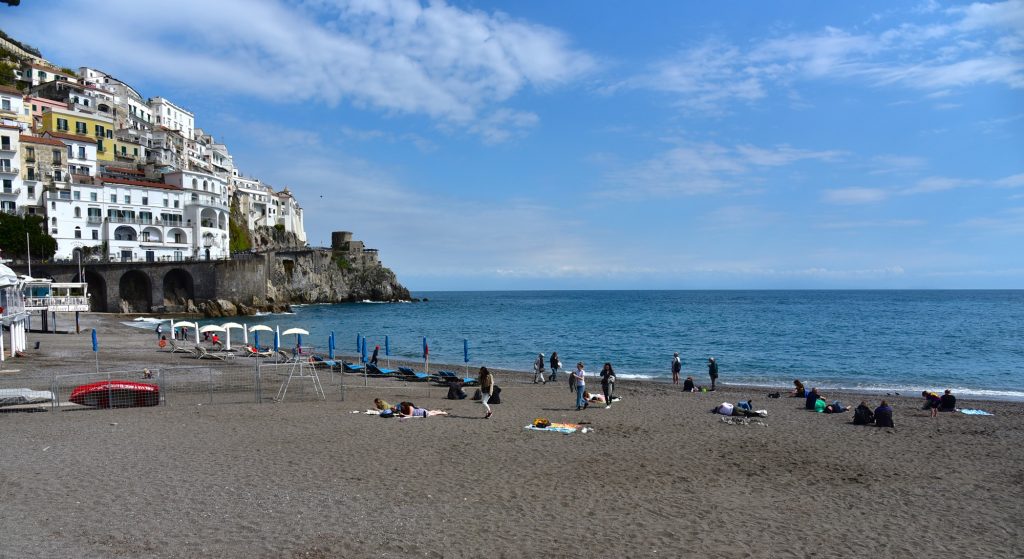
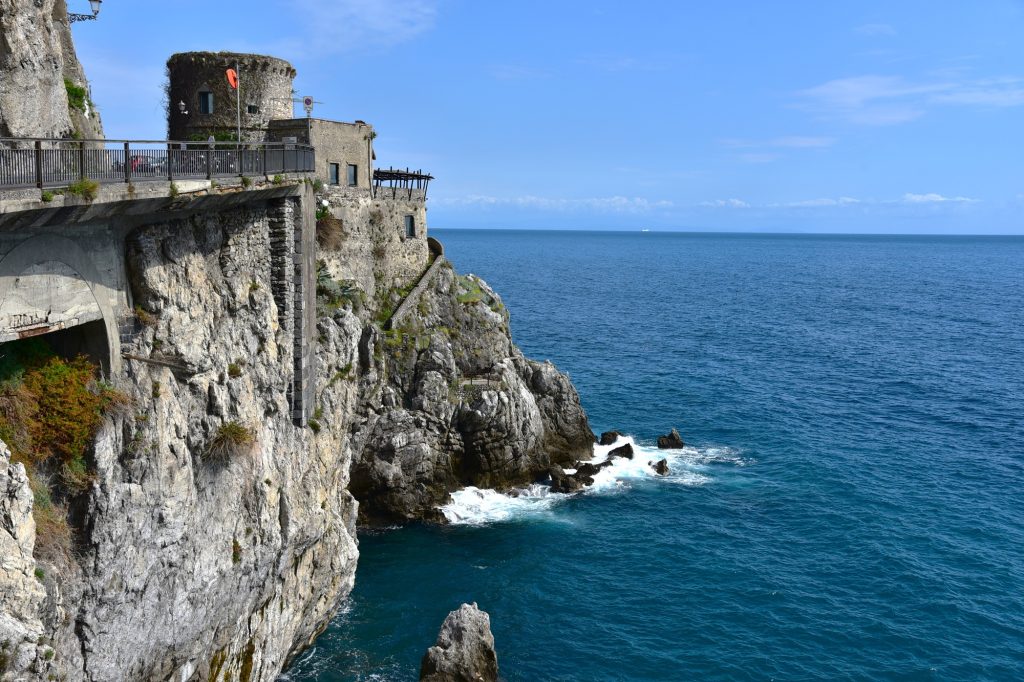
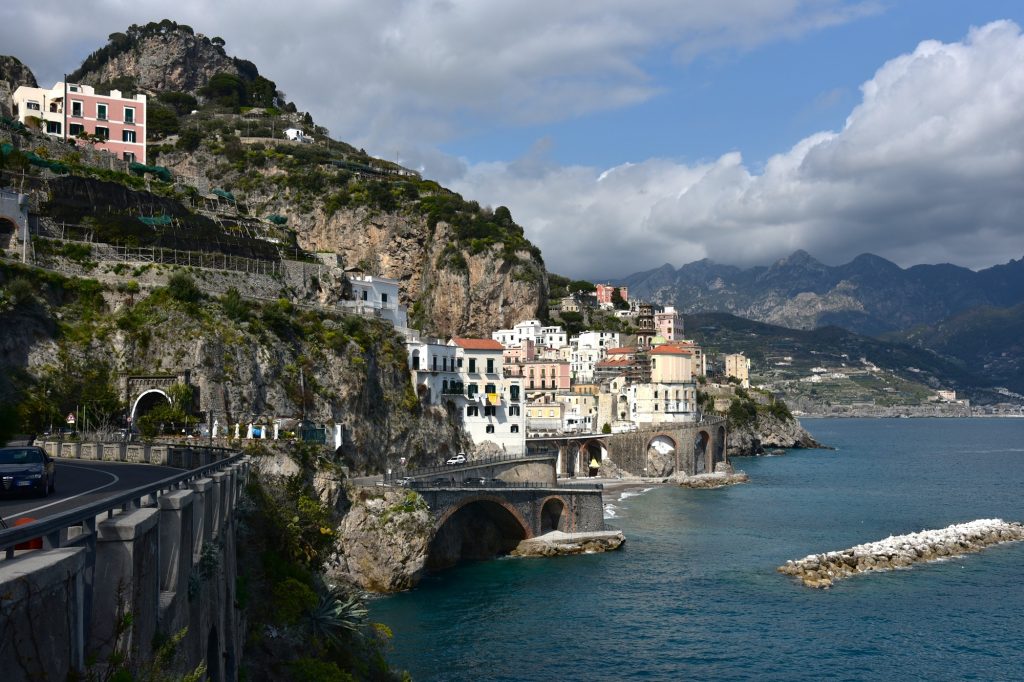
We came back to the main road and walked along it a little further till we came to a bend from where we could see the town of Atrani. What a panoramic view it was – Amalfi with its church dome on the one side, and the quaint looking Atrani on the other side. We were in the middle , standing on an aqueduct turned into a road, with people frolicking below at the beach – just above the vertical drop of a cliff on which the ocean had created wave-smashed chasms.
Though it was only 5, the last bus for Agerola was leaving and reluctantly we had to go – but not before sipping on Amalfi’s famous lemon juice. Remembering about that at the last moment , I dashed back to the Piazza ,bought a glass of lemon juice which was huge and ran back to catch the bus , but the driver wouldn’t allow me to board the bus with it, so instead of relishing it at a leisurely pace I literally gulped down the juice and set out on the ride with a queasy stomach.
We reached Agerola before sunset and strolled around the place again ,this time doing some grocery shopping ,planning for some home-cooked meal. It was so therapeutic shopping from those tiny groceries. The day ended with a lovely meal of chicken and wine. Next day we had to leave early to catch a plane to Sicily. Francesco had arranged a driver to pick and drop us to Naples airport.