

Applecross village was a stark contrast to the road we had traversed to reach it. I have described the road journey in my write-up ‘Drive to Applecross‘.
For centuries, Applecross could only be reached by boat. Even today, just two narrow roads connect it to the mainland, the most dramatic being the legendary Bealach na Bà. After crossing the hair-raising road through this mountain pass, we reached Applecross mid afternoon in relatively inclement weather. Tired from thrill and exhaustion, we headed straight for our BnB ,calling it a day.

Our BnB
We spent the evening in our splendidly remote BnB tucked away far from the more remote village centre. This cosy nook had the most incredible view from its balcony and we just spent the rest of the evening savouring it. Ours was a modern wooden cabin sitting lightly on the slope, its clean lines softened by rain-darkened timber and wild grasses swaying around it. Beyond, the land rolled away into a patchwork of mossy greens, rocky outcrops, and rough pasture, stitched together by fence posts that seem almost a futile , unnecessary protection against the vastness. In the distance, low hills faded into the mist, their contours blurred by drizzle and drifting clouds, while a lone white cottage nestled in the valley below, dwarfed by the surrounding landscape.

History of Applecross
Often called The Sanctuary, the Applecross Peninsula lies tucked away in Wester Ross (such a Game of Thrones vibe in the name!), framed by Loch Kishorn to the south, Loch Torridon to the north, and the wild Inner Sound opening west towards Skye and Raasay. Rugged, mountainous, and thinly populated, it feels like one of Scotland’s last true edges.

Applecross was extremely isolated until the early 19th century and was accessible only by boat. The area has been inhabited for over 1,300 years and is among the earliest settled areas in Scotland. A Celtic Christian monastery was founded here in the 7th century by Saint Máel Ruba. Today a single carved stone near Clachan Church is all that remains, watched over by the quiet graveyard and the nearby Heritage Centre.

Despite its name, ‘Applecross’ isn’t what locals call the village. The whitewashed cottages lining the bay are simply known as ‘The Street‘—officially Shore Street—curving gently beside Applecross Bay with wide views towards Raasay, Scalpay, and the Isle of Skye. Applecross is not a single village but a collection of small townships stretching from Ardishlaig in the north to Toscaig in the south. The permanent population is approximately 230 people. Locals told us that for this reason many inhabitants take turn doing even up to 7 different jobs in a week.
Amenities in Applecross
The local economy is now largely tourism-based, though fishing, crofting, and construction continue. Facilities include the Applecross Inn and the Applecross Hotel, both known for superlative accommodation and seafood. The Applecross Estate attracts visitors to its walled garden and Potting Shed Café. Community-led initiatives include an unmanned fueling station operating round-the-clock, subject to broadband connectivity.

Next morning ,after devouring an enormous Scottish breakfast of egg, sausages ,bacon, toast, fried tomatoes, baked beans, tattie scones, coffee and trying Haggis for the first time at the BnB breakfast room we headed out to explore Applecross.

The weather was brilliant with the sun shining bright above us. With the sun out all the cold was gone and for the first time on our trip we could actually take off our jackets! We had no itinerary as such, no fixed things to explore -the intention was just to roam around and soak in whatever Applecross had to offer. There was nothing dramatic about Applecross-only peaceful, tranquil surroundings setting a relaxing ambience for the day.

The first thing we came across was a quiet inlet at low tide. A weather-beaten wooden boat laid stranded on the shore, its peeling paint and sagging ribs telling stories of tides, storms, and years of patient service. Around it, the shoreline was a mosaic of dark stones, slick seaweed, and rust-coloured kelp, exposed as the water retreated and left behind shallow, mirror-like pools.
Across the inlet, a tiny, lone house sat on the far bank, beneath a wide Highland sky where the clouds drifted lazily between blue and grey. The whole scene carried a sense of stillness and slow rhythm – dictated not by clocks, but by the turning of the tide and the enduring calm of the place. We just couldn’t get over the novelty of the place with its riot of colours.

Read more after the links below :

The Scottish Highlands Part 1 – Loch Lomond and Glencoe
After spending just a few days in the Lake District we drove towards Scotland. We…

The Scottish Highlands Part 2 – The Glenfinnan Viaduct
Glenfinnan Viaduct The Glenfinnan Viaduct was our next destination because of its close association to…

The Scottish Highlands Part 3- drive to Applecross
The last leg of our long drive from Loch Lomond was from Glencoe to Applecross…
We ventured further in search of the sea-the Inner Sound ; we found it but what greeted us along with it was totally unexpected – a whole flock of sheep lazing around near the shores. What a delightful scene it was ! Sheep is a common sight in the whole of the UK. Wherever you go you find more sheep grazing in fields than you see people but this was like a sheep invasion -so close to us we could touch them ! Sheep in all shapes and sizes wandered freely across a lush green slope close to the sea , some grazing, others pausing to look up with mild curiosity, their thick, white wool contrasting softly with the vivid grass.

In fact this scene captured the everyday, quietly charming side of Applecross village life. Behind the sheep, weathered , whitewashed cottages with slate roofs sat low against the land ; a single telegraph pole and looping wires cut lightly across the sky; beyond the houses, the hills rose gently, muted under a brooding Highland sky. Why I say brooding is because as soon as we got down from our car the weather changed dramatically – in minutes, from bright and sunny to cloudy and windy and stayed like that for the rest of the day. It was an unhurried, pastoral moment — where animals have the right of way. This I mean both literally and figuratively because while returning we were faced with serious traffic congestion created by these sheep on the single lane roads.

We went down to the shore. After miles of enclosed glens, calm lochs, and narrow rivers, the Inner Sound at Applecross was a welcome, bracing change because it was the first glimpse of an ocean on our trip. A raw, muscular shoreline of jagged rocks, kelp-strewn edges, and wide pebbled beaches lay in front of us. The air felt different here—cooler, saltier, with a steady wind that carried the sound of waves long before you could see them.

The sea itself was restless and alive, rolling in shades of steel grey and deep blue, flecked with white where it crashed against the rocks. It definitely was not a typical tropical or Mediterranean beach with soft sand. There was no gentle lapping like the lochs – this water moved with purpose, surging and pulling back, leaving dark ribbons of wet stone behind. Gulls wheeled overhead, and the smell of seaweed mixed with damp earth. We pulled our jackets tighter to protect us from the fierce wind now blowing from the sea on this wild Atlantic edge.

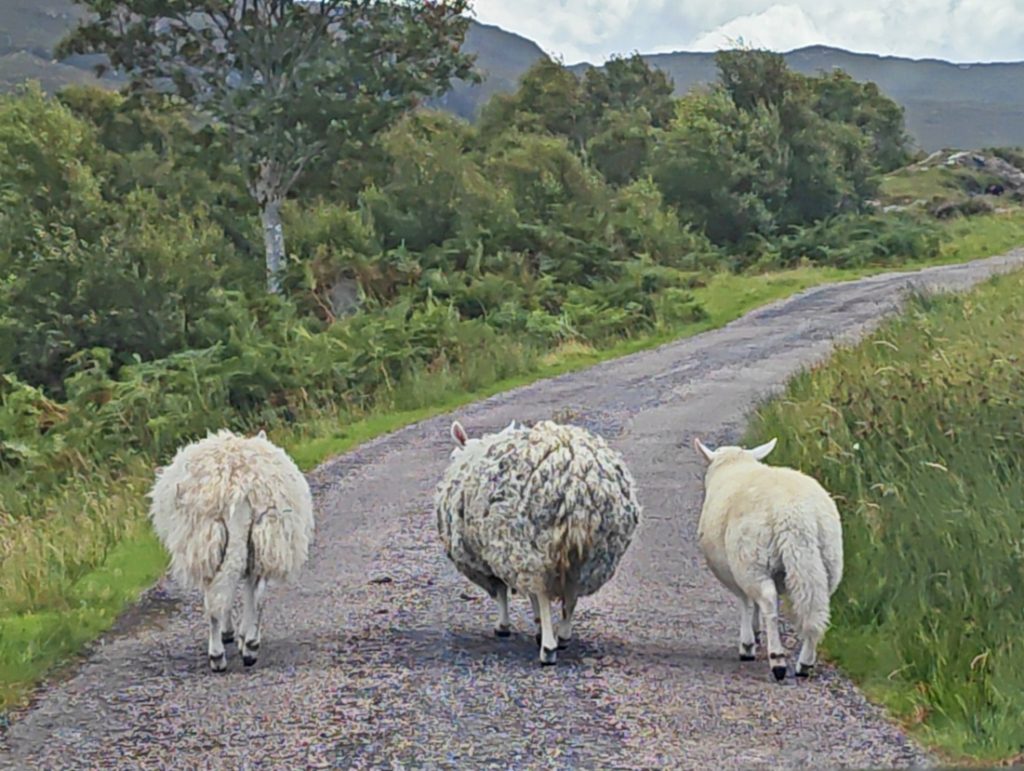
But we couldn’t stand for long as it started drizzling. We rushed to the car only to be confronted again on the way by sheep traffic . The cute plump sheep were such a delight to watch – blocking our way, absolutely unperturbed by the honking of the car horn.
Driving towards the village centre we came across the Applecross Photographic Gallery. The Applecross Gallery , housed in a former telephone exchange, exhibits landscape and wildlife images by photographer Jack Marris. We went inside and had a lovely chat with Jack ,who ,originally was from London but falling in love with Applecross and the Highlands made it his home. Though we didn’t buy anything we enjoyed the informative chat with him ,getting to know more about the place ,all with freshly ground coffee and sweeping sea views.


After our little coffee break amidst gorgeous photographs, we reached the village centre in search of food. But luck didn’t favour us as the only restaurant there was fully booked. So we just roamed around searching for interesting things . There was a cute little handicrafts shop selling marine life related handmade products.


But what I liked the most was the quaint petrol pump just outside it. In fact the Community Fuelling Station is, as its name suggests, community-run, with unmanned pumps standing ready day and night.
We spent most of our time at the Applecross Bay area. It was especially beautiful at the time, with reflections across the calm water and Skye silhouetted in the distance.
At the other end of Applecross is the Applecross Heritage Centre which offers insight into local history, crofting life and the peninsula’s past. Found this link for those who are interested to know about the Heritage Centre.

Outdoor lovers can kayak with local guides, hike the surrounding hills or cycle along the quiet coastal roads , available through local operators. While Applecross is not about strenuous hiking, there are several gentle walks that allow you to experience the land up close. Short trails near the coast and inland lochs reveal wildflowers in summer, autumn colours later in the year and ever‑changing skies overhead. On clear days, Bealach na Bà Summit Viewpoint offers sweeping views over the Inner Sound to Skye and Raasay.
Just four miles south of the village is Sands Beach, the largest beach on the peninsula. Nearby is a Mesolithic rock shelter that was occupied around 9,500 years ago, providing evidence of early human settlement in the area.
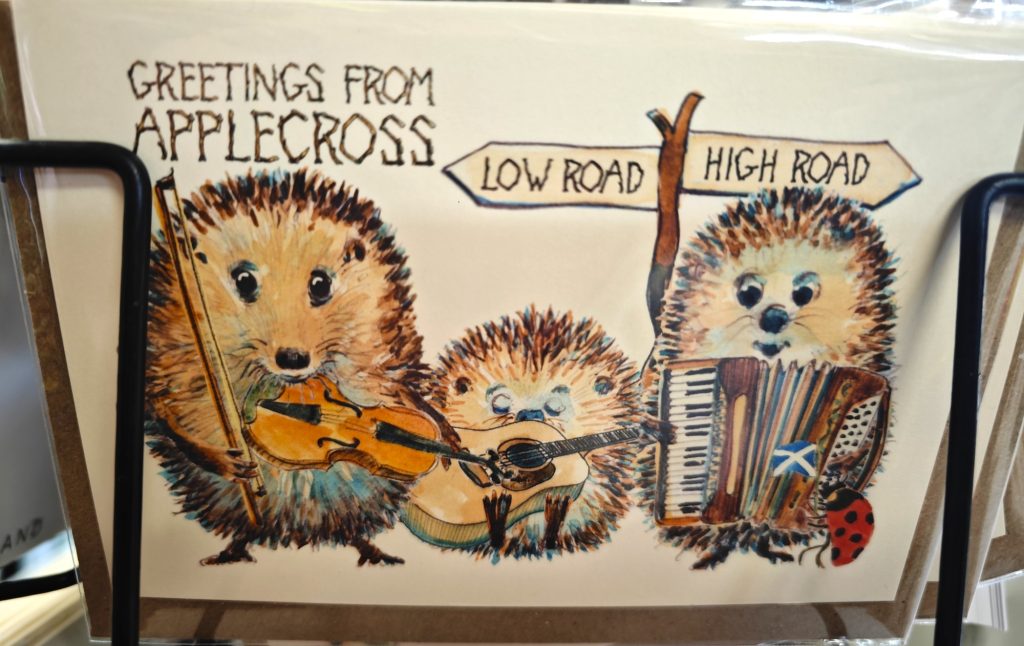
After spending some time at the Bay area we headed towards our BnB planning to explore the opposite side. On the way we stopped at the only provision store cum post office in Applecross. The tiny post office with its store which was tucked quietly along the road, felt like a living postcard. It was like experiencing quietly sustained rural life at its most. Shelves lined with everyday essentials—tins of soup, packets of biscuits, jars of sweets, and basic household supplies stood shoulder to shoulder with postcards, stamps, and neatly stacked envelopes ; the place carried the comforting scent of paper, groceries, and wood.

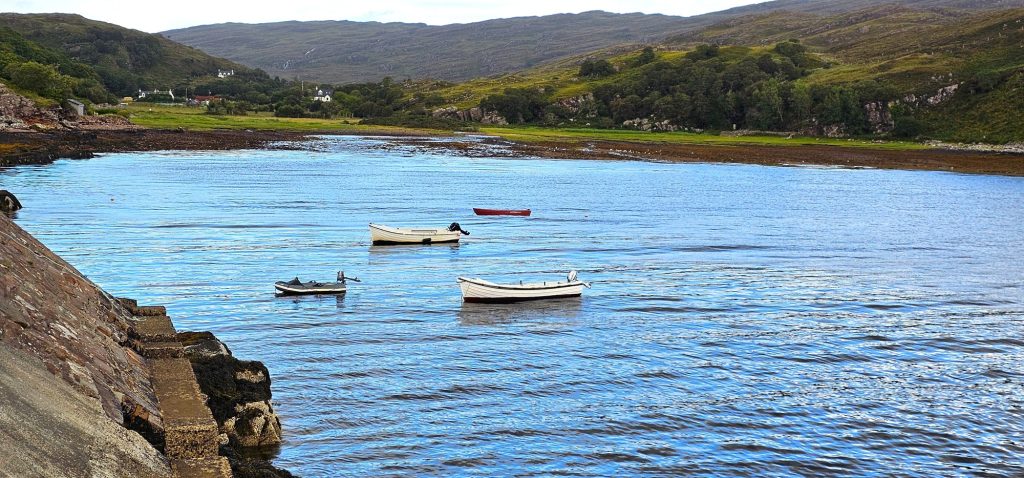
Further from the BnB we came across another cove. Gone were the choppy waters of the sea. Here the waters were absolutely still and for the first time there was no wind or rain to be bothered by. But what we experienced for the first time on our trip were midges ; nasty mosquito-like insects notorious for their sharp ,prickly bite !
Applecross for us was not a place to tick off our bucket list. It was a place to savour slowly without any rush or plan , and that’s the way it should be done – take your time, drive carefully, stop often, and talk to the locals. Carry essentials, don’t rush the route, and let the landscapes and quiet moments shape the experience.


