Where is d’Orsay?
Our next venture was the Musee d’Orsay.
Musee D’Orsay was a formidable task after visiting the whole of the Louvre. But we had to since both are literally next to each other on the opposite banks of the Seine and there was almost zero chance of coming to the same place a second day.
We still had to cover Palace of Versaille on one side of Paris and Monmatre on another side.
If visiting the Louvre was an aggressive marathon , running through endless corridors and steps ,dodging throngs of visitors for a glimpse of the never-ending artifacts there then d’Orsay was a cosy walk-through, admiring brilliantly coloured Impressionist paintings up close without fighting through an arena and actually finishing the museum in time for tea. What a contrast !
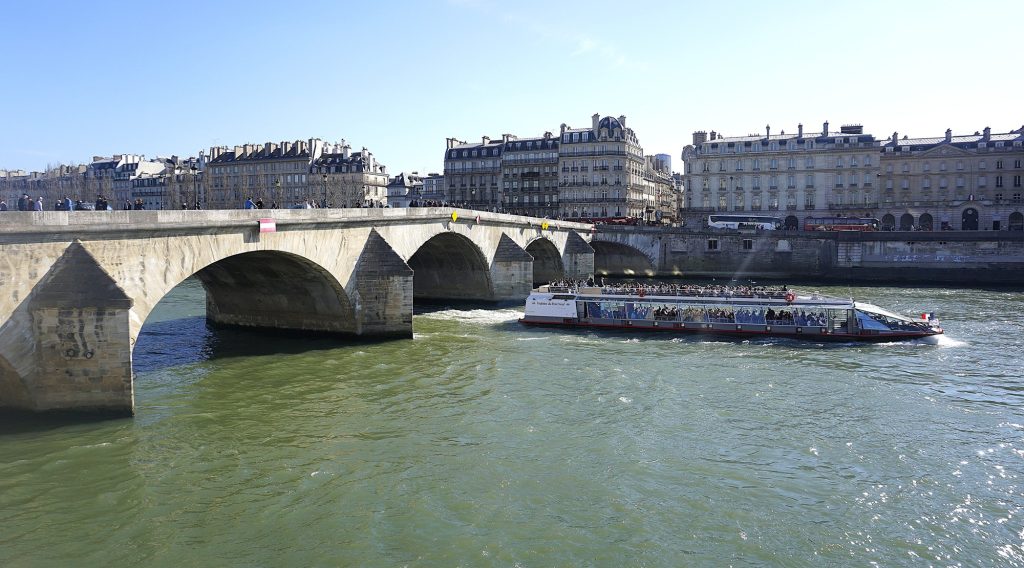
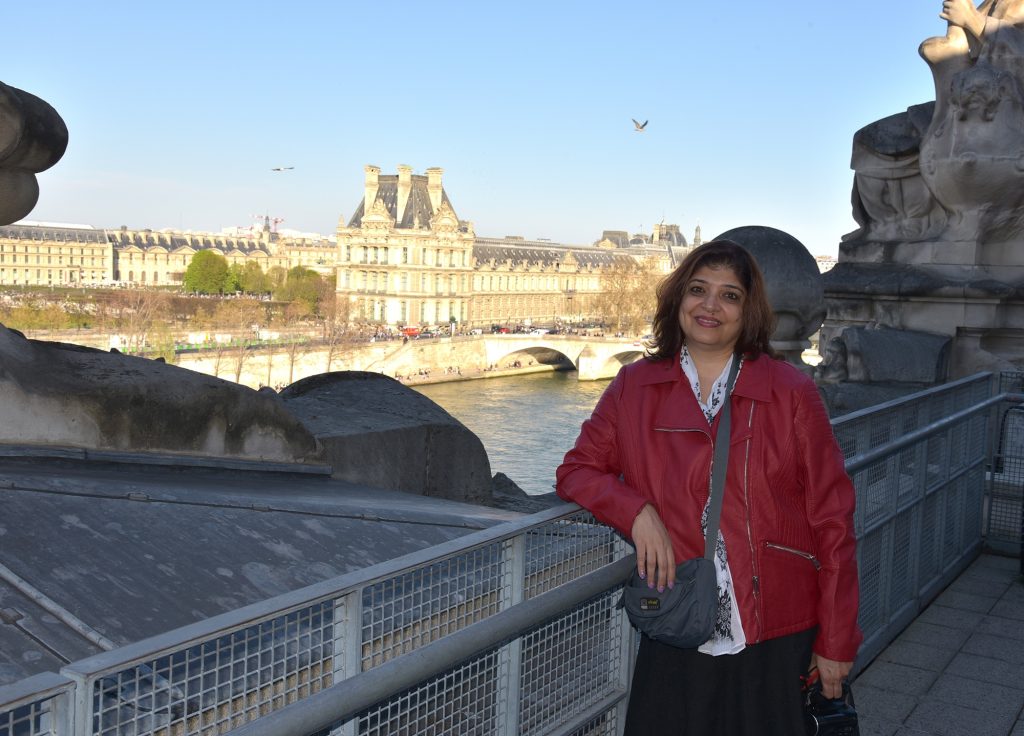
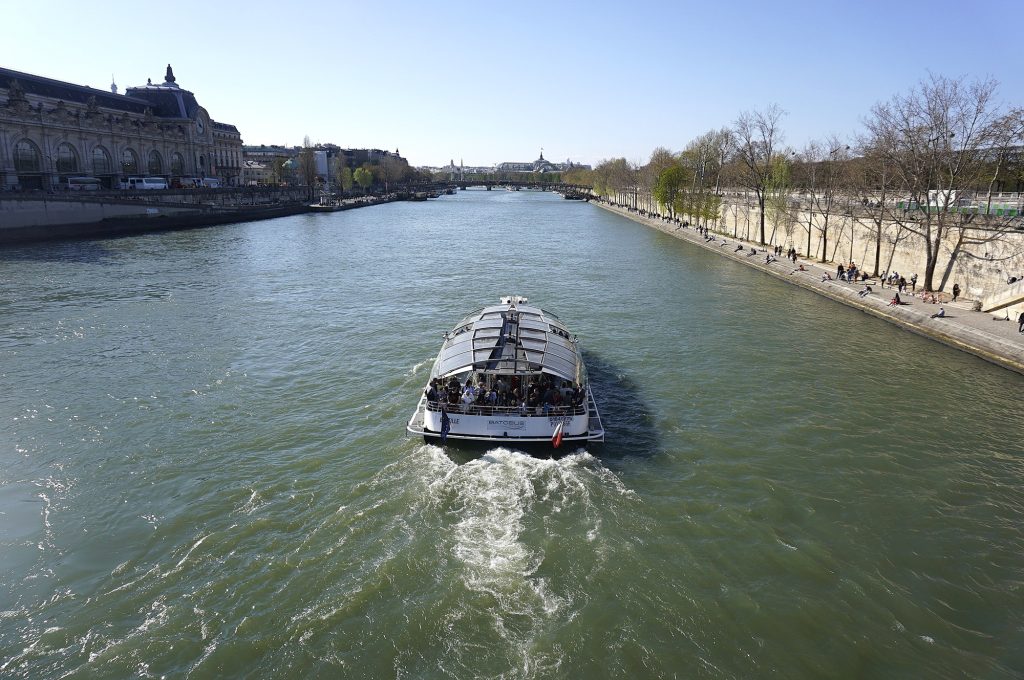
But before entering we took some time enjoying the view of the Seine. Located directly across from each other, the two museums are connected by a brief, scenic walk. The stretch of the Seine between the Louvre on the Right Bank and the Musee d’Orsay on the Left Bank is one of the most picturesque riverfronts in Paris. Connecting the two sites directly is the Pont Royal , the third-oldest standing bridge in Paris after Pont Neuf and Pont Marie.
The Tuileries Garden on the right bank of the Seine ,adjacent to the Louvre , offered wide gravel paths, manicured lime trees, statues and classic green metal chairs surrounding large fountains. Below the gardens along the water, the Parc Rives de Seine, there is a tree-lined, pedestrianized promenade filled with cafes, pop-up seating and open space for walking or biking.
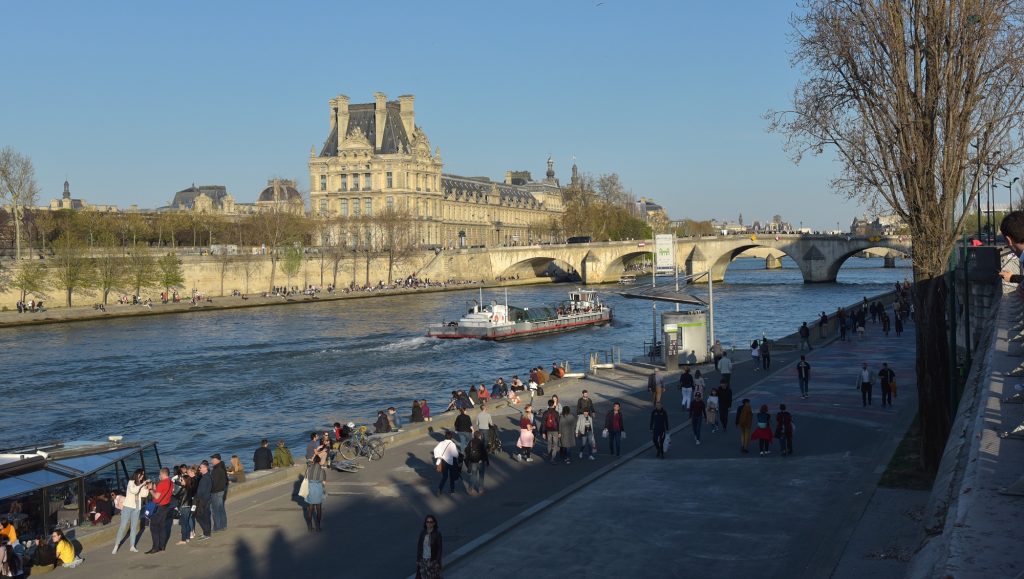
D’Orsay rests directly along the Quai Valery-Giscard-d’Estaing, a part of the longer Quai Anatole France on the left bank of the Seine. Just like the right bank, the Orsay side is also completely pedestrianized, lined with stone embankments where locals and visitors sit by the water’s edge. The vibe along this short stretch is relaxed and open.
Antiquarian secondhand booksellers called Bouquinistes lined the upper stone parapets on the Left Bank selling vintage prints, used books, and art . These booksellers operate out of iconic dark-green stalls made of wooden boxes mounted along the stone parapets on both banks of the Seine all over Paris. The lower riverbank hosted street musicians and people enjoyed picnics by the water.
Roaming around on the streets of Paris brought memories of so many movies-Midnight in Paris, Amelie and The Da Vinci Code.
Origins of Musee d’Orsay
Previously Musee d’Orsay used to be the Gare d’Orsay, a Beaux-Arts railway station built between 1898 and 1900. It was the terminus for the railways of southwestern France until 1939.
By 1939 the station’s short platforms had become unsuitable for the longer trains that had come to be used for mainline services . So instead of shutting down and demolishing the building for good, the Directorate of the Museum of France suggested to turn the station into a museum .
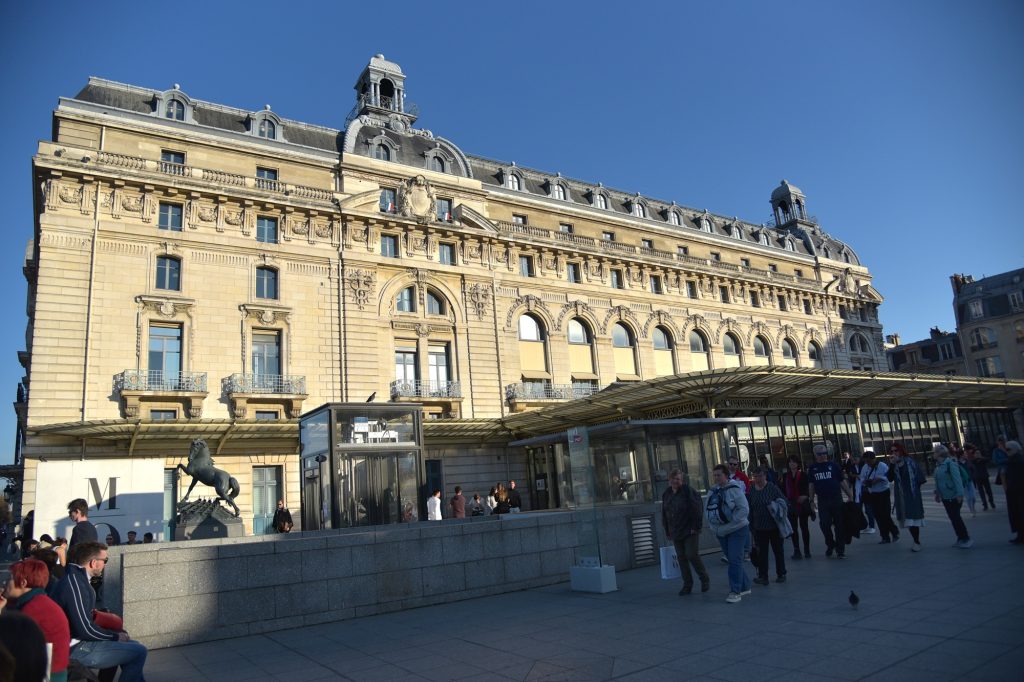
The idea was to build a museum that would bridge the gap between the Louvre, which displays art and artefacts from around 4000 BC up to 1848 and the Pompidou Centre which displays art from 1905 to the present day. Designed by architect Victor Laloux, the plan was accepted by Georges Pompidou who commissioned it in 1974 and the museum was ready for the public by 1986. Bridging the gap, the Orsay Museum holds mainly European art dating from 1848 to 1914, including paintings, sculptures, furniture, and photography.
The collections in d’Orsay
D’Orsay houses the largest collection of Impressionist and Post-Impressionist masterpieces in the world, by painters including Monet, Manet, Degas, Renoir, Cézanne, Seurat, Sisley, Pissaro, Rousseau, Gauguin and our favourite ,Van Gogh.
Major sculptors represented in the collection include Alfred Barye, Francois Rude, Jules Cavelier, Jean-Baptiste Carpeaux, Emile-Coriolan Guillemin, Auguste Rodin, Paul Gauguin, Camille Claudel, Sarah Bernhardt and Honore Daumier.
Of course apart from Rodin I hardly knew any of the sculptors but seeing Rodin’s work among them was enough for me.
The Interior of the Museum
The queue to enter Musee d’Orsay was relatively short ,maybe because it was already late afternoon and the crowd had seen whatever they had to see in the first half of the day.
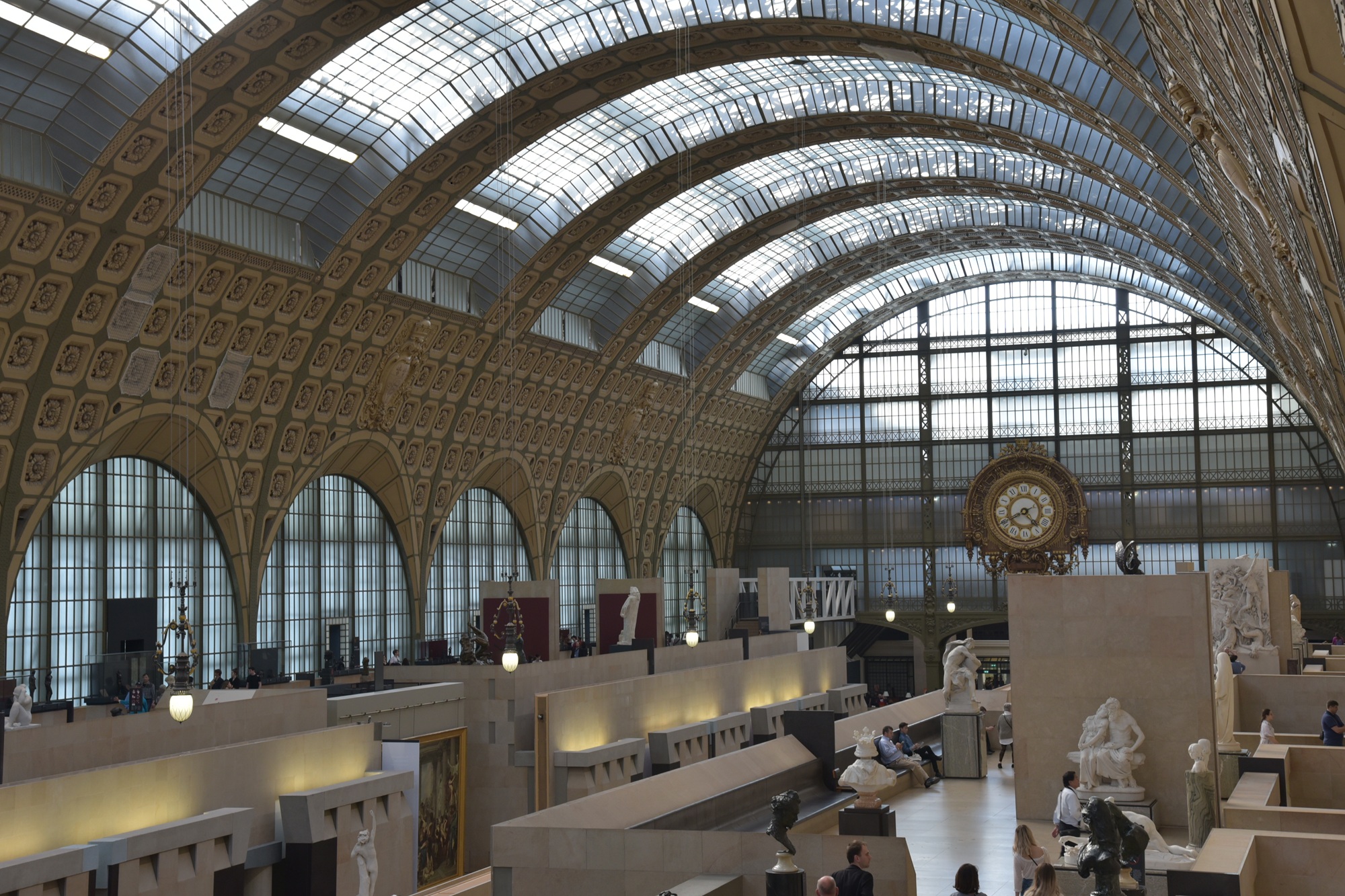
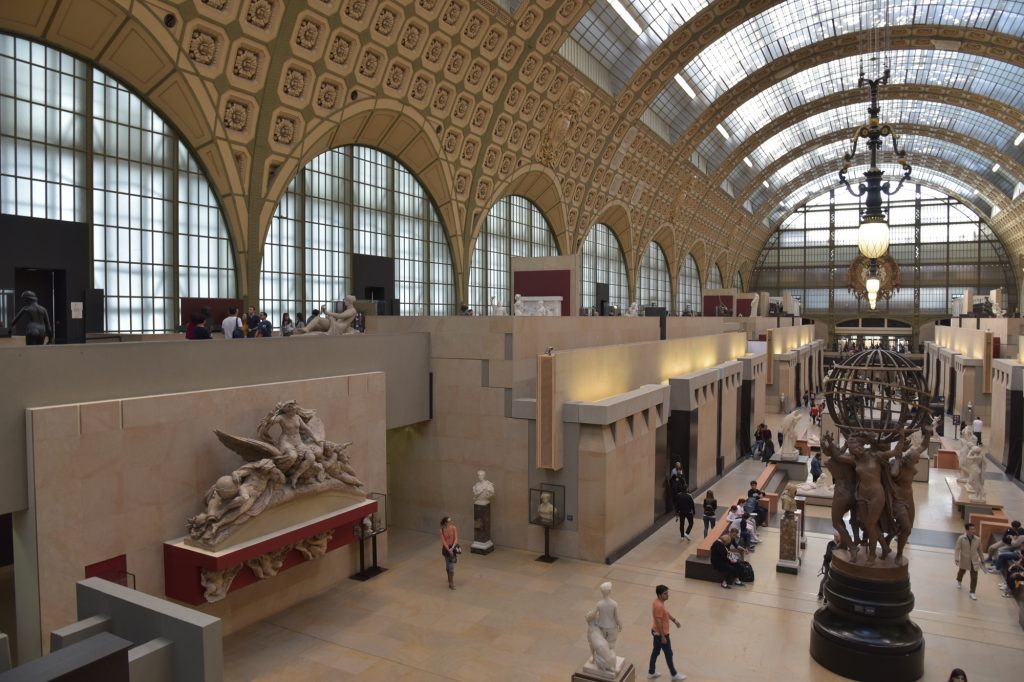
Since the building was a long stretch of platform which could be taken in at one glance it seemed easy to navigate. The interior of the museum is especially beautiful because you can still sense that it was once a train station rather than a purposefully built museum. It feels more monumental and open than a conventional palace-style museum.
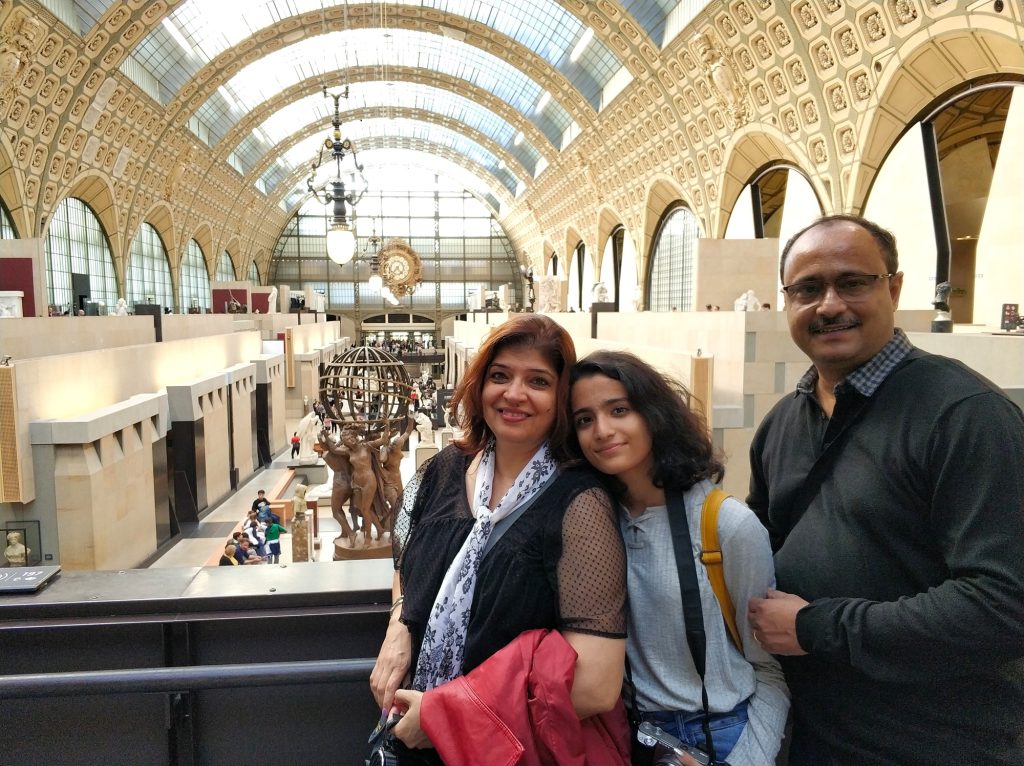
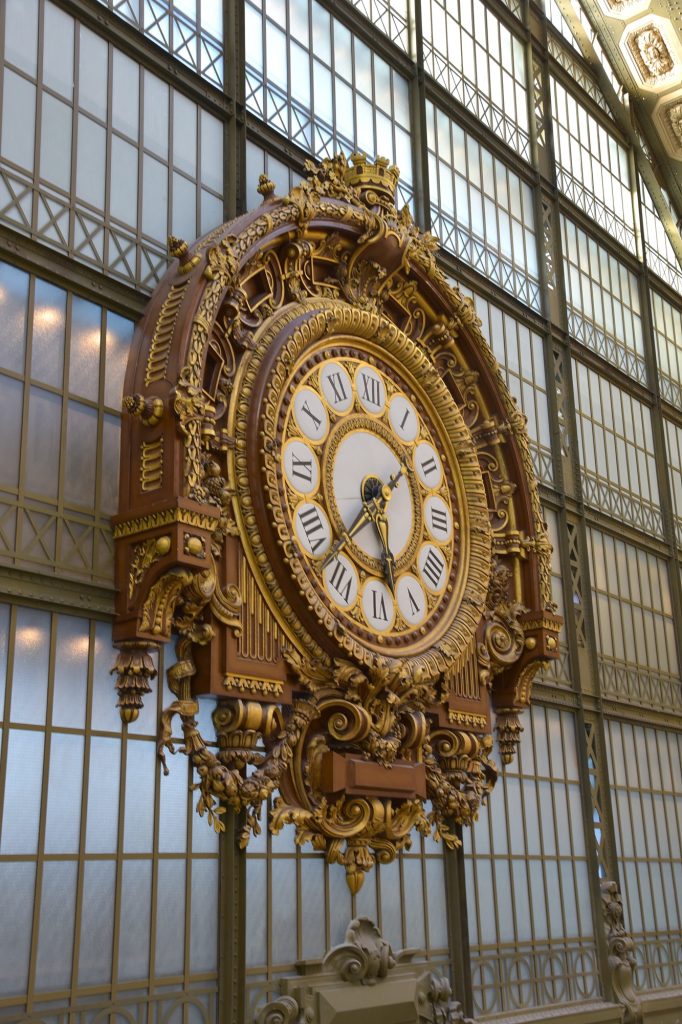
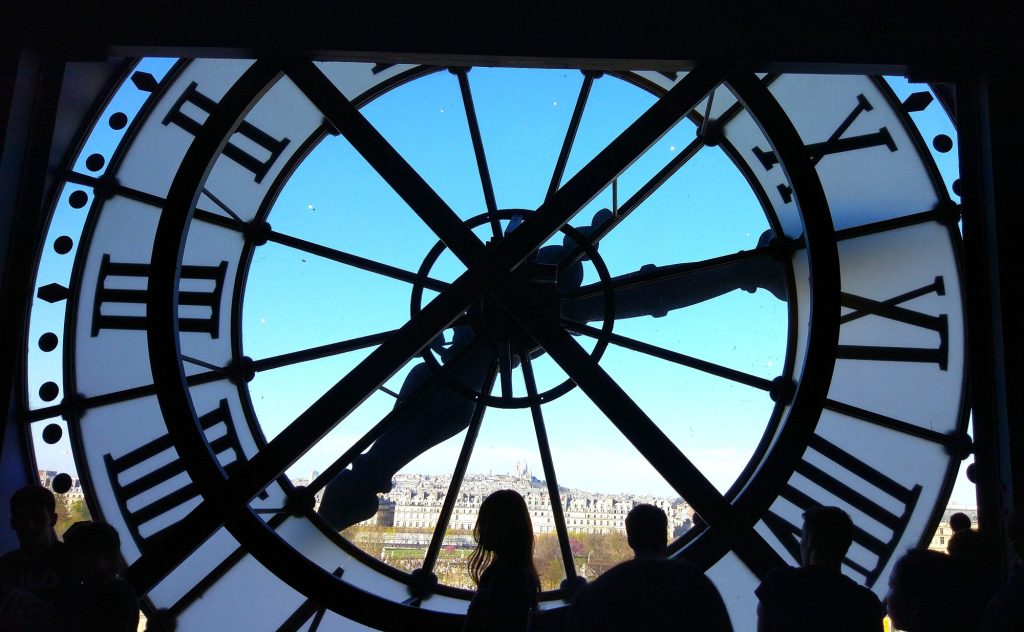
The most striking feature inside the Orsay is the enormous former train-station hall, with a long, high, barrel-vaulted ceiling and a spacious central axis. A massive 138 metre long iron and glass roof floods the central nave with natural light. At one end is the famous giant clock, one of the museum’s most recognizable interior features. It looks out over Paris and creates a dramatic focal point. The architecture combines pale stone walls with the station’s original metal structural elements, giving the interior a mixture of Beaux-Arts elegance and industrial railway architecture. Ornate stone arches and classical motifs hide the industrial steel structure inside.
The main collection is arranged along spacious galleries and levels, with paintings and sculptures displayed against relatively restrained walls so the artworks remain the focus. Large sculptures are displayed in the central areas, making the former railway hall feel almost like a colossal indoor avenue.
Van Gogh and Gauguin : the Post-Impressionists
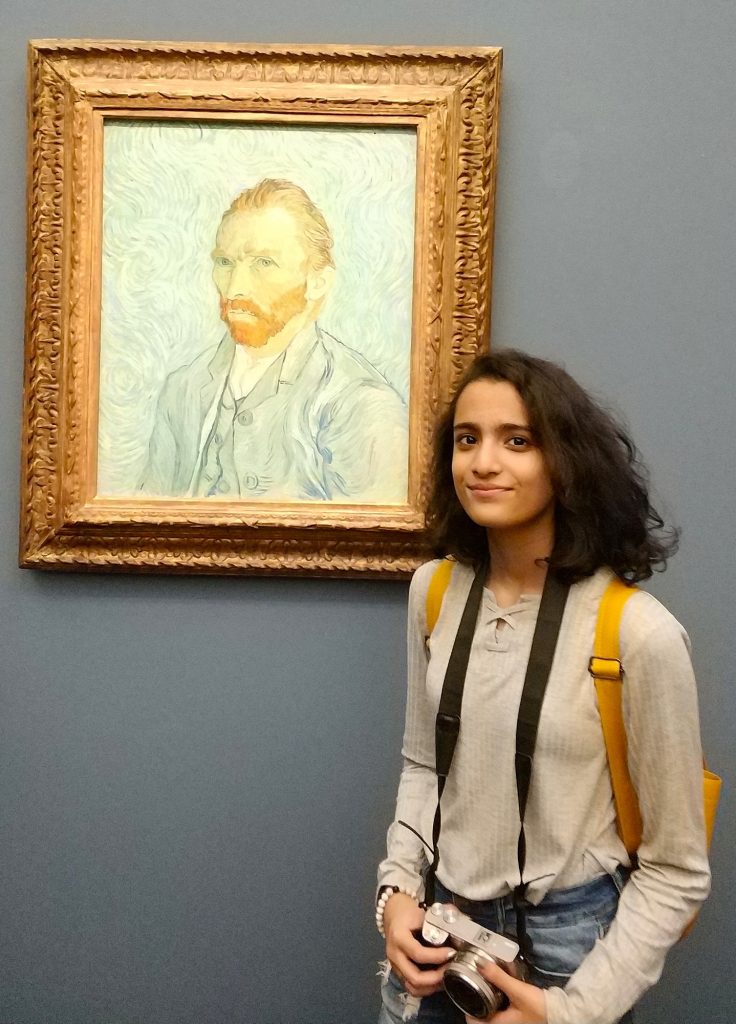
First we bee -lined for Vincent Van Gogh and Paul Gauguin’s work. That is what comes first after you enter the museum. And what a collection it was ! We all three being huge Van Gogh fans went gaga over his vast collection, marveling at his Self Portrait, the Church at Auvers ,Bedroom at Arles and many more of his superlative work ! What a feeling of deja vu we had ; I can still feel the goosebumps!! Seeing Van Gogh’s paintings made us feel more elated than witnessing Da Vinci’s Mona Lisa !
For Titir and me, the paintings inevitably brought back memories of the famous Doctor Who episode about Van Gogh, while I found myself thinking especially of Irving Stone’s unforgettable novel Lust for Life, which had brought the artist’s turbulent life so vividly to my imagination.
Just a footnote here(not related to Van Gogh) since I’m talking about Irving Stone ; just like Van Gogh , Michelangelo’s masterpieces in the Louvre had evoked a seemingly similar literary association for me: Irving Stone’s The Agony and the Ecstasy, his biographical novel on the famous artist.
It was fascinating how the paintings before us seemed to open doors not only to the lives of the artists, but also to the books, stories and memories that had shaped our own ways of seeing them.
Call it obsession or whatever you want to but its difficult for me to resist from going into my two bits on the magnificent Post -impressionist paintings displayed in the Orsay -specially about Vincent Van Gogh.
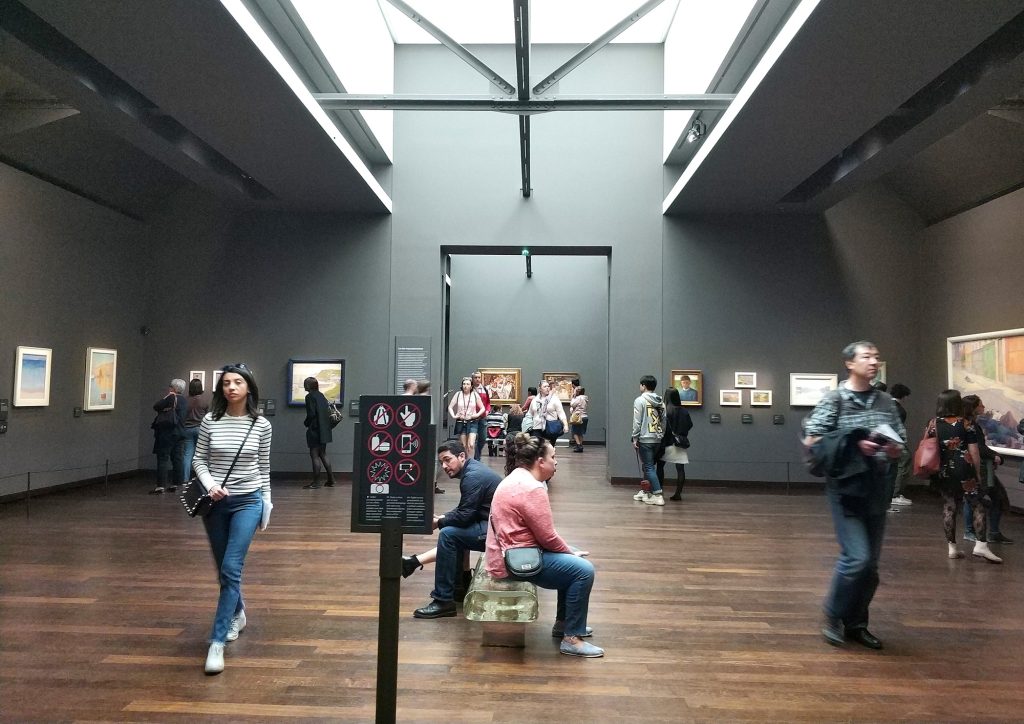
Vincent van Gogh was a Dutch Post-Impressionist painter whose works revolutionized modern painting. Its hard to believe that he sold only a handful of his paintings during his lifetime. But has he created nearly 2,100 artworks characterized by bold colors, dramatic impasto texture and expressive brushwork which are celebrated worldwide for their raw beauty and intense psychological depth. Here’s some details about a few of his paintings:
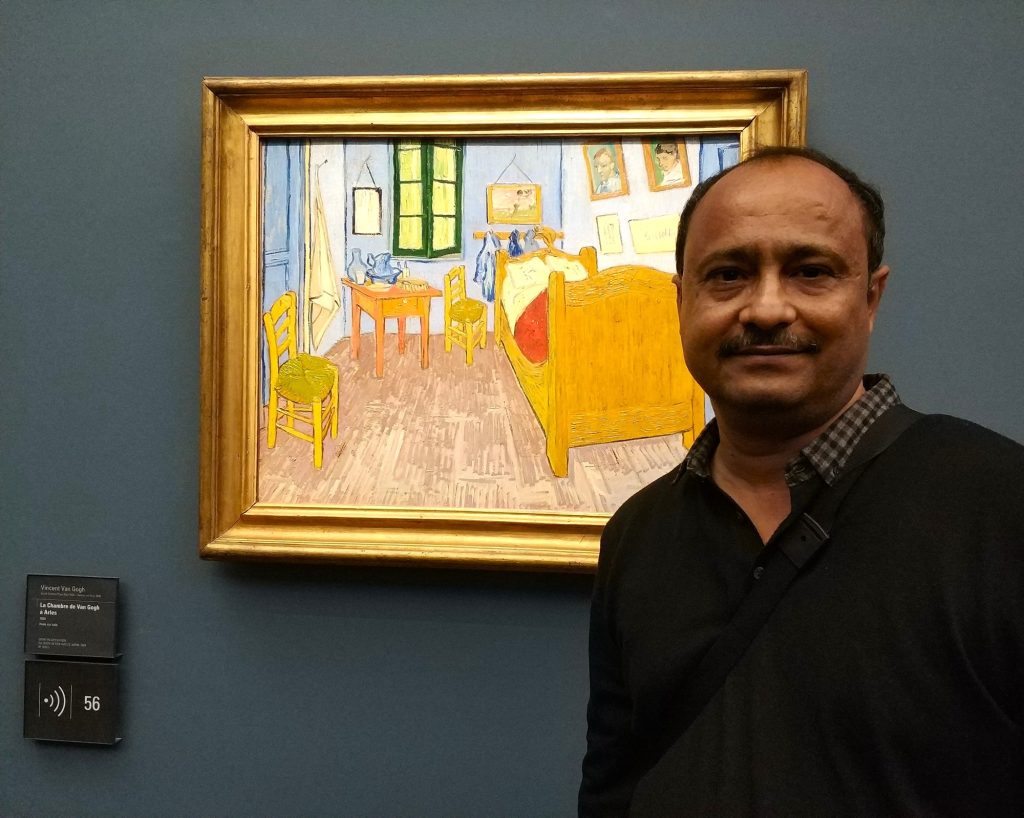
Bedroom at Arles
Seeking to escape Paris and build an artists’ colony, Van Gogh moved to Arles in 1888 and rented the Yellow House. He carefully furnished his bedroom with simple pine pieces, eager to welcome Paul Gauguin to join his new community.
And this is where he drew this painting, the Bedroom at Arles or La Chambre à Arles. Rather than copying exact real-world colors, Van Gogh deliberately used bold, contrasting color pairings – yellow against blue, red against green – to convey emotional weight and feeling.
The unusually steep angle of the floorboards and skewed furniture were partly due to the irregular, non-square geometry of the actual room in the Yellow House, but Van Gogh exaggerated these angles to give the room an intimate, enclosed atmosphere.The uncluttered arrangement and closed space were meant to evoke a sense of safety and calm.
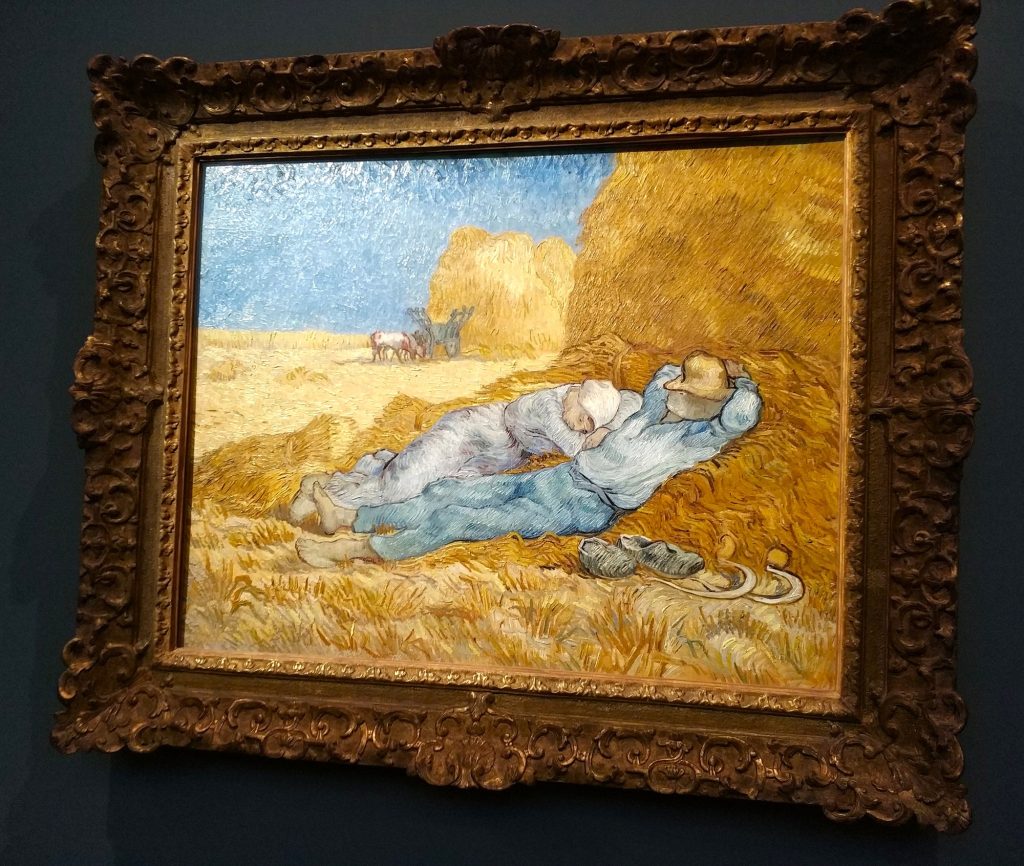
Siesta
Painted while confined at the Saint-Rémy asylum, Van Gogh created The Siesta as a colorful reimagining of a black and white woodcut by his idol, Jean-François Millet. He transformed the tranquil scene of two resting farmworkers into a vibrant masterpiece, balancing warm yellows against cool blue shadows through thick, energetic impasto. For Van Gogh, reinterpreting Millet’s work through his own bold color palette provided deep comfort and artistic renewal during a turbulent period.
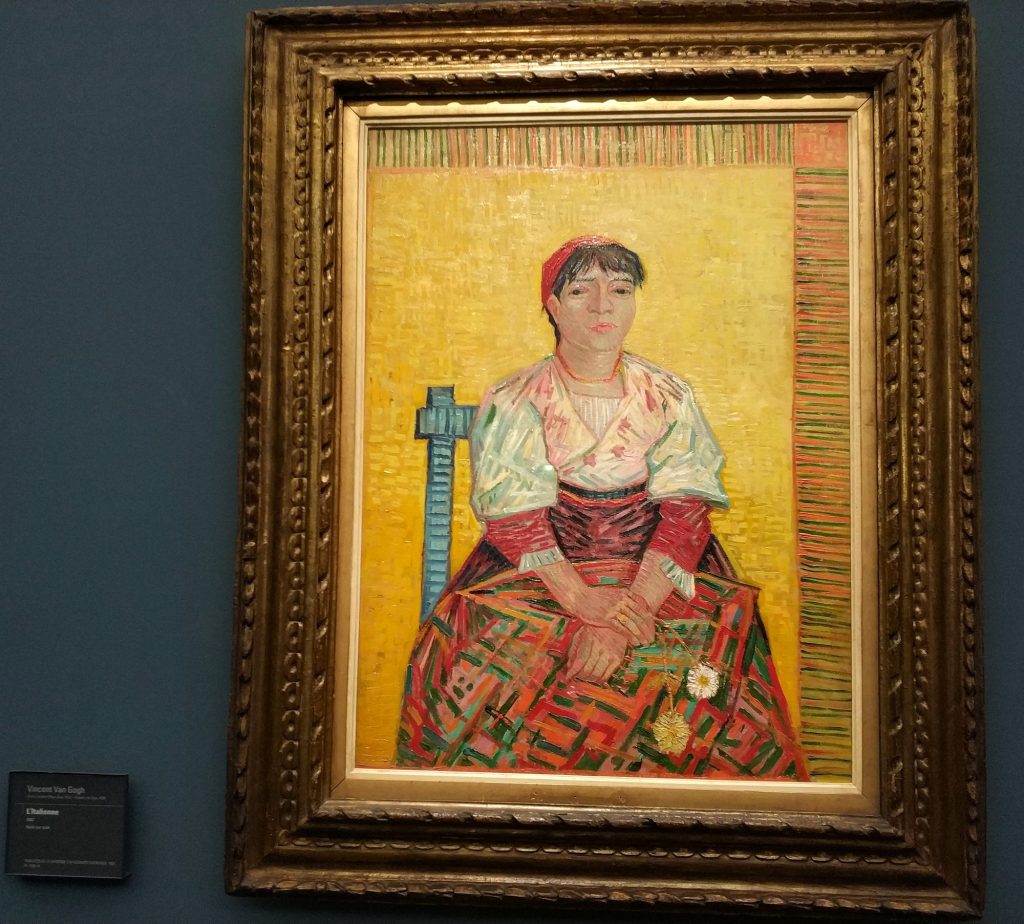
The Italian Woman
Painted in Paris in late 1887, The Italian Woman depicts Agostina Segatori, the café owner and former artists’ model with whom Van Gogh had a brief romance. What struck me most was the way Van Gogh seems to bring together influences that, at first, might appear rather unlikely. The flattened perspective and decorative border recall the Japanese woodblock prints he admired – Katsushika Hokusai’s The Great Wave off Kanagawa being perhaps the most familiar example – while the complementary colours and crisscrossed hatching reflect the influence of Neo-Impressionism.
The result is anything but a conventional portrait. The vivid colours and almost deliberately stylised outlines make Agostina seem to emerge from the canvas with a presence that is both striking and slightly unsettling. Looking at it, I found myself noticing less the woman being portrayed and more Van Gogh’s restless attempt to see , and reinvent, the world around him.
The Church at Auvers
Painted in June 1890 shortly before his death, The Church at Auvers depicts a 13th-century Gothic church north of Paris in dramatic Post-Impressionist style. Van Gogh used distorted, undulating architectural lines and a striking contrast between bright grass and a deep, twilight-blue sky to give the heavy stone structure a fluid, unsettling energy. A solitary peasant woman walking along a splitting path in the foreground adds a poignant sense of human isolation to the scene.
But this painting will give goosebumps to anyone who has seen the brilliant Doctor Who episode Vincent and the Doctor. The Church at Auvers becomes an important part of the story when the Doctor spots an alien creature hidden in one of the church windows at the Musée d’Orsay. That discovery sends the Doctor and Amy back to Auvers-sur-Oise in 1890, where they join Van Gogh in trying to confront the creature lurking around the church.
But for me, the real magic of the episode comes at the end. The Doctor and Amy bring Vincent into the future and show him just how deeply his work is admired around the world. Watching his reaction to seeing his paintings celebrated , and finally hearing someone tell him how extraordinary he was , is heartbreaking. Knowing what we know about Van Gogh’s life makes the scene even more moving. And standing in front of The Church at Auvers, I couldn’t help thinking of that episode.
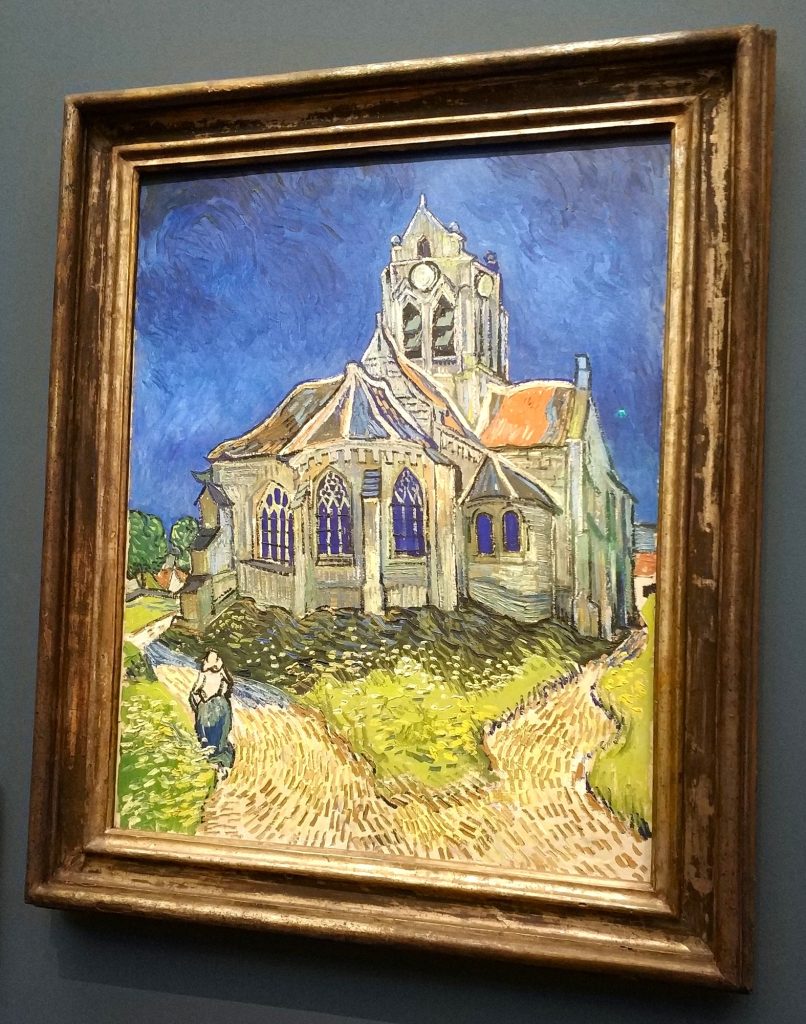
Thatched Cottages at Cordeville
Painted in May 1890 shortly after Van Gogh arrived in Auvers-sur-Oise, Thatched Cottages at Cordeville captures rustic homes that reminded him of his Dutch roots. Through thick impasto and a cool palette of greens and soft blues, Van Gogh transformed the quiet rural landscape into a surging, dynamic composition where thatched roofs undulate, trees branches swirl like flames and clouds swirl across the sky in expressive, turbulent patterns.
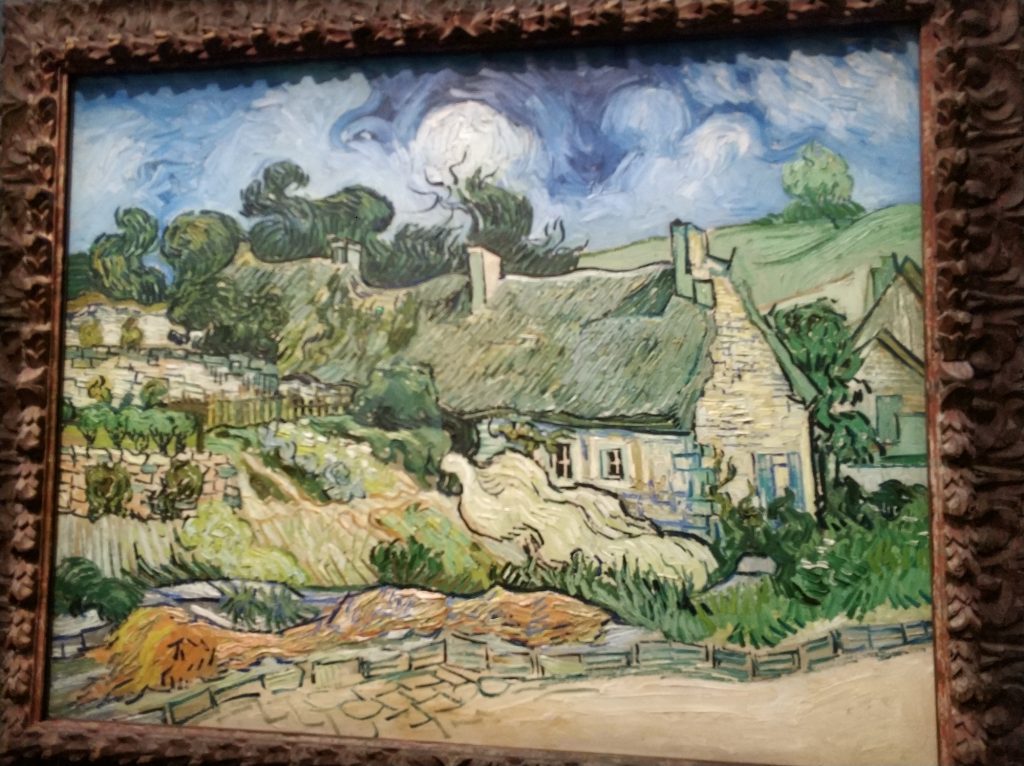
Imperial Fritillaries in a Copper Vase
Painted in Paris in spring 1887, Imperial Fritillaries in a Copper Vase showcases Van Gogh experimenting with Neo-Impressionist Pointillism, using rhythmic dashes of complementary blues and oranges to make the bouquet shimmer.
Neo-Impressionist Pointillism is a scientific technique developed by Georges Seurat in the 1880s where artists paint meticulously with small, distinct dots or dashes of pure color side by side. Instead of pre-mixing paint on a palette, the colors are left to blend inside the viewer’s brain , creating a shimmering, luminous effect that brings systematic order to the chaos of Impressionism.
This painting is also a vital precursor to his famous Sunflowers series. Van Gogh signed this piece ‘Vincent’ in the top left corner. Out of his roughly 900 oil paintings, he signed only about 130, indicating he considered this a particularly completed, high quality work ready for display or sale.
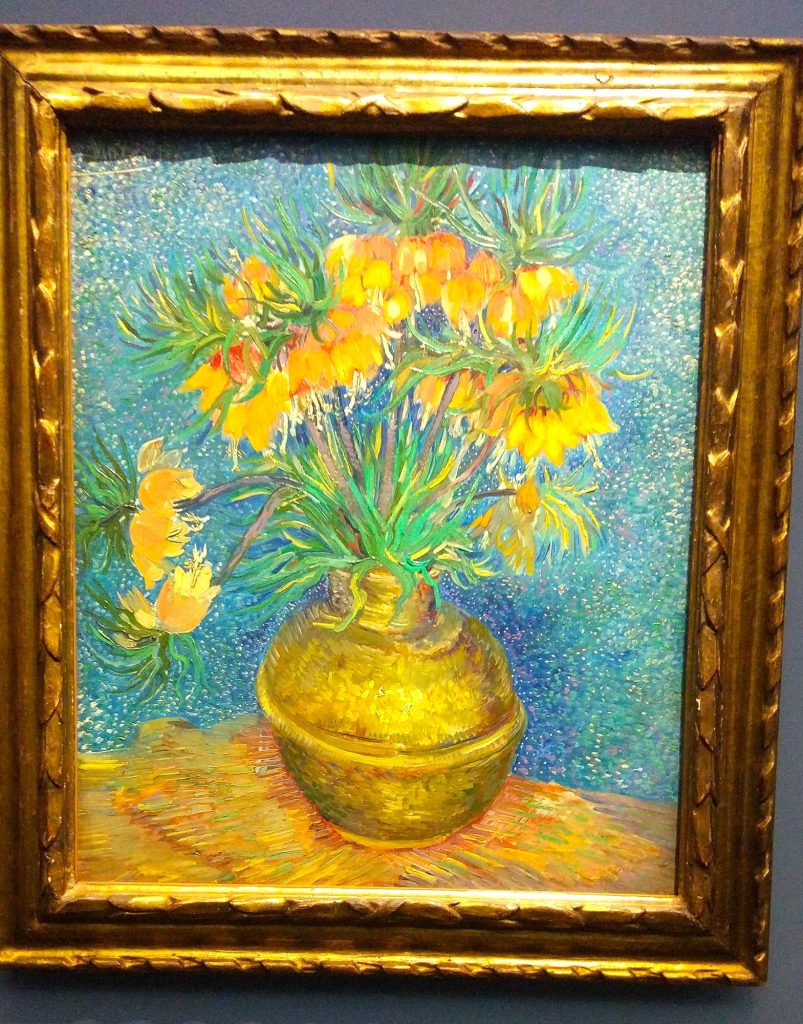
There were so many more paintings of Van Gogh – Starry Night Over the Rhone, Portrait of Dr. Gachet, The Dance Hall in Arles, In the Garden of Doctor Paul Gachet and Mademoiselle Gachet in her Garden, Caravan: Gypsy Camp Near Arles, Roses and Anemones. In spite of the room being pretty crowded we spent our time in front of them to our hearts’ content.
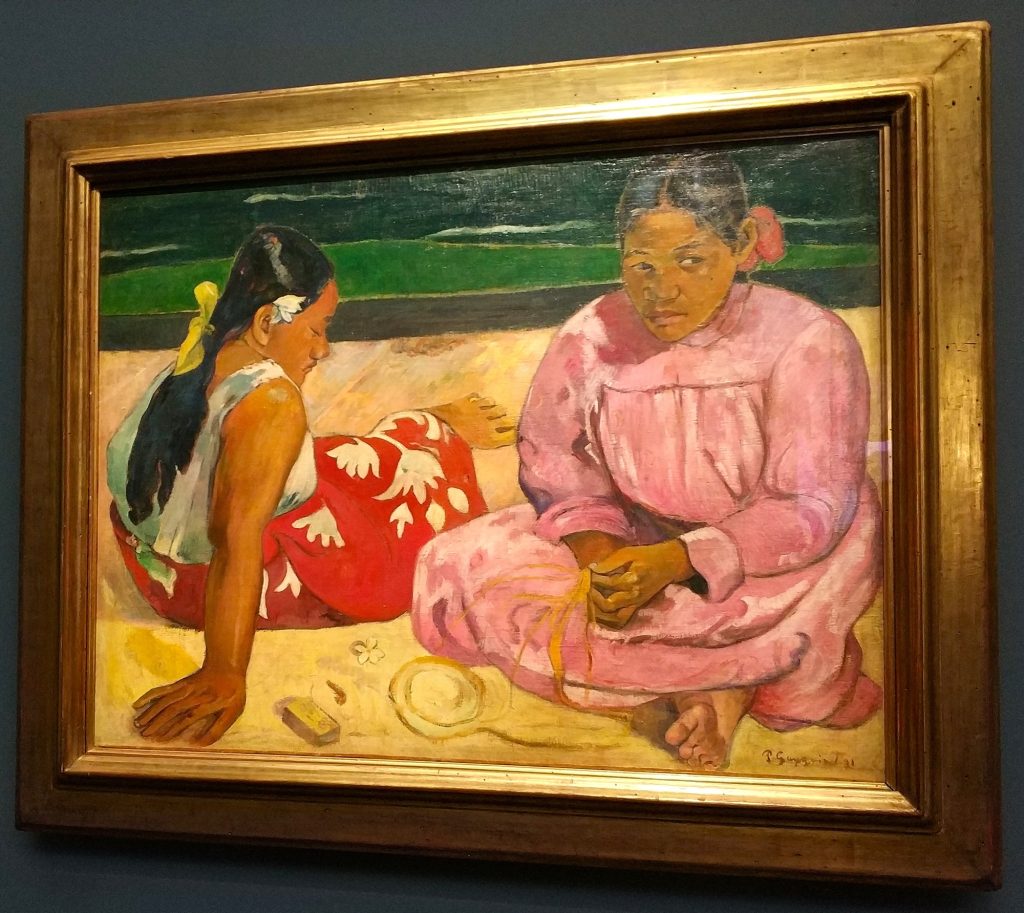
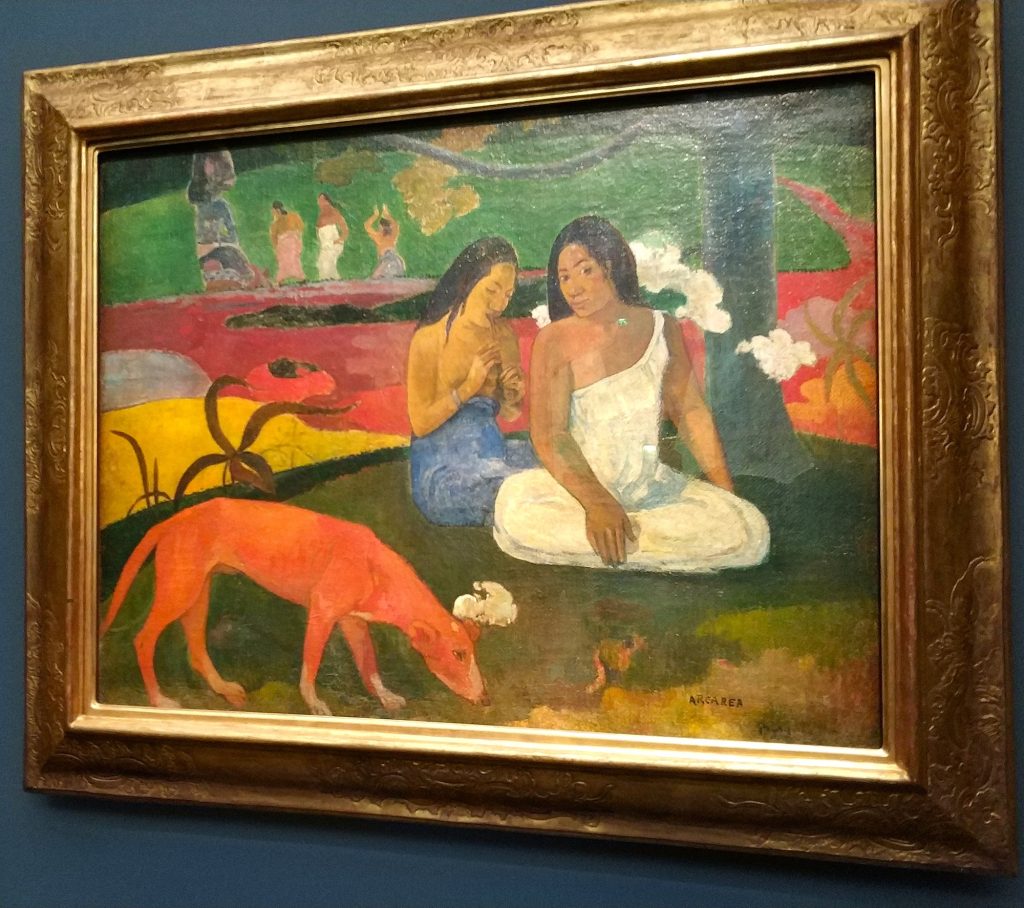
Then there were Gauguin’s works. All those simple Tahitian beauties-another deja vu moment from ‘Lust for Life‘, as well as Woody Allen’s famous movie ‘Midnight in Paris‘.
The painting below is called Et l’or de leur corps or And the Gold of Their Bodies. Painted shortly after Gauguin moved to the Marquesas Islands in French Polynesia, the work depicts two Polynesian women resting on a violet-colored ground set against a background of lush, tropical foliage. The work celebrates the warm, golden skin tones of the two women using his signature Synthetist style of bold, simplified contours and flat, harmonious colors.
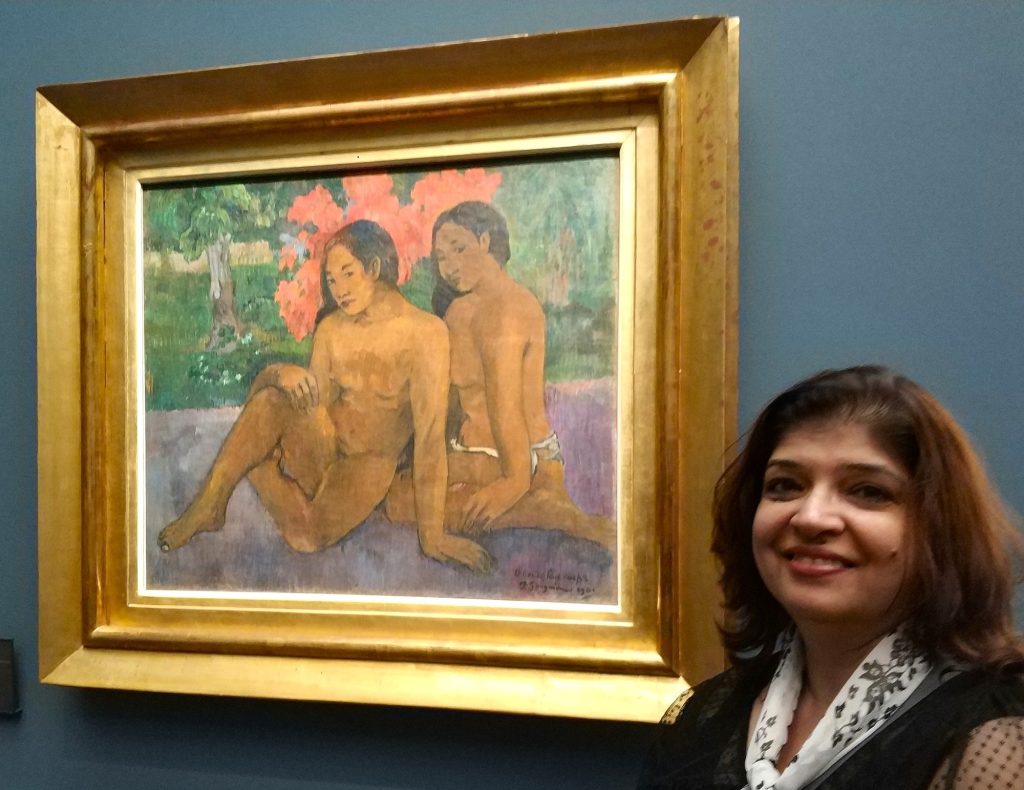
Paul Gauguin was a French Post-Impressionist who abandoned his career as a Parisian stockbroker to pursue a radical, primitive art form. He broke away from naturalistic painting by using bold outlines, flat planes of non-naturalistic color and deep symbolism – most famously captured in his vivid portrayals of Tahitian life. His experimental style (known as Synthetism) rejected visual realism in favor of emotional truth, profoundly influencing 20th-century movements like Fauvism and Cubism.
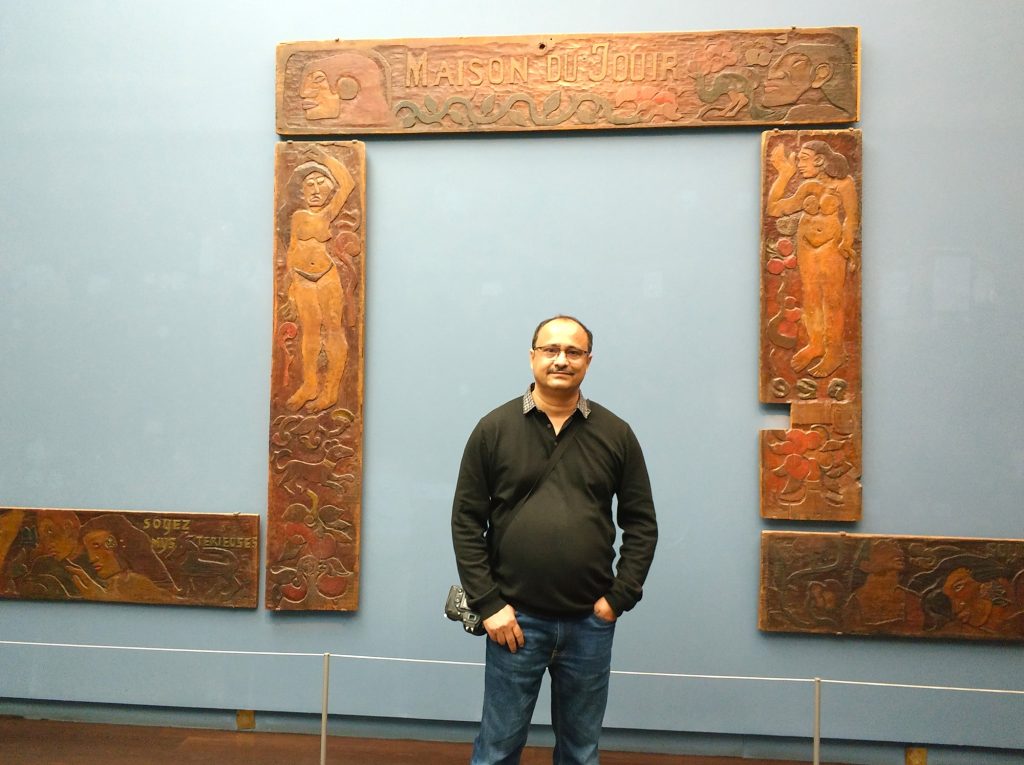
Synthetism – pioneered by Paul Gauguin – merged an artist’s inner emotions with simplified outward forms instead of copying nature directly. Working from memory, artists combined bold dark outlines, flattened shapes and vivid, unshaded color to create paintings that prioritized symbolic meaning over visual realism.
Led by Matisse, Fauvism liberated color from reality, using wild, unmixed hues and energetic brushwork to convey raw emotion.
Cubism, pioneered by Picasso and Braque, dismantled traditional perspective by shattering subjects into geometric planes and displaying multiple viewpoints at once.
Together, they replaced classical realism with bold emotional expression and structural abstract work.
The sculptures
Easy to navigate, we spent the next half hour in the huge hall and went through all the sculptures. We had originally included the Rodin Museum in our trip but had to exclude it due to lack of time but seeing so many works of Rodin at d’Orsay compensated for that loss.
With a major part of our interests ,Van Gogh and Gauguin, done , we actually stood in front of the sculptures to read about them.
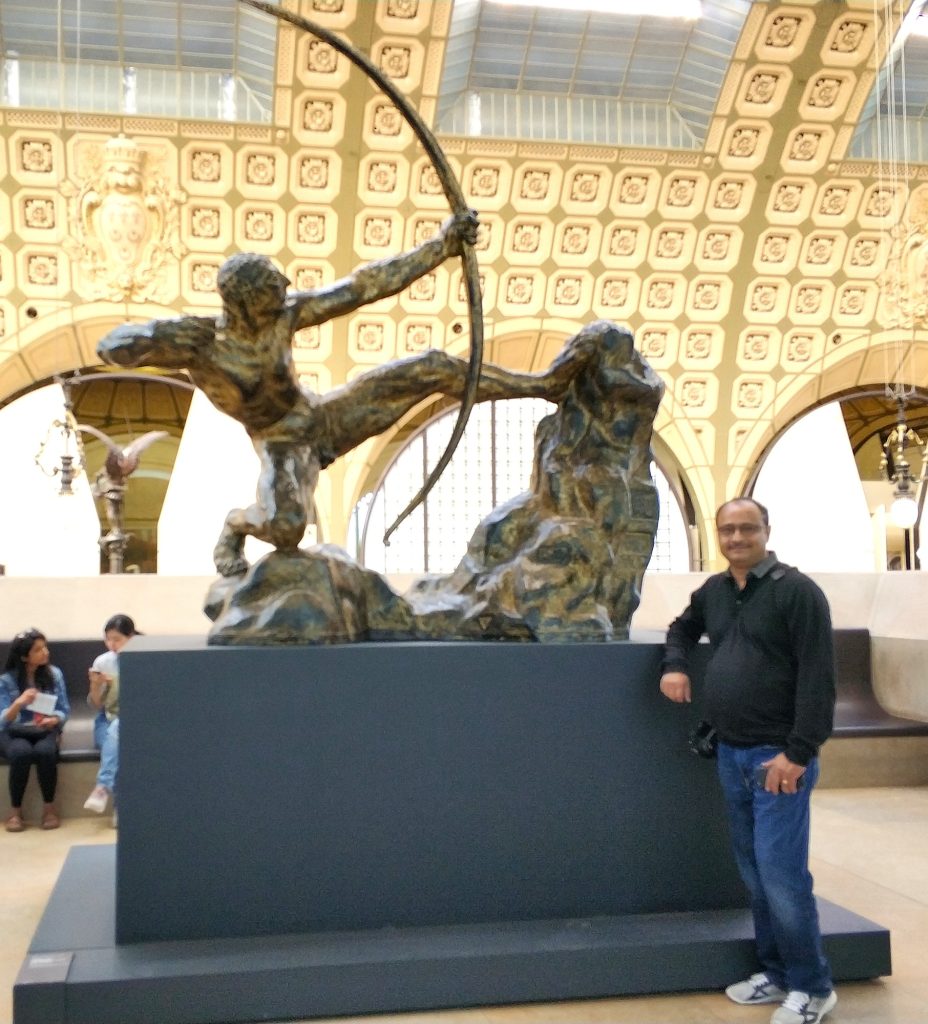
The first one you see after leaving the room of paintings by Gauguin and Van Gogh is Hercules the Archer made by Rodin’s assistant , Emile-Antoine Bourdelle. Such a magnificent statue it was with its dark bronze colour and brown streaks ! Created in 1909 , Hercules the Archer depicts the mythological hero slaying the Stymphalian birds using dynamic geometric tension inspired by Archaic Greek art. Posed by a French cavalry officer, this iconic bronze sculpture marked Bourdelle‘s break from his mentor Rodin .
Jean-Baptiste Carpeaux
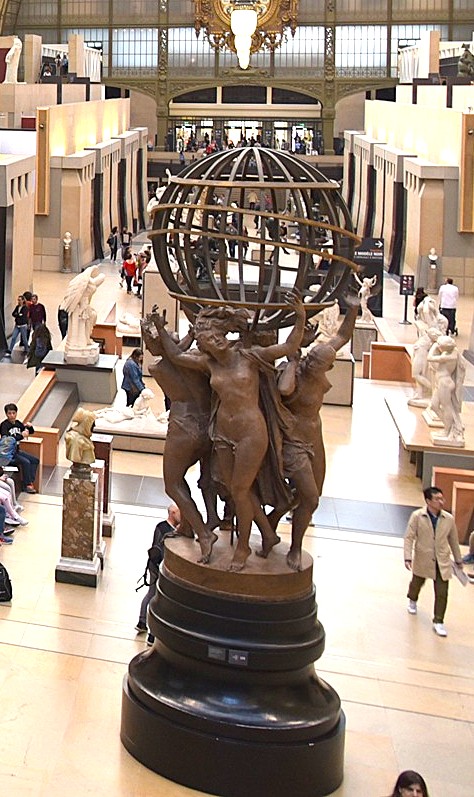
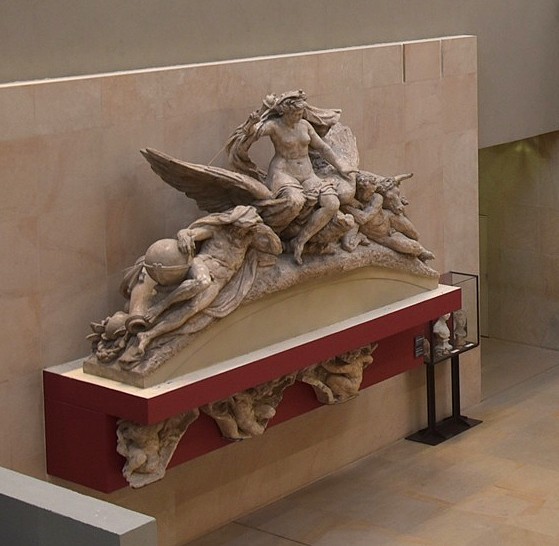
You can actually see all the sculptures below from the balcony above. Other works were the ‘Imperial France protecting agriculture and sciences’ and ‘The four parts of the world holding the celestial sphere’ by Jean-Baptiste Carpeaux ; and a miniature version of the Statue of Liberty by Frederic-Auguste Bartholdi .
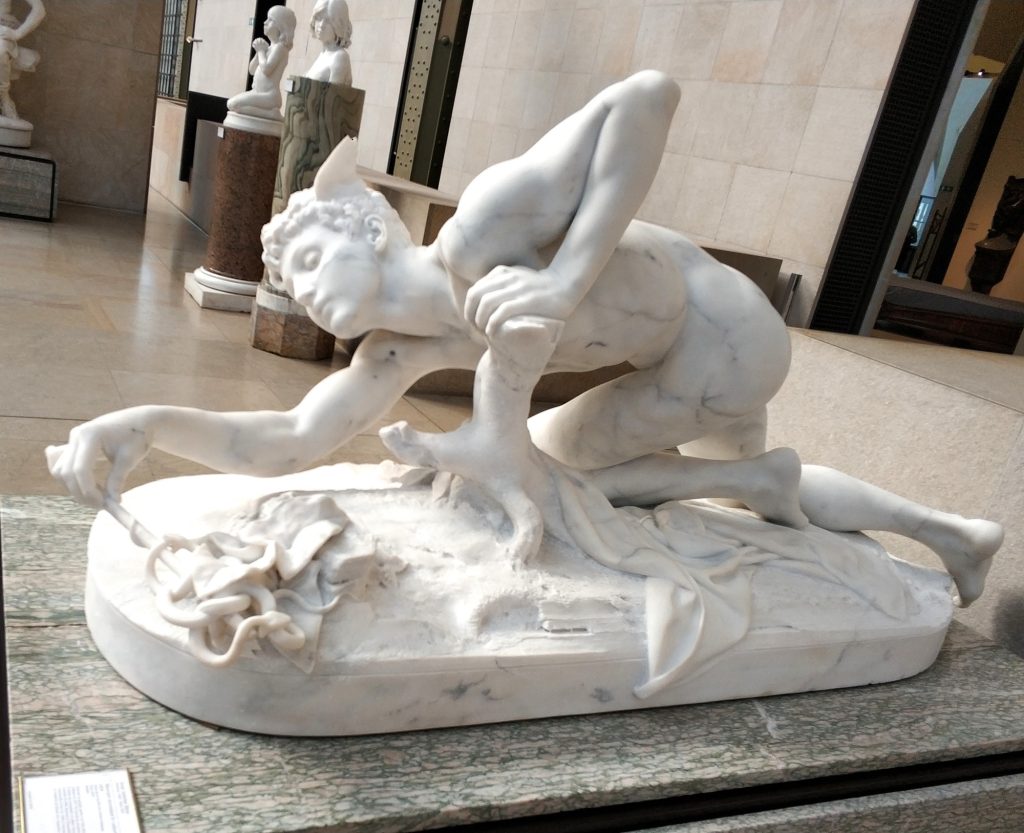
Jean-Baptiste Carpeaux (1827–1875) was a leading French sculptor of the Second Empire under Napolean III, who broke from rigid classical traditions to pioneer expressive realism. Inspired by Michelangelo and Francois Rude, his dynamic forms and life-like movements directly paved the way for Auguste Rodin.
Imperial France Protecting Agriculture and Sciences:
Commissioned in 1863 for the pediment of the Pavillon de Flore at the Louvre, this allegorical work features a central imperial figure flanked by dynamic male nudes. Heavily inspired by Michelangelo’s Medici Chapel tombs, Carpeaux infused the traditional pediment structure with muscular vitality, dramatic drapery and Baroque motion.
The Four Parts of the World Holding the Celestial Sphere:
Designed between 1867 and 1874 for a major fountain outside the Jardin du Luxembourg, this bronze masterpiece depicts four female allegories representing Europe, Asia, Africa, and America. The figures dance in a dynamic ring while balancing the universe above them, capturing Carpeaux‘s signature emphasis on fluid movement and energy.
Auguste Rodin
Next to Hercules the Archer was The Walking Man by Auguste Rodin. My favourites were of course Rodin’s works. I had first heard of Rodin when I was very young ; I think maybe I was in grade 7 or 8. A temporary exhibition of his works was being held in Calcutta at the time and people were super excited about being able to see the masterpieces of none other than Auguste Rodin -a rare feat indeed in those days. I was too young to be allowed since the statues were all naked bodies(!!) but I was able to see a few photos in newspapers at the time and this had made me immensely curious. The image of The Thinker had stuck to my mind since my childhood and that curiosity was at last satisfied after so many years.
Auguste Rodin (1840–1917) was a revolutionary French artist widely considered the father of modern sculpture. He abandoned the stiff, idealized style of traditional academic sculpture in favor of raw realism, expressive energy and visible physical texture. Instead of focusing on smooth perfection, Rodin used deep contours, unfinished surfaces and dramatic body language to convey intense human emotion and psychological depth. His most iconic works including The Thinker, The Kiss and The Burghers of Calais, grew out of his monumental, lifelong project, The Gates of Hell.
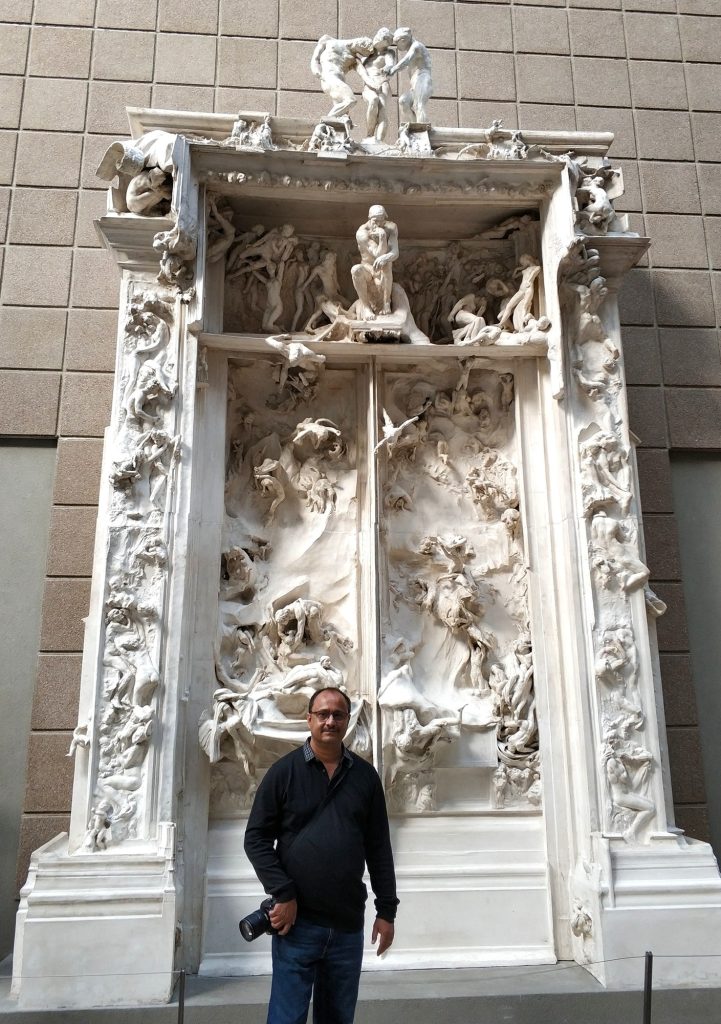
The Gates of Hell or La Porte de l’Enfer is a colossal sculptural portal created by Auguste Rodin, commissioned in 1880 for a planned Paris museum that was never built. Based on Dante’s Inferno, the massive portal depicts a swirling, chaotic vision of human souls in agony and passion. Over 180 writhing figures adorn the structure, serving as the birthplace for many of Rodin’s most iconic individual masterpieces including The Thinker – seated at the top as Dante/the creator – and The Three Shades. Rodin worked, reworked and added to the plaster model for 37 years until his death in 1917; the original plaster model was just before our eyes now.
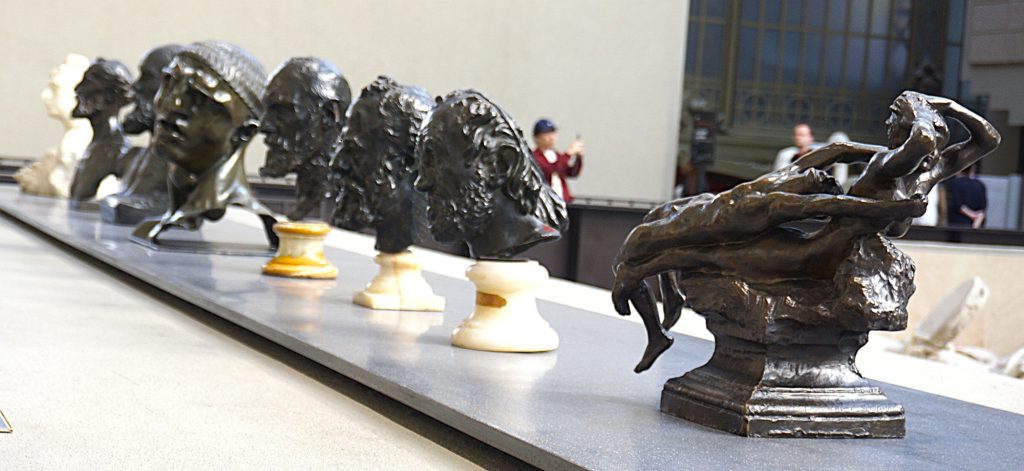
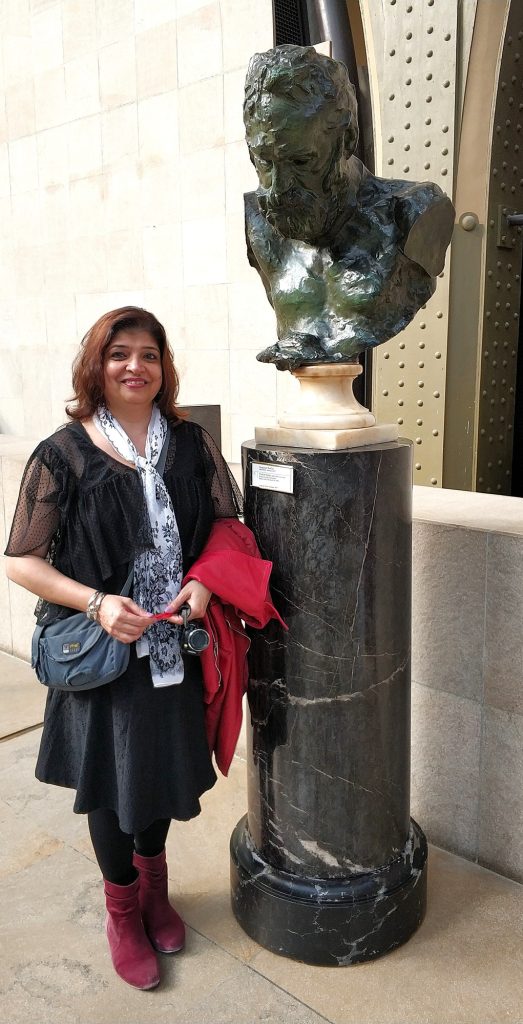
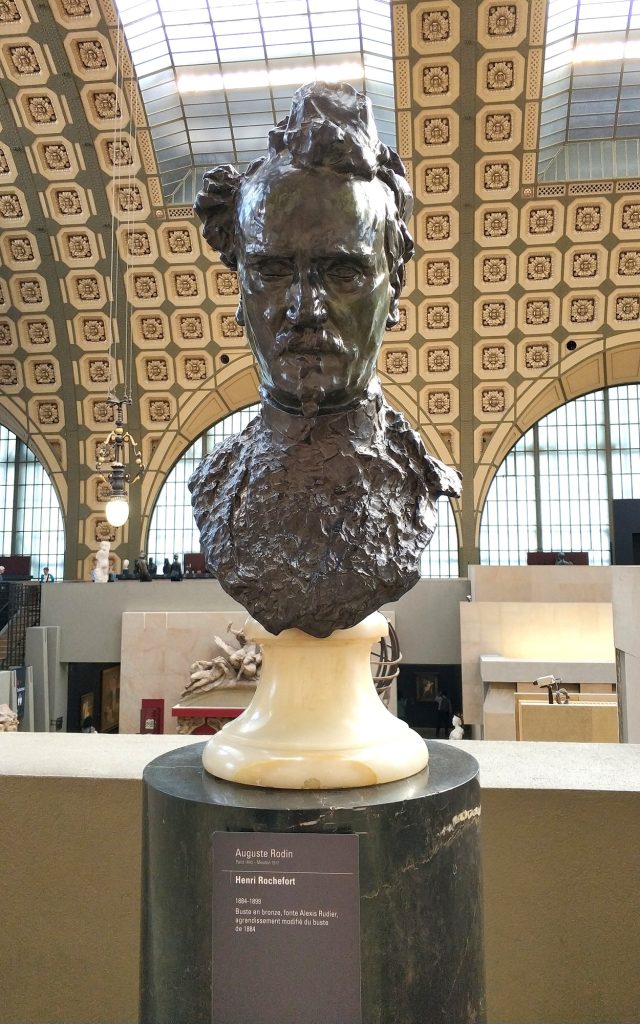
Then there was the bust of Victor Hugo along with other busts of Gustave Geffroy, Henri Rochefort and many more.
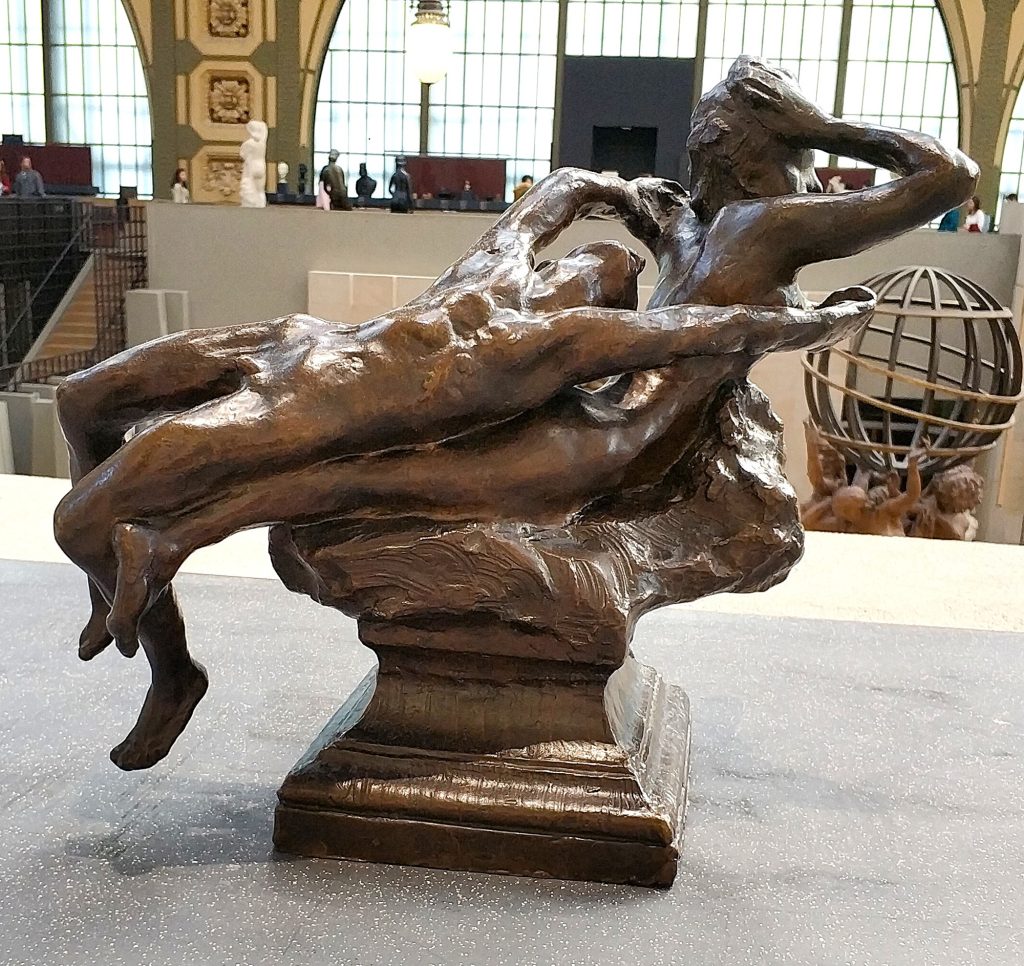
Also there were his other famous works the Age of Bronze, Fugit Amor , Conte Ugolino and many more, most of whose names I hadn’t heard of before.
Fugit Amor or Fleeting Love is Auguste Rodin’s 1887 sculpture depicting the doomed lovers Paolo and Francesca from Dante’s Inferno, originally created for The Gates of Hell. It depicts a desperate man clinging to a woman who arches away like a gust of wind, brilliantly capturing the tragic impossibility of holding onto elusive passion.
The Impressionists
After the statues we went upstairs to see the Impressionist paintings and that gallery was mind-blowing .
Located on the fifth floor adjacent to the roof we had to pass the famous clock window. The view from there was spectacular .You can take in quite a little bit of everything from that round bluish tinged window – a corner of the Louvre, the Jardin des Tuileries with its trees and Ferris Wheel ,the row of Haussmann buildings, the shops and apartments on the Rue de Rivoli, the Sacre Couer from the corner of your eye and even the Seine from the bottom.
Again I have to start my critique about my favourite artists especially Manet, Monet, Dega and Renoir ! Pardon the ranting !! But before that let me explain a little bit the difference between Impressionism , Neo-Impressionism and Post-Impressionism.
Below are Impressionist artists Caillebotte and Gonzales :
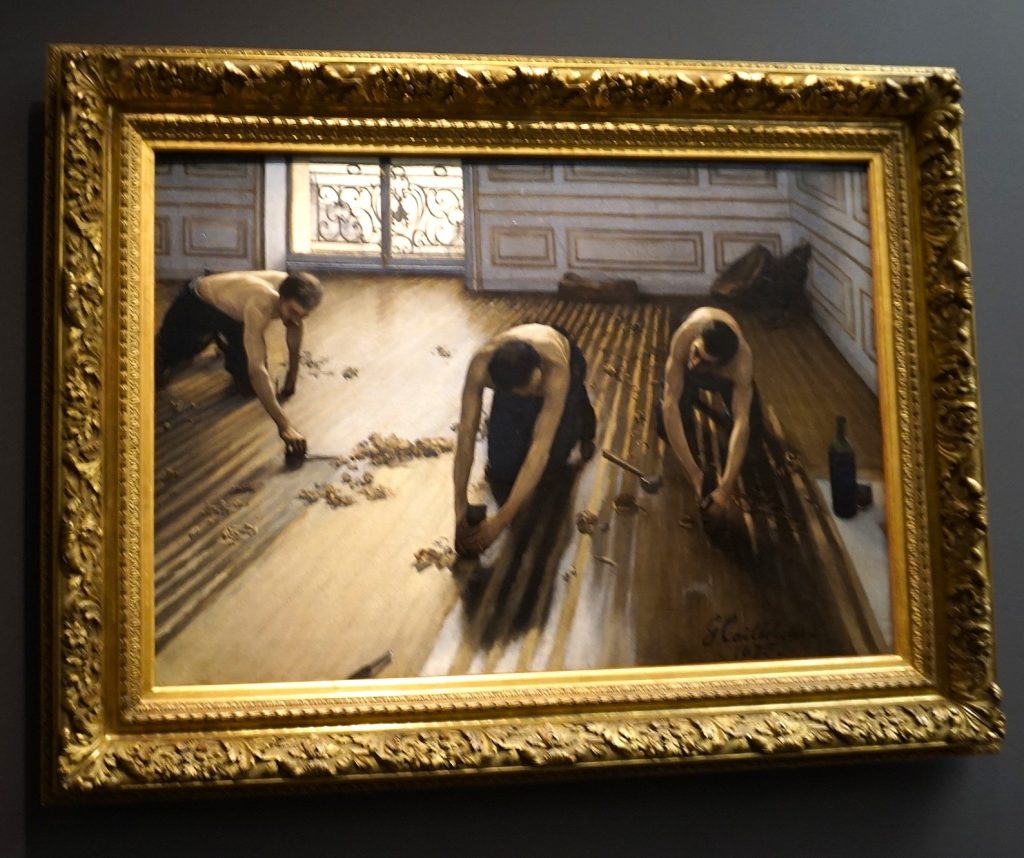
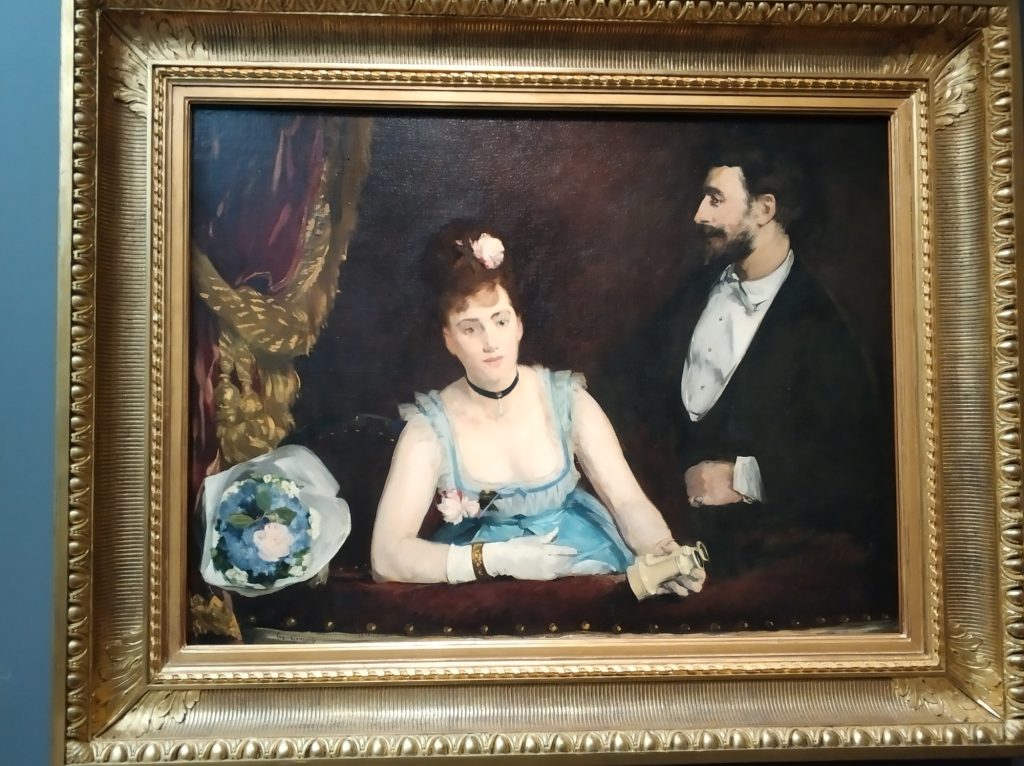
Impressionists aimed to capture fleeting light and real-life moments outdoors using loose, spontaneous brushstrokes. Some of the most famous Impressionists are Claude Monet, Pierre-Auguste Renoir, Edgar Degas, Camille Pissarro, Berthe Morisot.
Neo-Impressionists refined this into a strict, studio-based science, using tiny dots of pure color (Pointillism) that blend optically in the viewer’s eye. The Neo-Impressionists are Georges Seurat, Paul Signac, Henri-Edmond Cross.
Here are some Neo-Impressionist paintings below:
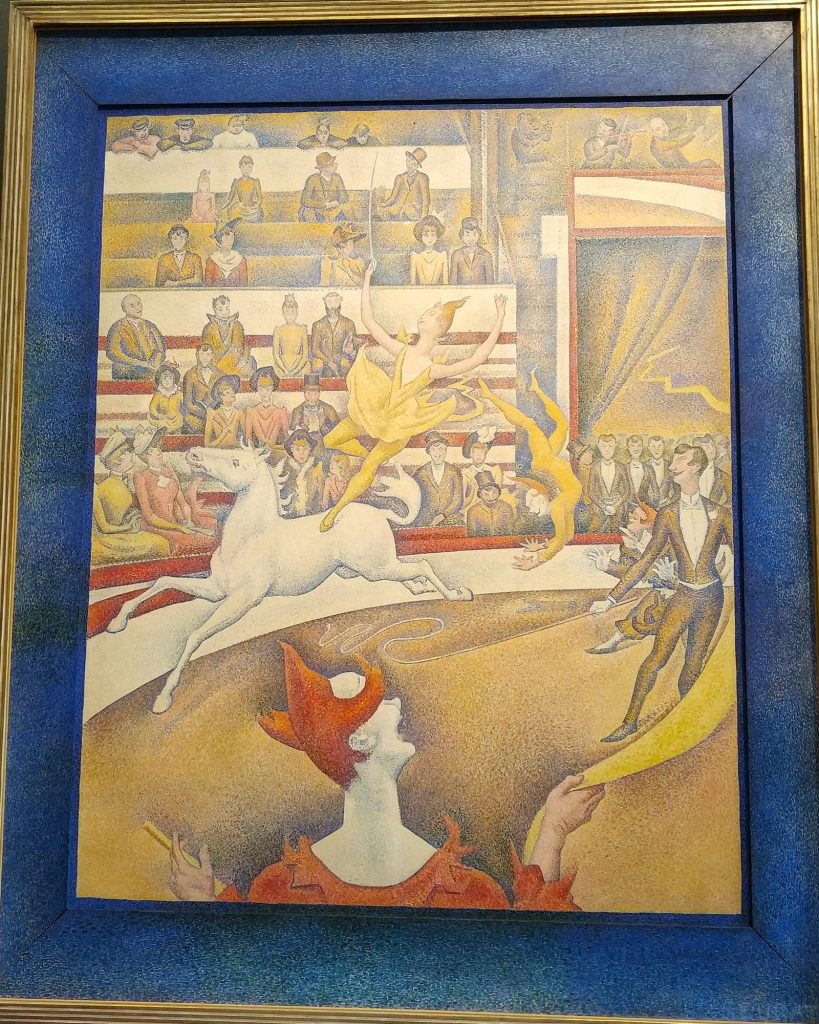
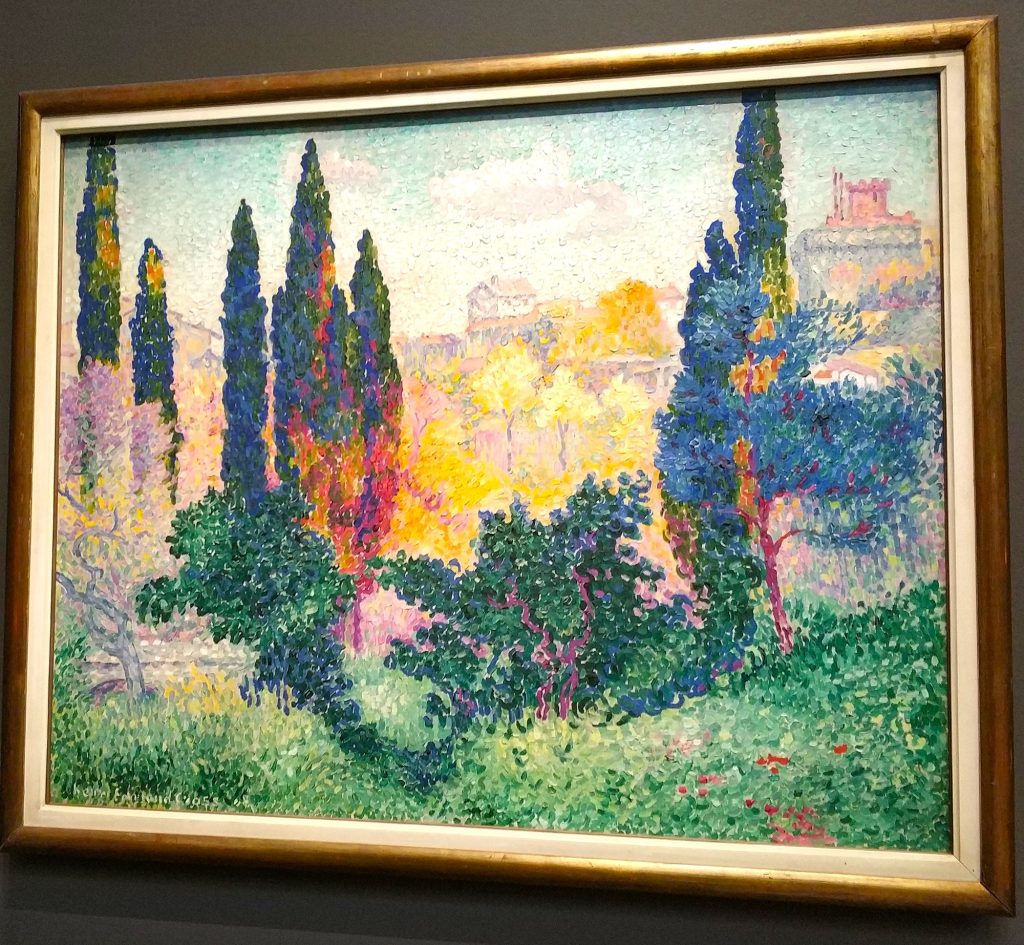
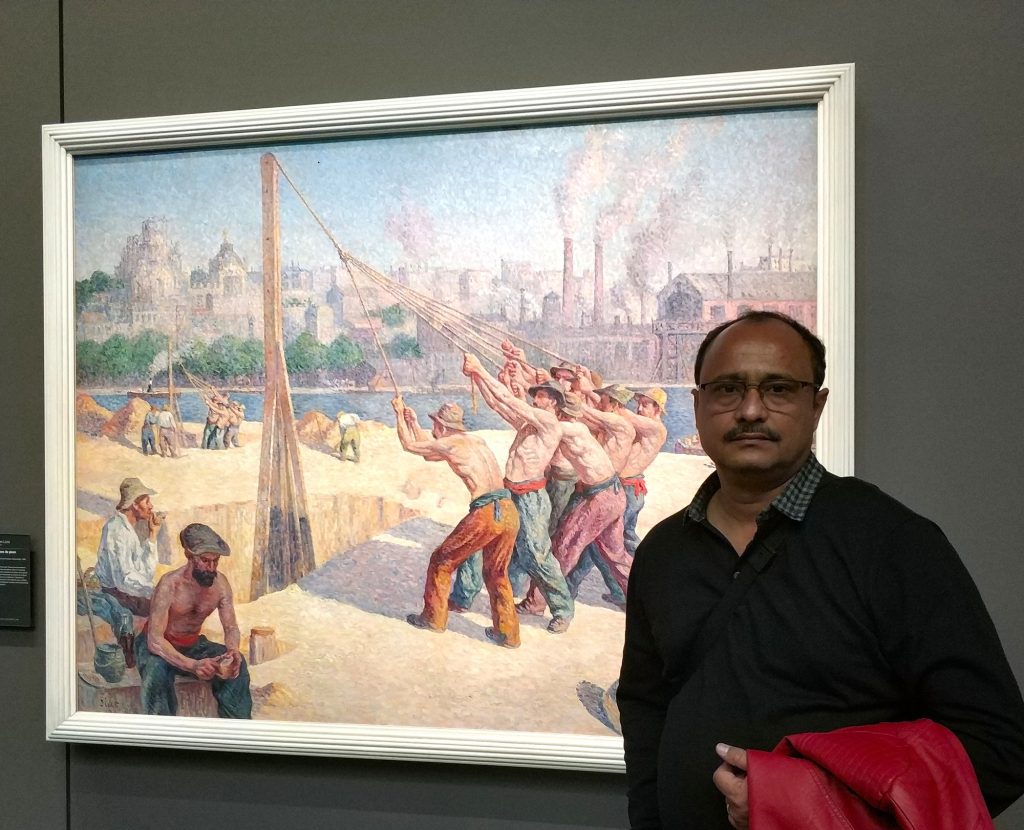
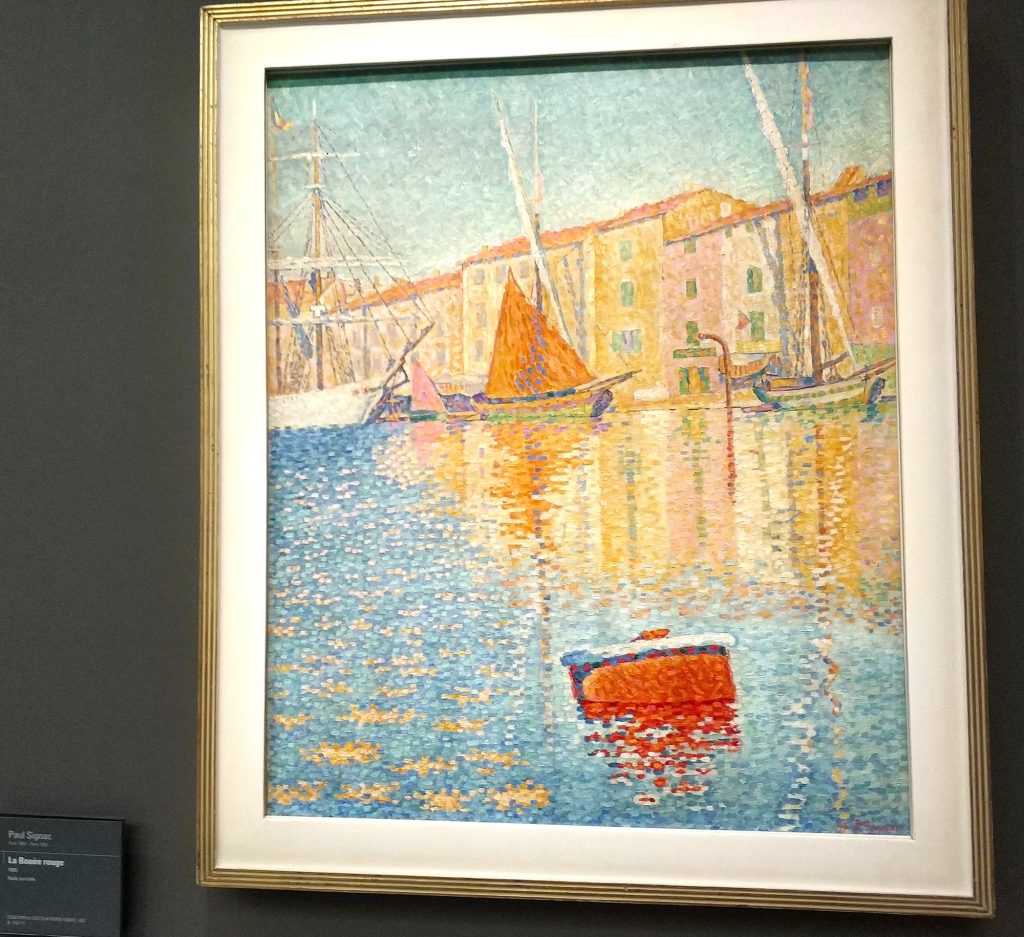
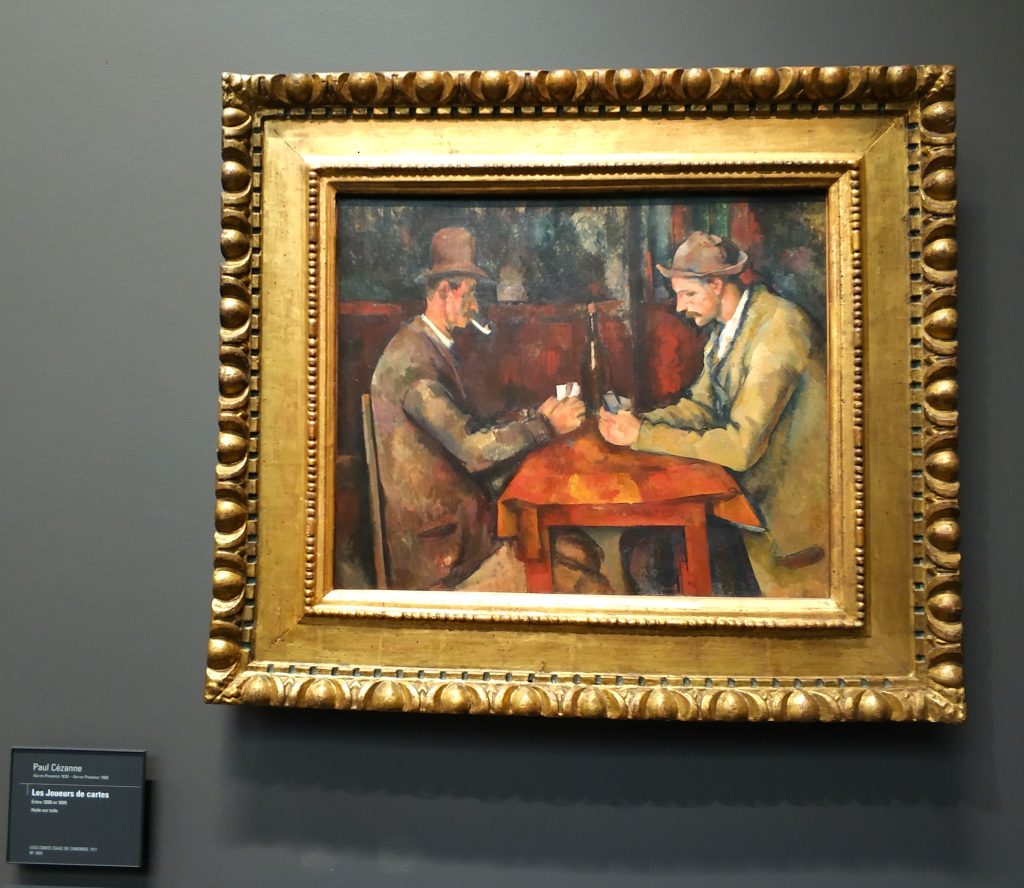
Post-Impressionists rejected both strict naturalism and scientific formulas, using bold colors and stylized forms to express deep personal emotion and underlying structure. Vincent van Gogh, Paul Gauguin, Paul Cézanne, Henri de Toulouse-Lautrec are the famous Post-Impressionists .
More Post-Impressionist paintings below apart from Van Gogh and Gauguin :
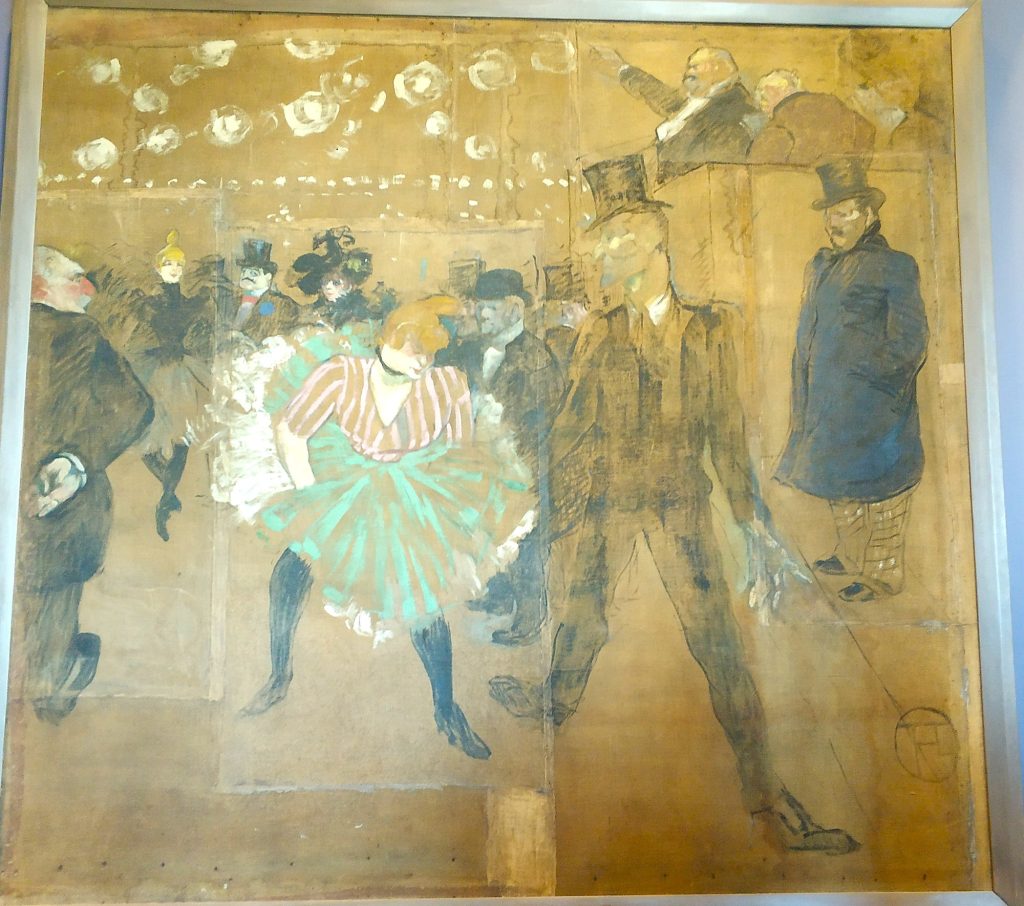
Monet
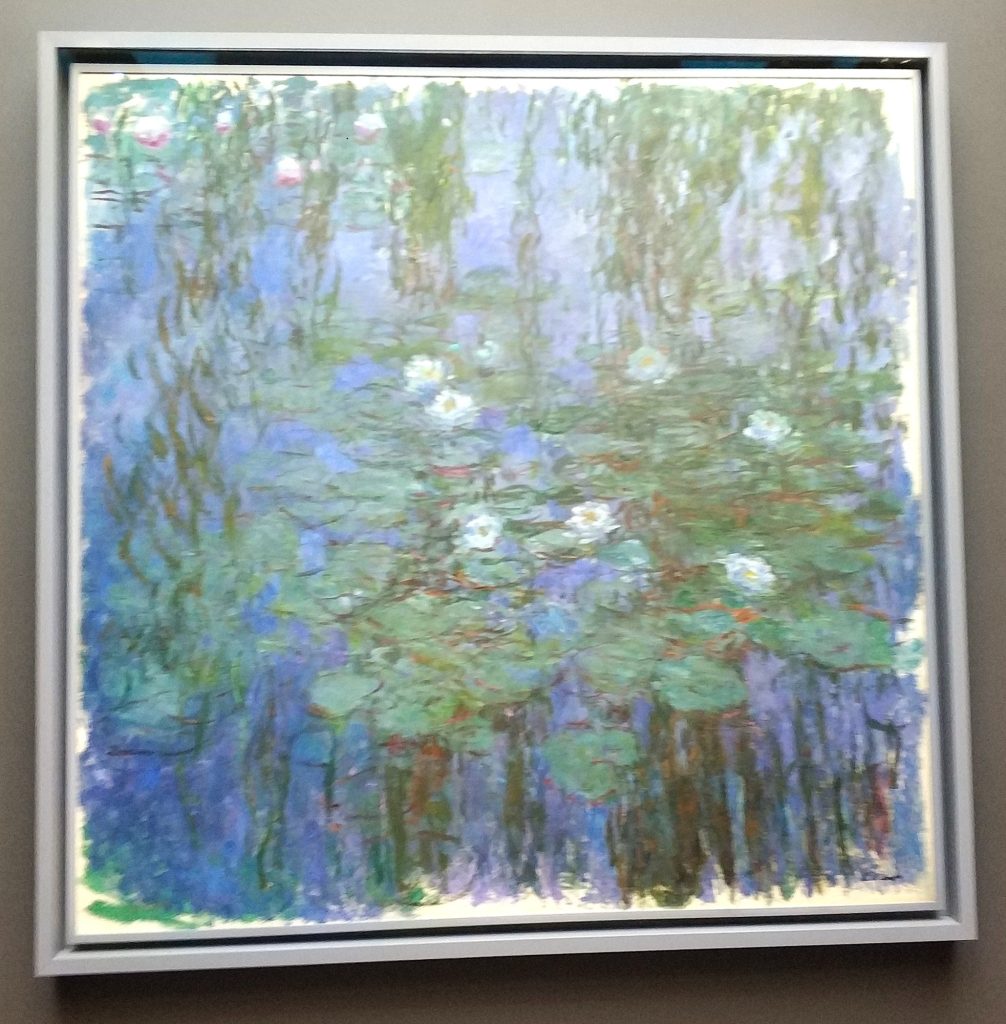
Claude Monet (1840–1926) was a French painter whose 1872 work, Impression, Sunrise, named the Impressionist movement. He pioneered capturing shifting light, atmospheric conditions and fleeting moments through vibrant colors and rapid brushstrokes. Famous for painting series like haystacks and cathedrals across different seasons and times of day, his ultimate masterpiece was the Water Lilies (Nymphéas) series created in his Giverny gardens.
Monet‘s masterpiece ‘The Blue Water Lillies’ focuses entirely on the surface of his water garden at Giverny, completely omitting any horizon or shoreline. Using rich blues, purples, and soft whites, Monet captures the luminous reflections of the sky and weeping willow trees merging seamlessly with floating lily pads and blooming water flowers.
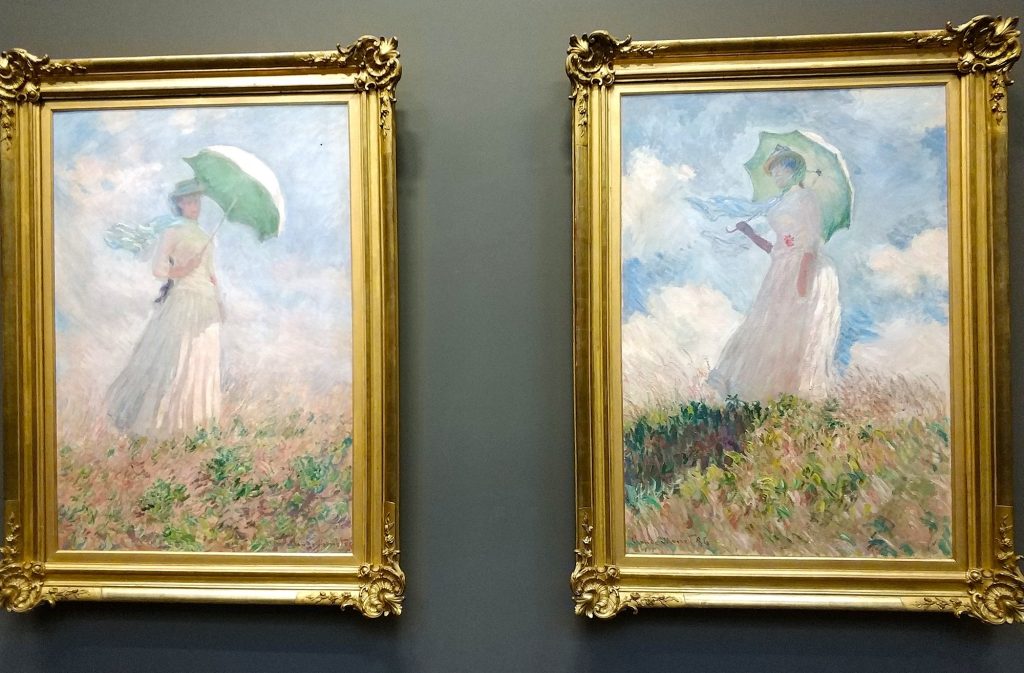
Study of a Figure Outdoors: Woman with a Parasol Facing Right and Facing Left are twin 1886 masterpieces by Claude Monet, displayed side by side at the Musee d’Orsay. Modeled by Suzanne Hoschedé in Giverny, these works pay homage to Monet’s 1875 portrait of his late wife, Camille. Monet blurred Suzanne’s features into anonymity, treating her as an element of the landscape to focus entirely on light, wind and movement. Painted outdoors from a low angle, Monet used rapid, sweeping brushstrokes to capture wind-whipped fabric, swaying grass and drifting clouds under bright sunlight.
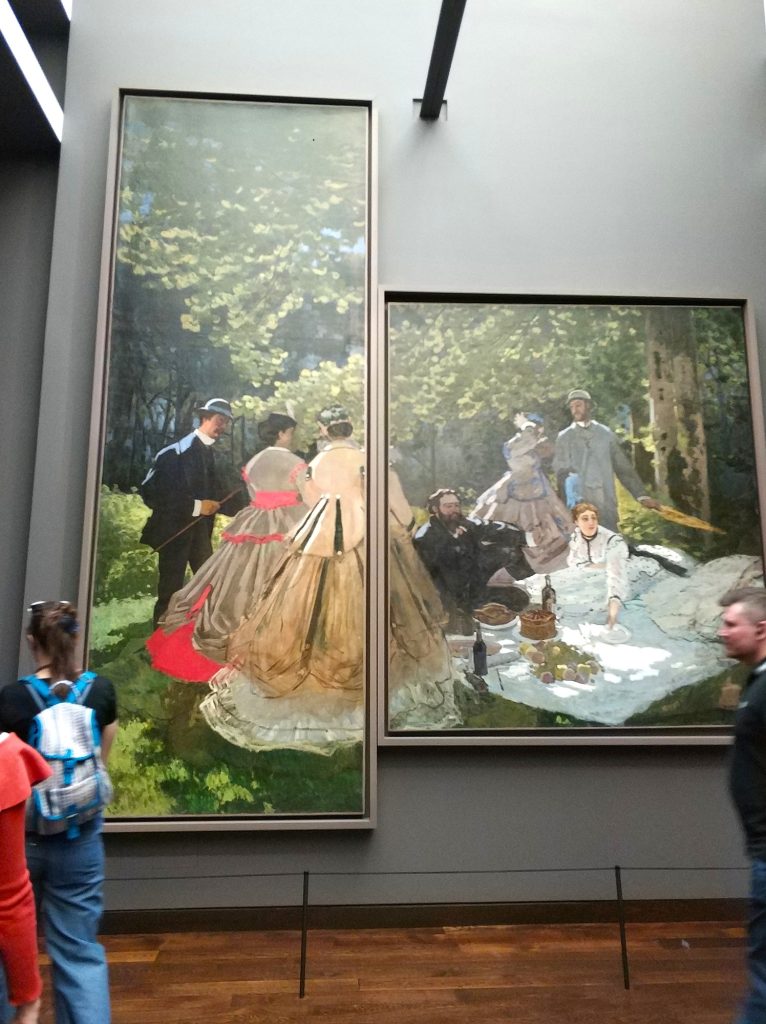
I have to mention one more painting by Monet : Luncheon on the Grass – because Edouard Manet had also painted a painting with the same name and the contrast between the two paintings are quite interesting.
Monet‘s Luncheon on the Grass is a gigantic 1865–1866 work, preserved as surviving fragments .Created as a massive 15×20 foot response to Manet‘s controversial painting, it was left unfinished and damaged by cellar moisture. Monet saved the undamaged portions by cutting them into panels: the left features his future wife Camille and painter Frédéric Bazille, while the right shows figures picnicking in the Chailly-en-Bière forest. Painted largely outdoors , Monet used natural light filtering through trees to capture realistic, dappled sunlight and shadows on the figures and fabric.
Edouard Manet
Édouard Manet (1832–1883) was a pivotal French painter whose groundbreaking work bridged the transition from Realism to Impressionism, making him a founding figure of modern art. While he never officially joined the Impressionist exhibitions Manet was a close friend, mentor and major influence to the Impressionists, like Monet and Renoir, sharing their focus on modern life and direct brushwork. Departing from classical, idealized traditions, he depicted raw, unfiltered scenes of contemporary 19th-century Parisian life using flat planes of color, sharp tonal contrasts and rapid brushwork. Masterpieces like Luncheon on the Grass and Olympia sparked public outrage and critical scandal, permanently challenging traditional artistic standards and paving the way for the Impressionist movement.
Le Déjeuner sur l’herbe or The Luncheon on the Grass is an 1863 masterpiece by Édouard Manet. The painting depicts a nude woman, modeled by Victorine Meurent , picnicking with two fully clothed, stylish Parisian men in a woodland clearing, while another woman bathes in a background stream. Rejected by the 1863 Paris Salon, it outraged the Salon des Refusés by presenting an unashamed, contemporary woman confronting the viewer’s gaze rather than an idealized classical goddess.
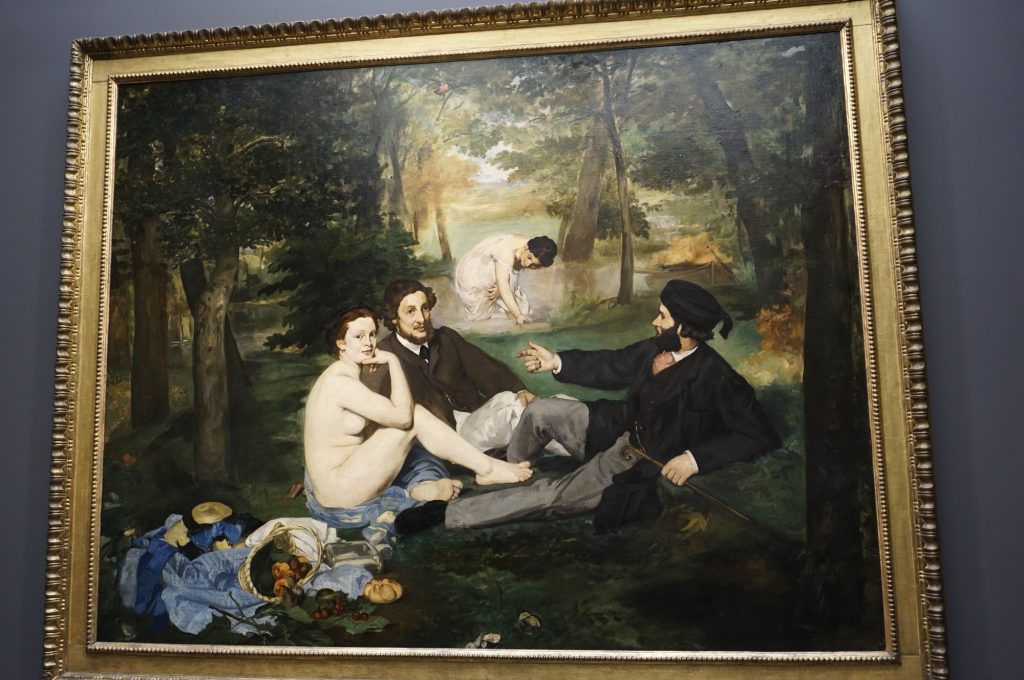
Both Édouard Manet and Claude Monet painted a Luncheon on the Grass , but with distinctly different approaches. Manet painted his version first, sparking a public scandal by depicting a nude woman sitting casually with fully clothed men. Her direct gaze and the scene’s stark realism challenged classical traditions and catalyzed modern art. Monet created his version two years later as a friendly response to Manet. Monet omitted the nude, focusing instead on fashionably dressed Parisians, natural sunlight, and dappled outdoor foliage . While Monet‘s giant canvas was damaged by moisture and cut into fragments, Manet‘s intact original remains a famous masterpiece at the Orsay.
Pierre-Auguste Renoir
Another one of my favourite painters is Pierre-Auguste Renoir. Renoir (1841–1919) was a leading French painter and a central figure in the Impressionist movement, celebrated for his joyous, warm depictions of modern life, vibrant social gatherings and delicate portraits. Unlike contemporaries who focused heavily on landscape or social critique, Renoir specialized in human intimacy, beauty and leisure. He famously painted lively outdoor dances, sunlit picnickers, theatergoers and serene portraits.
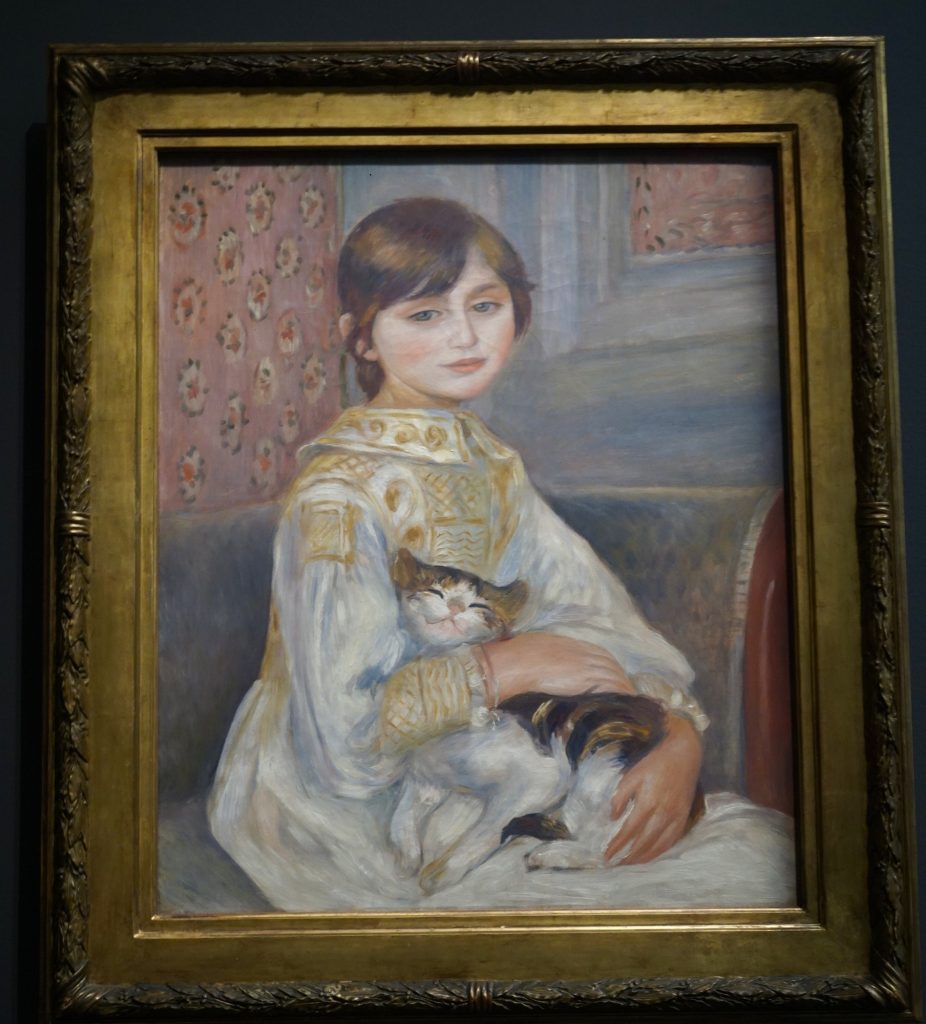
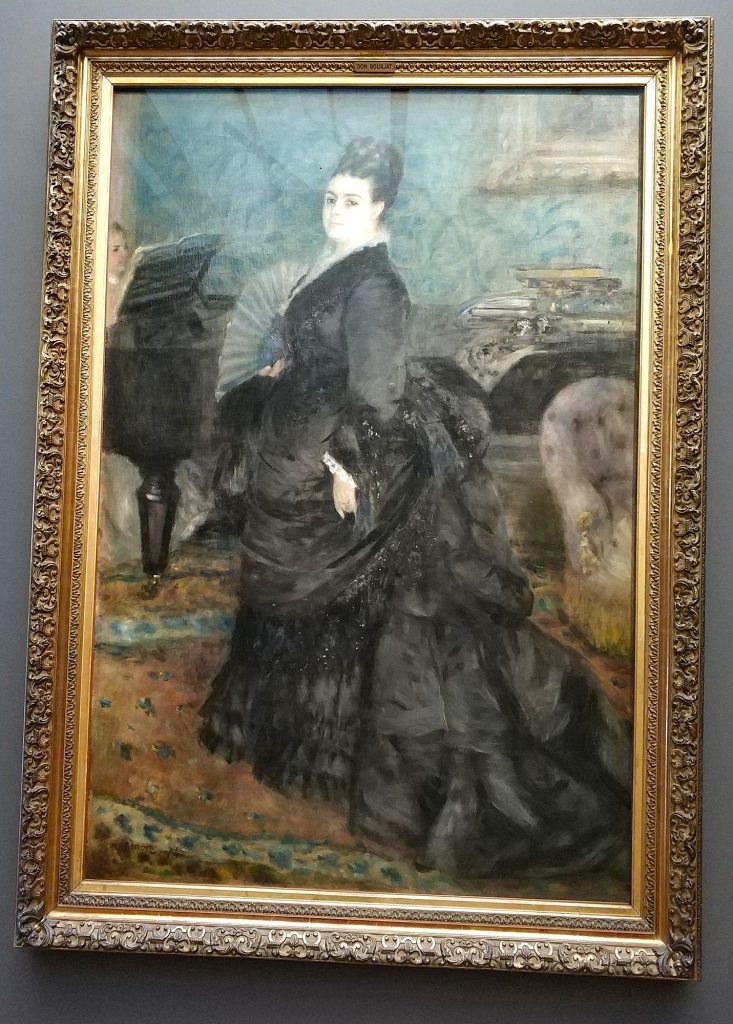
Renoir was a master at capturing dappled natural light filtering through trees and leaves onto skin and clothing, using soft, feathery brushstrokes and a rich, warm color palette. His most iconic masterpieces include Bal du Moulin de la Galette , Luncheon of the Boating Party ,Dance in the City/Country and Portrait of Madame Hartmann .
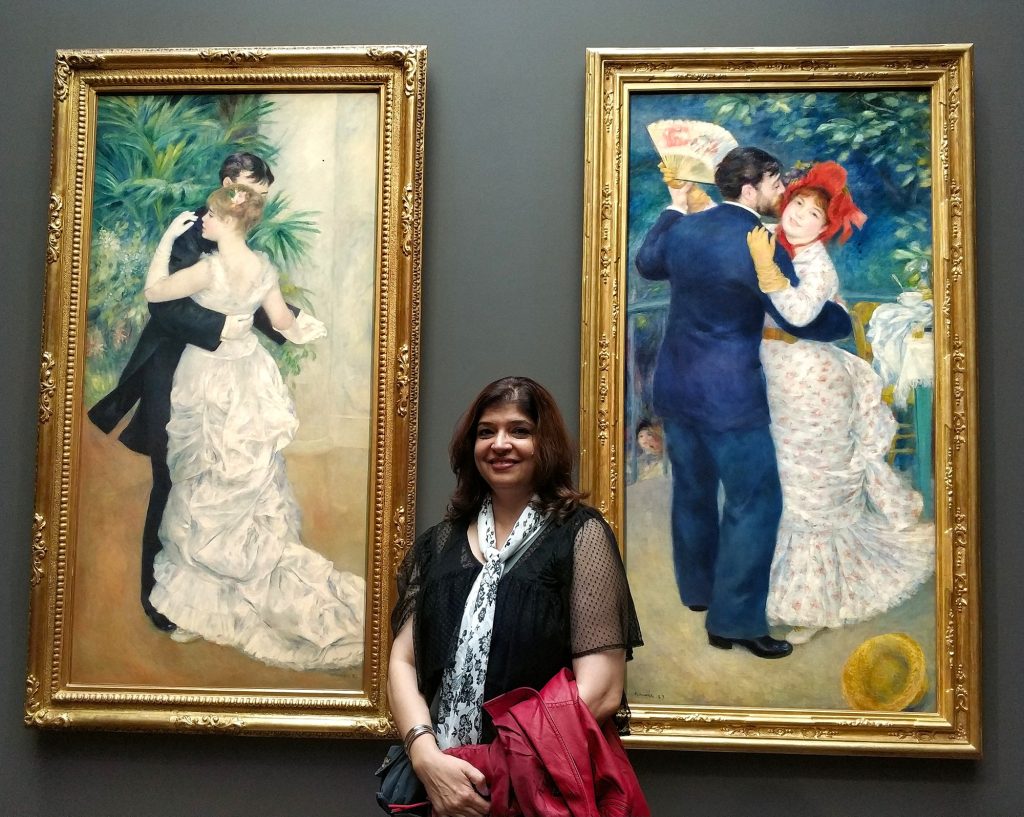
Dance in the City and Dance in the Country are a famous 1883 pair of companion paintings by Pierre-Auguste Renoir. Left Canvas (Dance in the City) features Suzanne Valadon and Paul Lhote dancing in a formal ballroom surrounded by palms, wearing an elegant tailcoat and a sweeping white gown. Right Canvas (Dance in the Country)depicts Aline Charigot (Renoir’s future wife) and Paul Lhote dancing outdoors in a sunlit setting, capturing a joyful, spontaneous moment. Commissioned by Paul Durand-Ruel, the pair contrasts refined urban life with lively rural leisure, demonstrating Renoir’s mastery of movement, fabric and light.
Edgar Degas
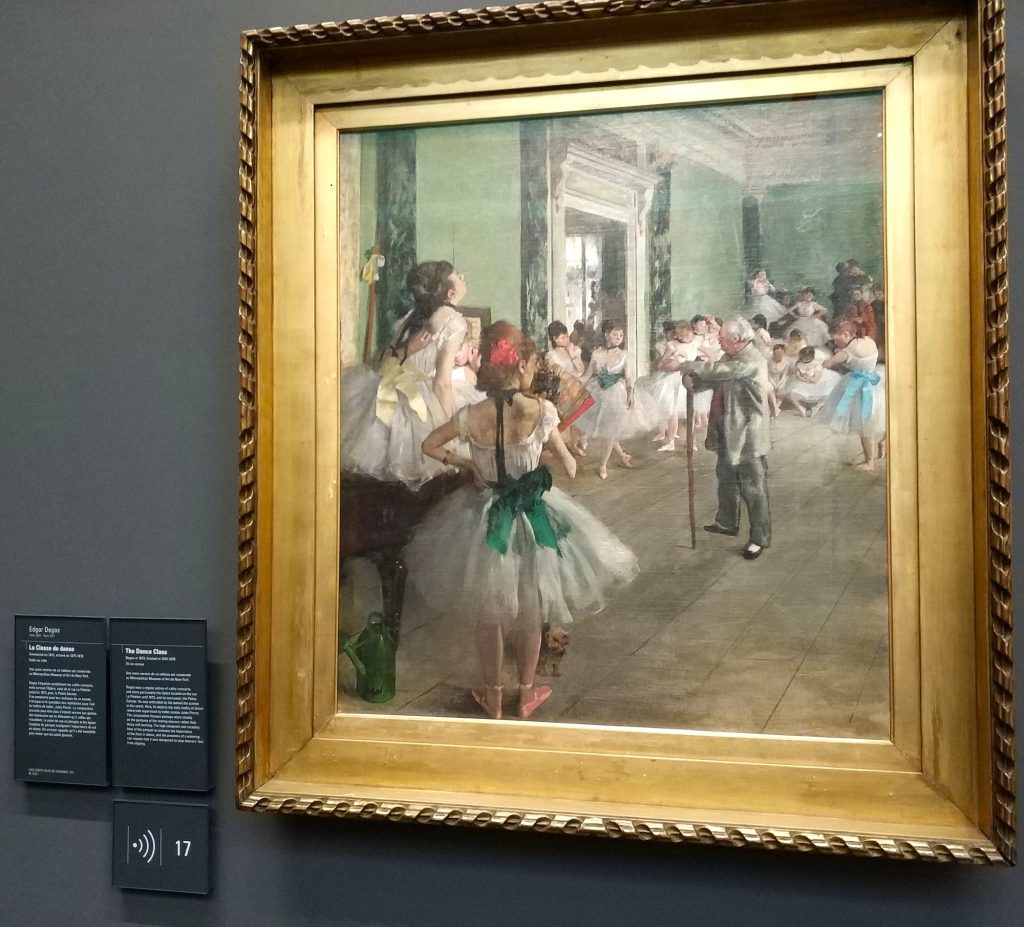
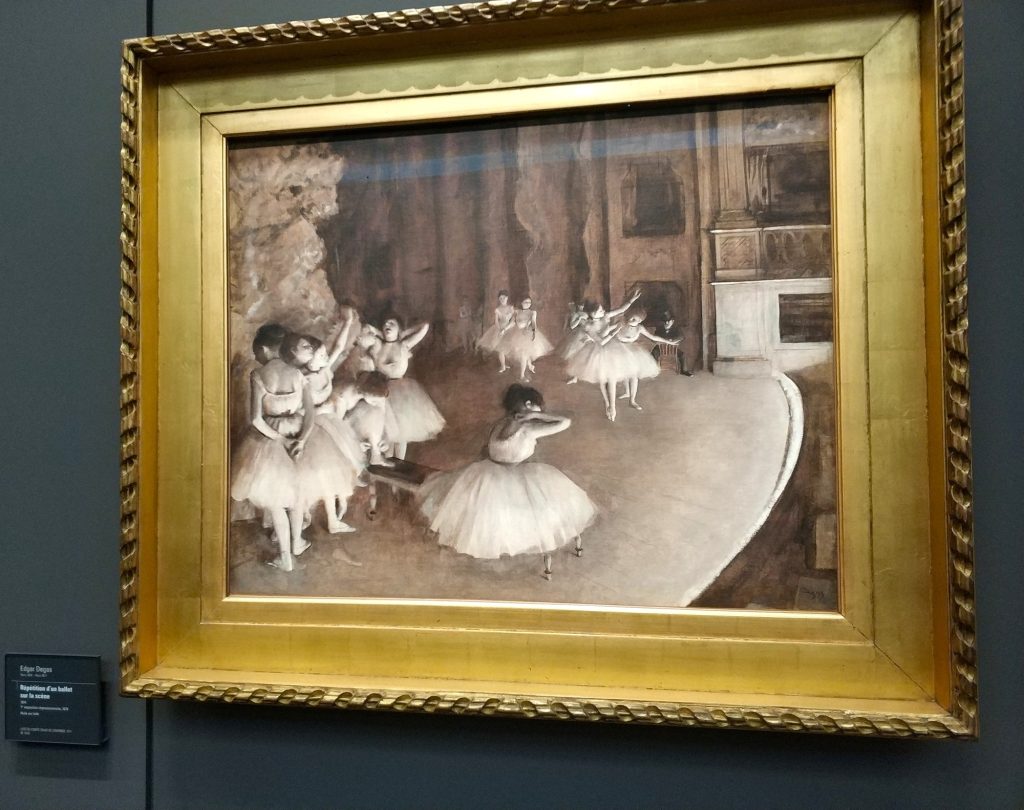
Another Impressionist artist who must be mentioned is Edgar Degas (1834–1917). Dega was a French artist celebrated for capturing movement and candid moments, most famously in his extensive studies of ballet dancers. Blending precise drawing with unconventional, photography-inspired compositions, he bridged classical realism with Impressionism while working in oil, pastel and sculpture.
Rehearsal of a Ballet on Stage (1874) captures dancers mid-rehearsal from a high, off-center perspective in monochrome tones, emphasizing open stage space and unposed moments.
The Dance Class (1873–1876) depicts dancers exhausting a lesson under ballet master Jules Perrot, using a deep diagonal composition rich in soft colors, detailed textures and candid foreground details.
Together, both masterpieces showcase Degas‘s brilliant ability to capture authentic movement and space behind the ballet curtain.
The gallery of Impressionist ,Neo-Impressionist and Post-Impressionist paintings turned out be staggeringly large and never-ending. I could actually touch the flowers and get a whiff of the fragrances from Monet’s Garden at Giverny and Blue Water Lilies ; It was as if I had joined Manet’s figures in his Luncheon on the Grass ; Renoir’s beautiful faces were an epitome of serene beauty; Seurat’s powerful pointillism was evident in the Circus ; and Dega’s Ballerinas were powerful enough to make you dance with them. Apart from them there were so many more works of other famous artists -all of which transported us back to another place and time and gave us endless joy!!
End of the day
Satisfied with the day, we roamed around the banks of the Seine once more for a while, watching skateboarders having a fun time, then caught a metro back to our place. Next day it was Versailles Palace on the list.