The Pompidou Centre of Art and Culture
Our first destination on the first day in Paris was The National Georges Pompidou Centre of Art and Culture – a haven to the largest collection of Modern and Contemporary art .
The museum is quite close to the Notre Dame and you also cross the river Seine to reach it. Before entering the museum we strolled around the Seine while there was still sunlight.
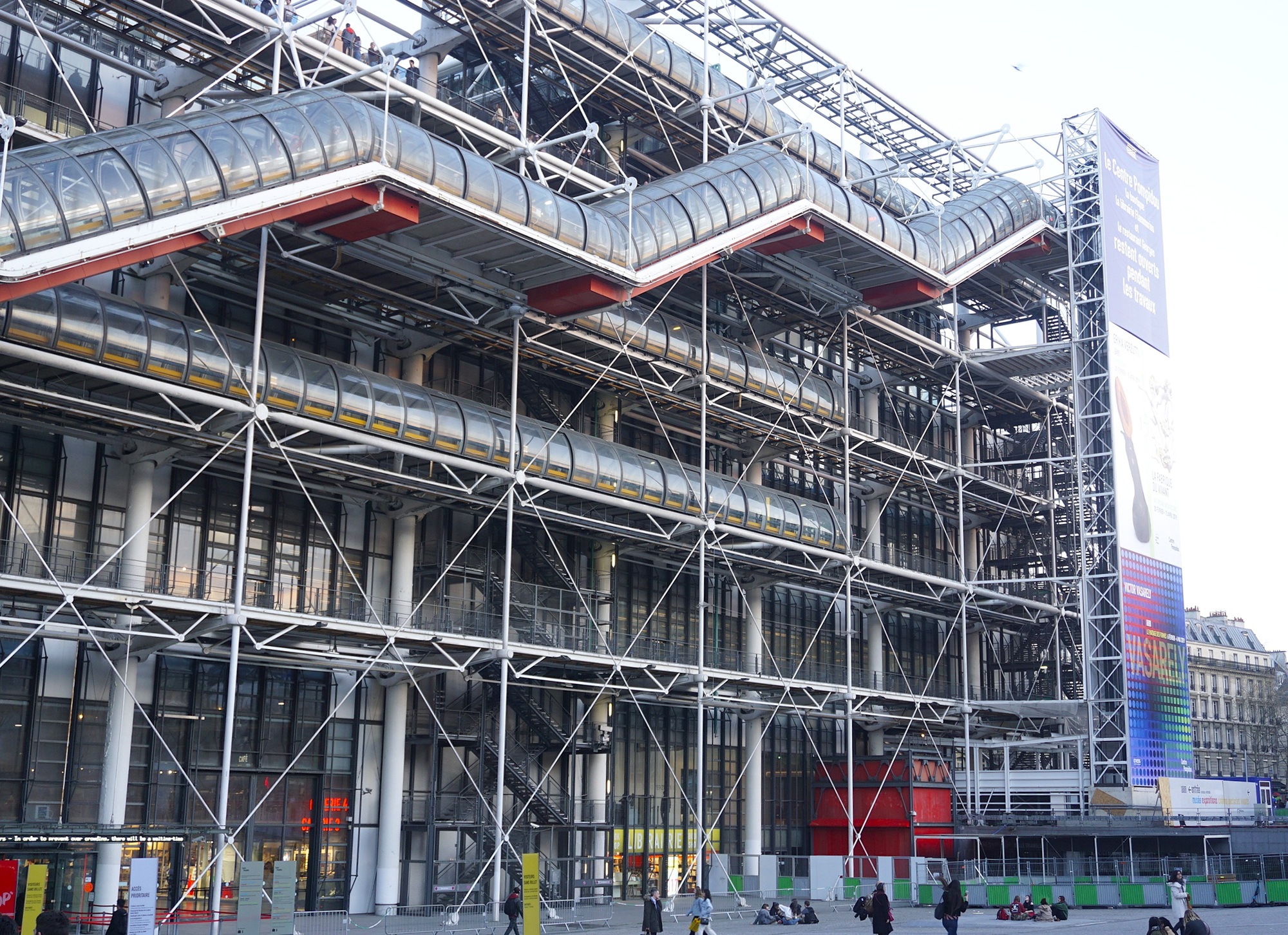
Amidst all the medieval, gothic and renaissance architecture of Paris , amidst all its old world charm, Centre Pompidou stands out like an abomination. The first impression I got of the building was that it was incomplete , naked ,stripped of its cover – exposing brick, cement , mortar, plaster and paint!
Its style : High-tech architecture
I guess it served its purpose of what it wanted to convey because later I read about its style. It was designed in the style of ‘High-tech architecture’.
According to Wiki, High-tech architecture, also known as Structural Expressionism, is a type of late modern architectural style that emerged in the 1970s.This type of style incorporated elements of high-tech industry and technology into building design.
It was the first major example of an ‘inside-out’ building in architectural history, with its structural system, mechanical systems and circulation, exposed on the exterior of the building.
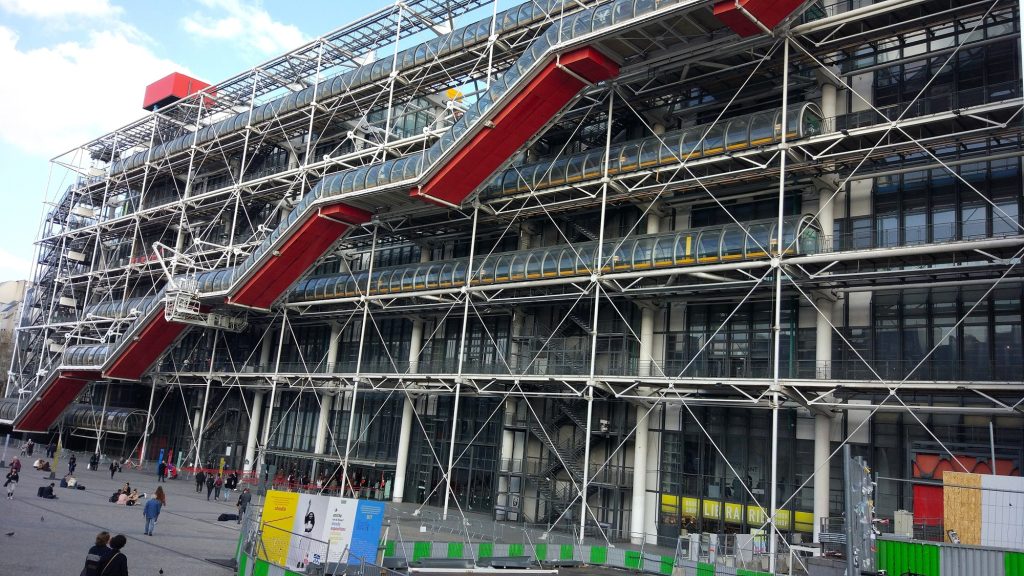
All of the functional, structural elements of the building are color-coded. The green pipes are plumbing, blue ducts are for climate control, electrical wires are encased in yellow and circulation elements and devices for safety (e.g., fire extinguishers) are red. The whole idea in itself was pretty cool!
The Pompidou Centre is named after Georges Pompidou, the President of France from 1969 to 1974 . It opened in 1977 . Compared to the other famous historical landmarks of Paris it is quite new. Not only is it an art museum but also a multicultural complex, having a huge library and a centre for music and acoustic research too.
The Art Collection
But the art collection itself is so vast that it would take almost half a day for art aficionados to go through each piece minutely. In spite of weary bones we tried to cover most of the paintings of 20th and 21st century artists. The works of iconic artists are displayed chronologically over two sections: the modern period, from 1905 to 1960 and the contemporary period, from 1960 to the present day .
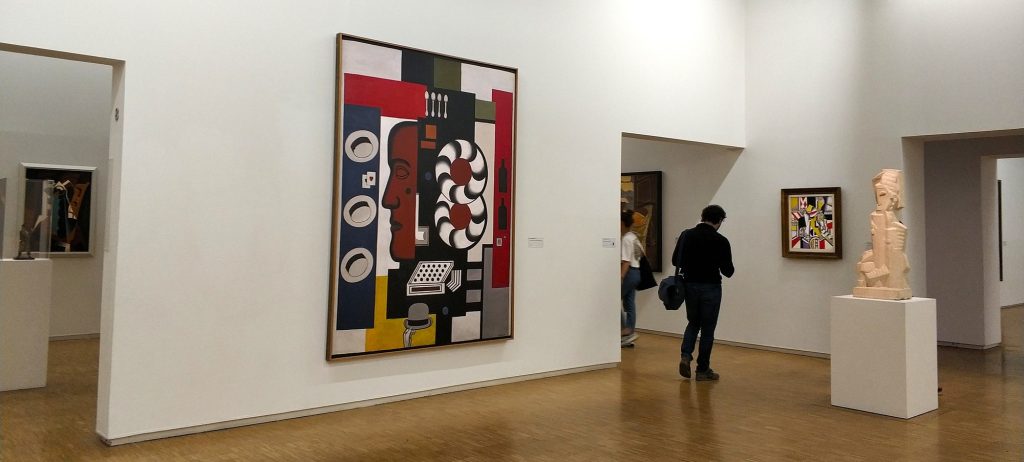
My favourite was the modern period since I’m not a big fan of contemporary art. We stood trying to understand the works of Pablo Picasso ,Jackson Pollock, Henri Matisse , Marc Chagall, and got acquainted with the works of Andre Derain, Fernand Leger, Antoine Pevsner, Jules Pascin, Georges Rouault and many more artists but I became an ardent admirer of Vassily Kandinsky.
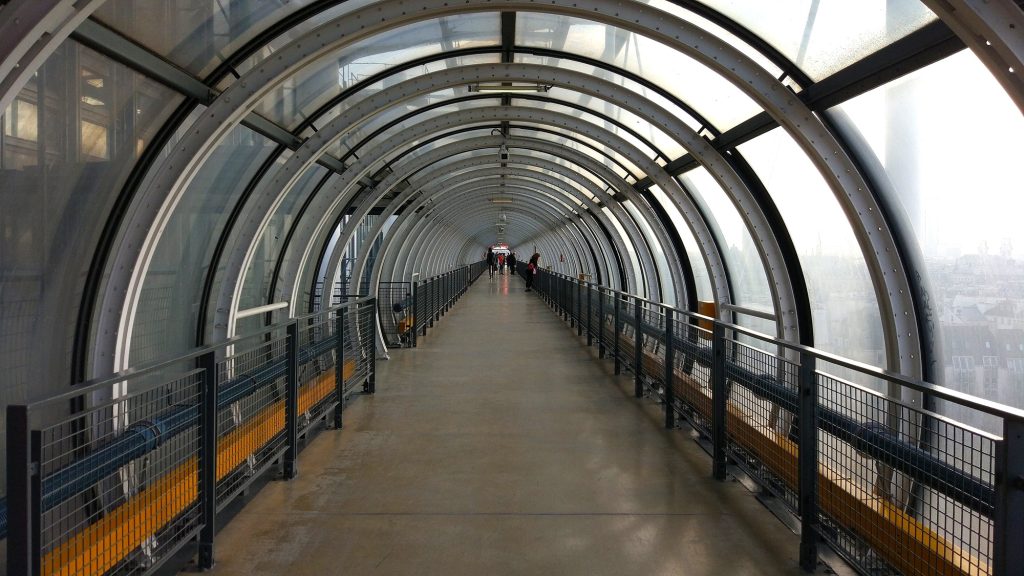
After passing through long, cylindrical passages situated on the outside of the building we reached the main galleries . In fact all the passages on each floor were on the outside of the building keeping in tradition with its inside out structure. The view from every passage was spectacular sweeping through one corner of Paris to another.
The Pompidou Centre isn’t very large compared to the Louvre but the vast collection made up for size. Unlike the ornate walls of the Louvre, Pompidou’s walls were all bare white leaving the paintings and displays to make up for anything that went as wall decor.
Henri Matisse (1869–1954)
The artist whose works we saw first was Henri Matisse. French artist Henri Matisse is renowned as one of the defining figures of modern art, celebrated for his revolutionary use of color and draftsmanship. He gained fame as the leader of Fauvism , an early 20th-century art movement characterized by the use of extremely bold, unnatural and vibrant colours, expressive brushstrokes and simplified forms, prioritising emotional impact over realistic representation.The word Fauves means ‘wild beasts’ in French, a name given to the artists because of their seemingly wild use of colour. Throughout his career, Matisse explored the relationship between interior memory, artistic creation and the exterior world.
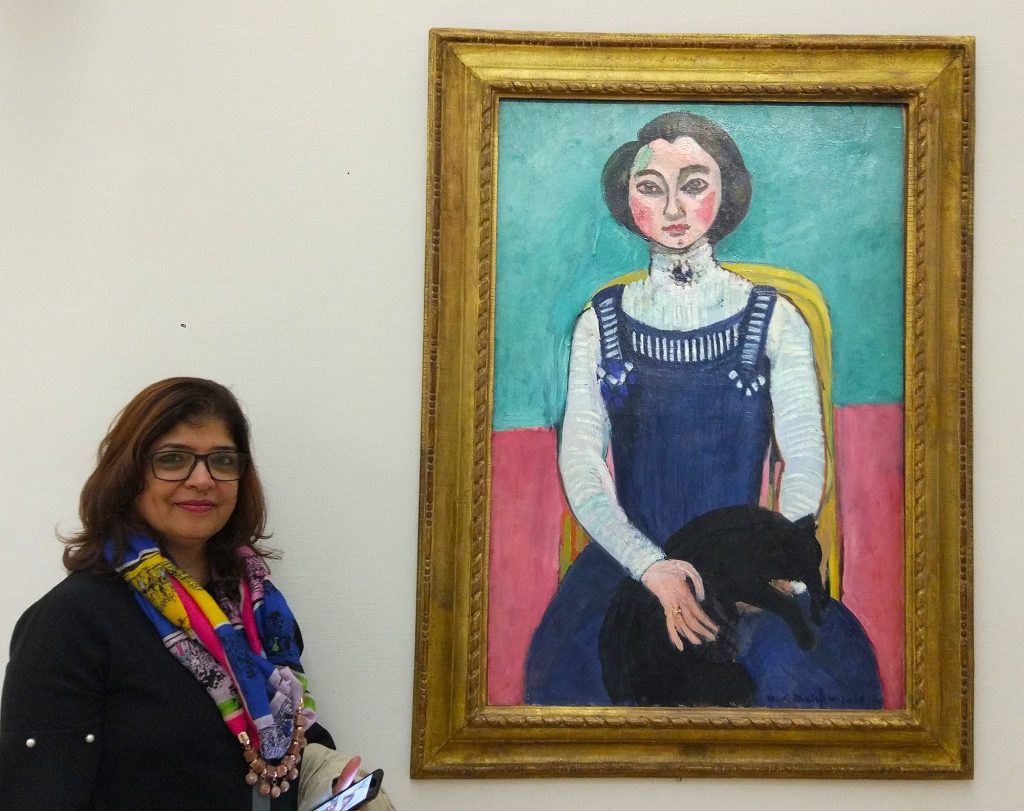
The painting The Girl with a Black Cat was painted by Henri Matisse in 1910. It features his daughter, Marguerite Matisse, seated and holding a black cat in her lap. I was struck by how the bold teal and rose backdrop instantly draws you into Marguerite’s calm, direct gaze. In this painting ,Matisse uses high-contrast and flat areas of bold color- a signature of his Fauvist and post-Fauvist style. The painting relies heavily on bold black outlines, flattened planes of color and simplified geometry, emphasizing form, color harmony and decorative structure over realistic shading or depth.
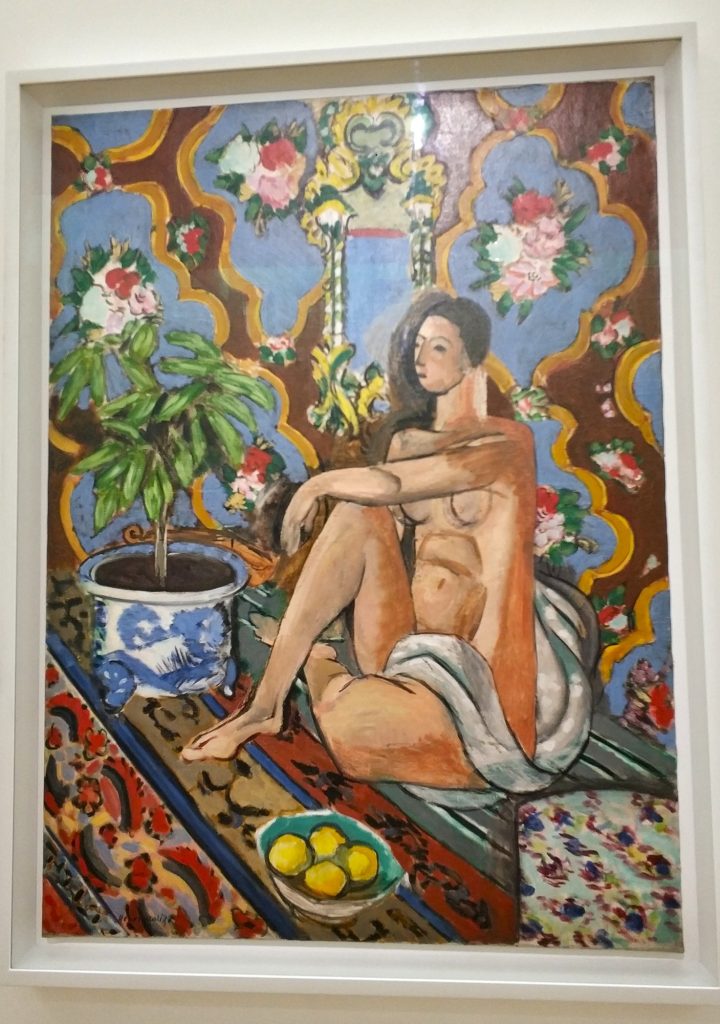
Another stunning painting, Matisse’s Decorative Figure on an Ornamental Background also intrigued me. Standing before it I was completely mesmerized by the sheer visual energy radiating from the canvas. Painted in Nice during the winter of 1925–1926, this masterpiece features an elaborate studio setup Matisse constructed using layered fabric panels, oriental rugs, a potted lemon tree and a bowl of fruit. The sharp contrast between the rigid, statuesque pose of the nude figure and the lush, overwhelming floral arabesques, the fluid, decorative wallpaper background behind her holds your gaze in a way that feels almost electric. By juxtaposing dense patterns, bold lines and flat planes of color, Matisse intentionally blurs the line between the foreground figure and the decorative background, creating a complex rhythm of shapes.
Marc Chagall (1887–1985)
I particularly liked Marc Chagall because his paintings felt like illustrated dreams. Marc Chagall was a Russian-French artist widely considered one of the most prominent early modernists, known for combining elements of Cubism, Symbolism and Fauvism with deeply personal storytelling. Much of Chagall’s body of work is rooted in his Jewish heritage and nostalgic memories of life in his hometown of Vitebsk, blending folk motifs with surreal imagination.
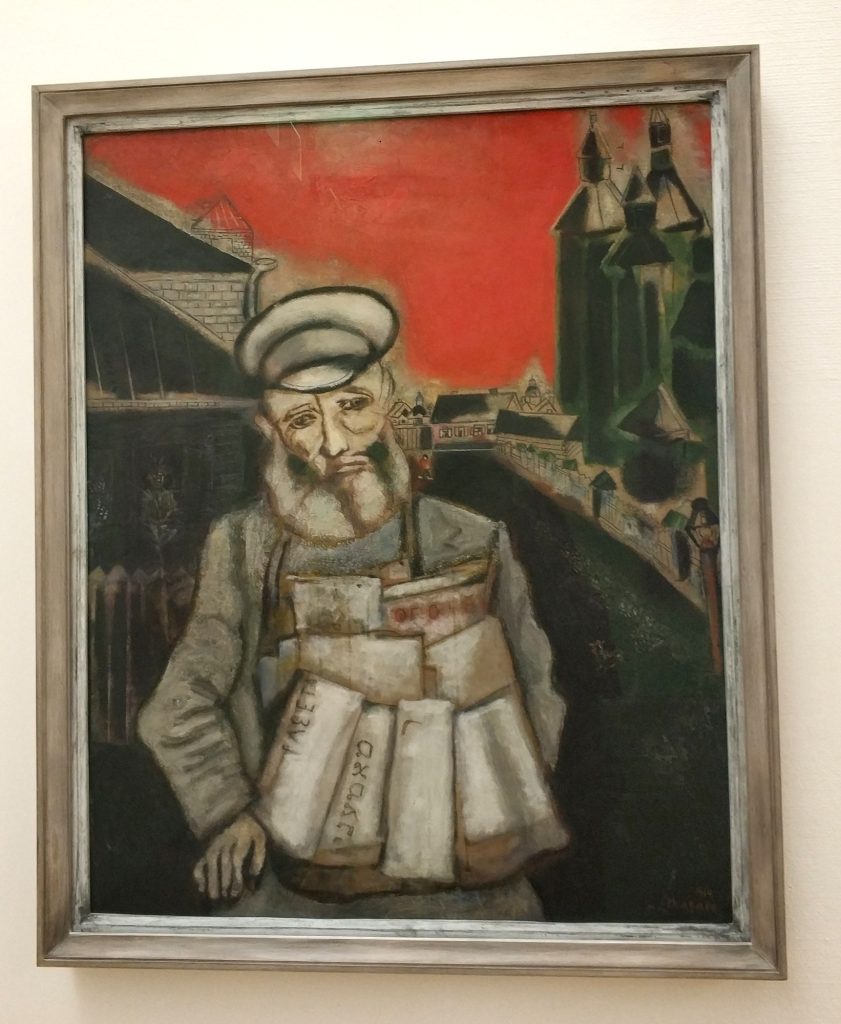
Painted in 1914, shortly after Chagall returned from Paris as World War I broke out, The Newspaper Vendor portrays an elderly Jewish hawker carrying newspapers in Russian and Yiddish. His weary expression, the gloomy town and the striking crimson sky capture the melancholy and anxiety of a world on the brink of war.
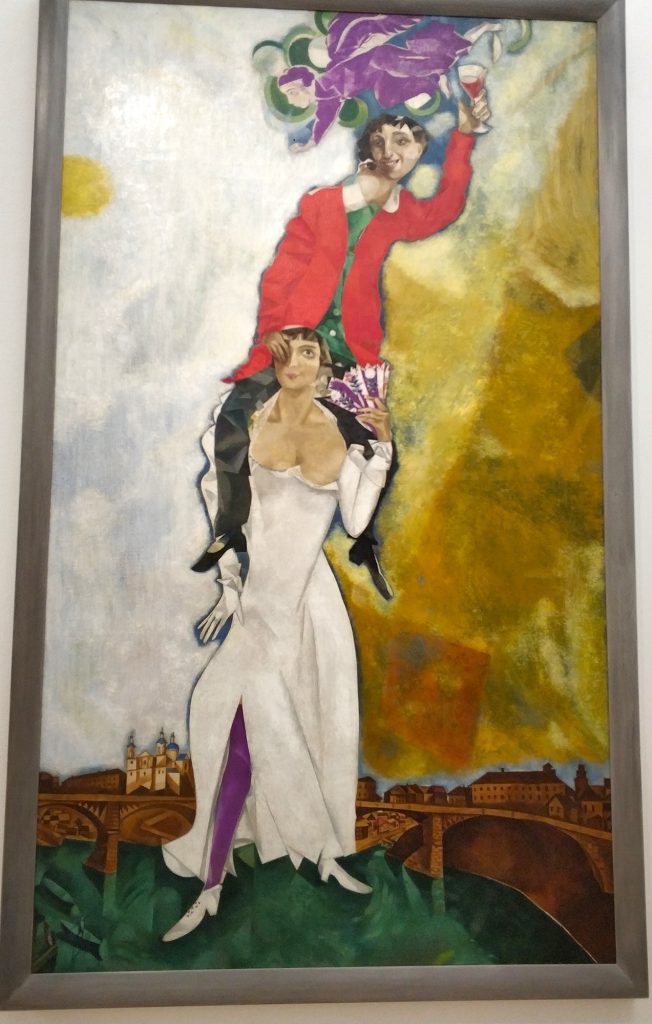
Chagall’s Double Portrait with Wine Glass celebrates his joyful marriage to Bella, with the artist perched on her shoulders, raising a toast as a purple angel hovers above. Blending Cubist fragmentation (seeing several sides of an object at once, rather than from a single viewpoint) with vivid, dreamlike Fauvist colours, the painting captures their love against a panorama of their beloved Vitebsk.
Fernand Léger (1881–1955)
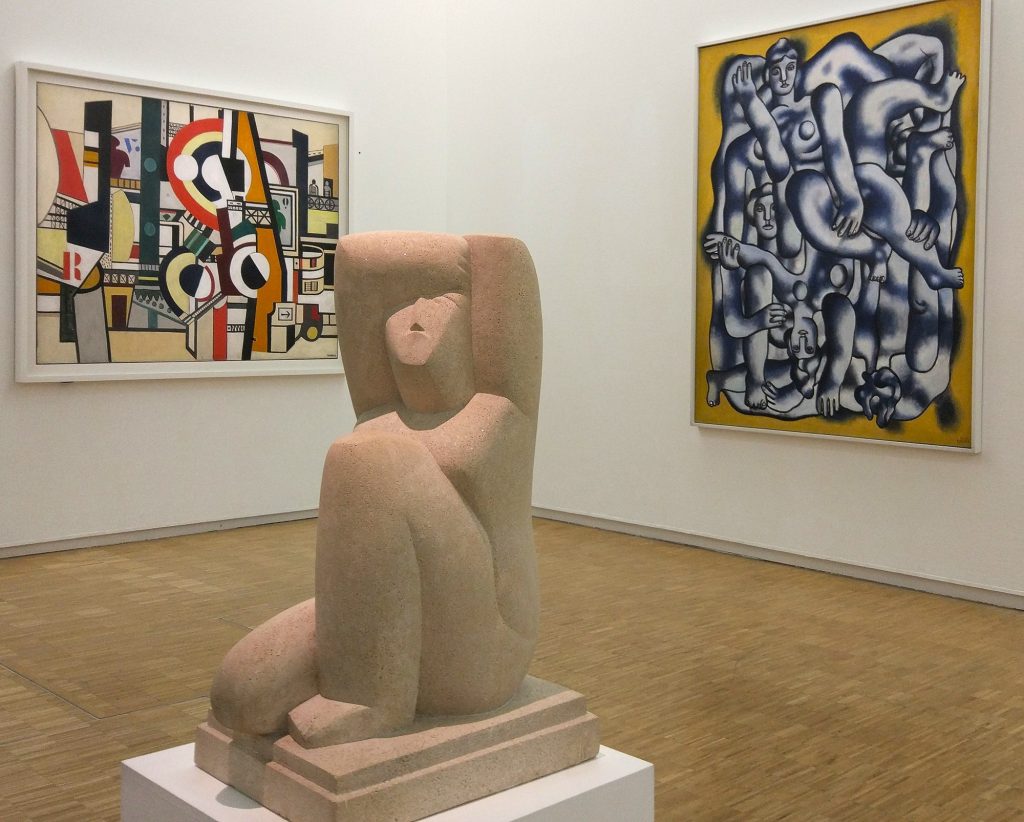
Then there was Fernand Leger ,an artist new to me. French painter Fernand Leger developed a highly distinct, modern style often referred to as Tubism or Mechanical Cubism, celebrating the speed, geometry and industrial spirit of 20th-century life. His experience serving as a soldier in World War I deeply transformed his art, leading him to admire the clean beauty of functional machinery, metal cylinders and industrial craftsmanship. Leger’s monumental works across painting, murals, film and ceramics bridged the gap between avant-garde abstraction and popular culture, influencing generations of modern artists and Pop Art.
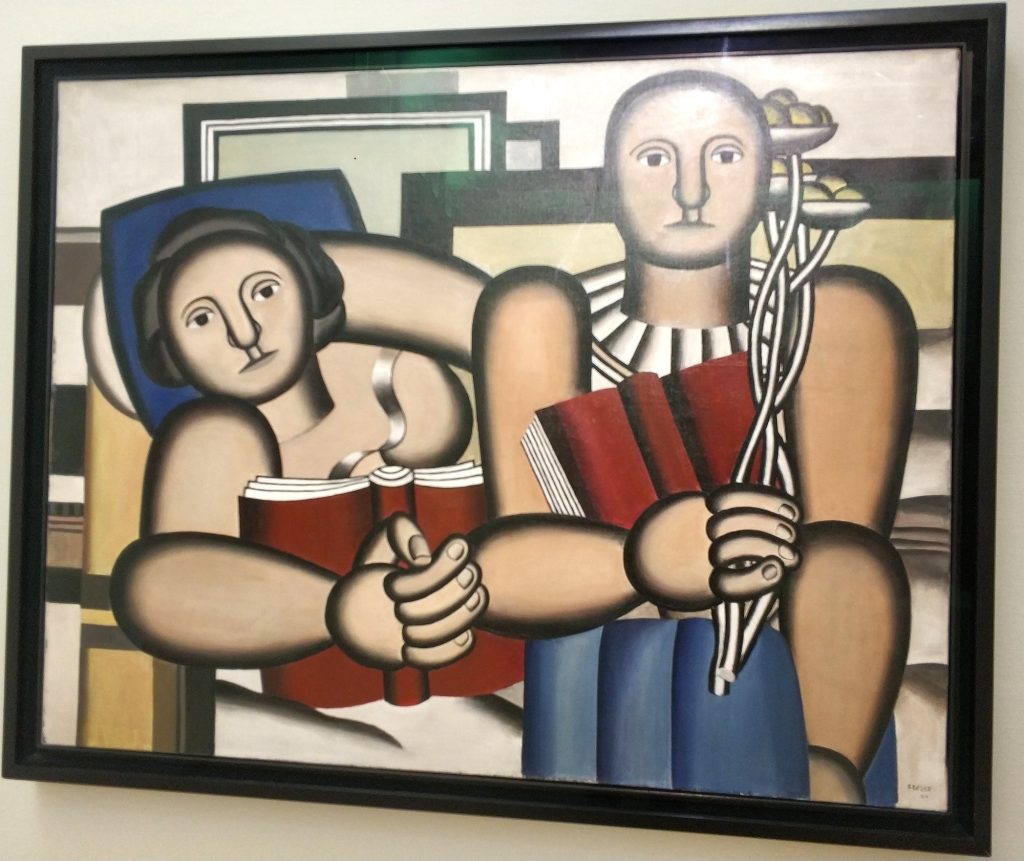
Painted in 1921, Léger’s Two Women Holding Flowers reimagines a traditional domestic scene through his mechanical style. The women’s tubular forms, bold black outlines and geometric planes reflect his fascination with industrial precision, structure and harmony.
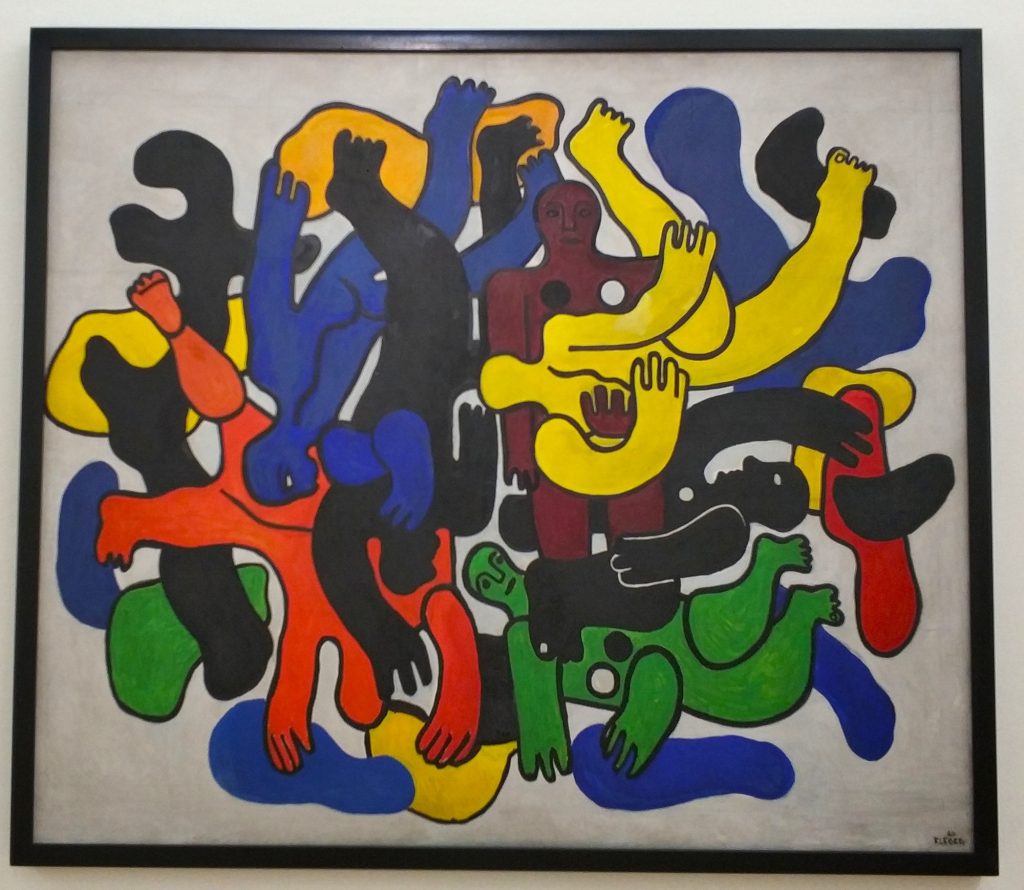
More than the women, I was spellbound by Léger’s The Acrobats (1948), with its joyous circus performers frozen in mid-air. Their intertwined limbs, bold black outlines and bursts of vivid primary colours create a wonderful sense of movement, energy and optimism.
In Acrobats in Gray, Léger revisits his favourite circus theme, depicting intertwined acrobats in sculptural shades of grey. Their powerful, tubular forms stand out against an ochre-yellow background, creating a striking sense of depth, rhythm and movement.
Pablo Picasso (1881–1973)
But probably the best of the moderns is Pablo Picasso. Spanish artist Pablo Picasso is universally acclaimed as one of the most influential figures of the 20th century, renowned for his continual reinvention of form, style, and technique. Alongside Georges Braque, Picasso revolutionary co-founded Cubism, breaking away from traditional perspective to depict subjects from multiple viewpoints simultaneously. Picasso’s vast body of work, spanning painting, sculpture, ceramics and printmaking , redefined the boundaries of artistic expression and continues to shape modern visual culture worldwide.
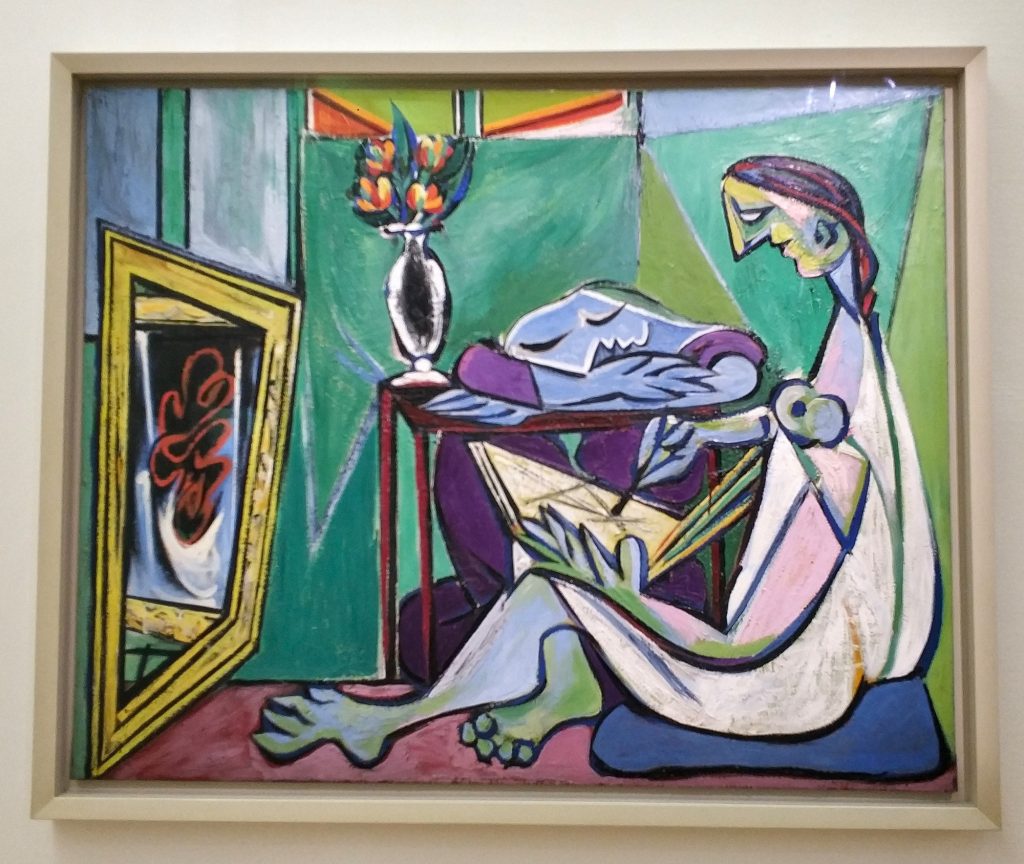
Pablo Picasso’s The Muse was painted in early 1935 during a period of deep personal transition. This work explores the theme of creative inspiration, featuring his young muse, Marie-Thérèse Walter. The scene centers on two allegorical figures, one seated on the floor intent on drawing, while the other slumped across a table in sleep, set against a framed mirror reflection and a vase of flowers. Marked by sweeping curvilinear arabesques, soft biomorphic shapes (abstract shapes and forms inspired by nature and living organisms, such as plants, cells, leaves and flowing organic structures) and bold planes of cool violet, emerald green and white, the composition balances peaceful contemplation with rhythmic visual geometry. Its luminous green atmosphere and serene intimacy create an almost hypnotic, dreamlike stillness .
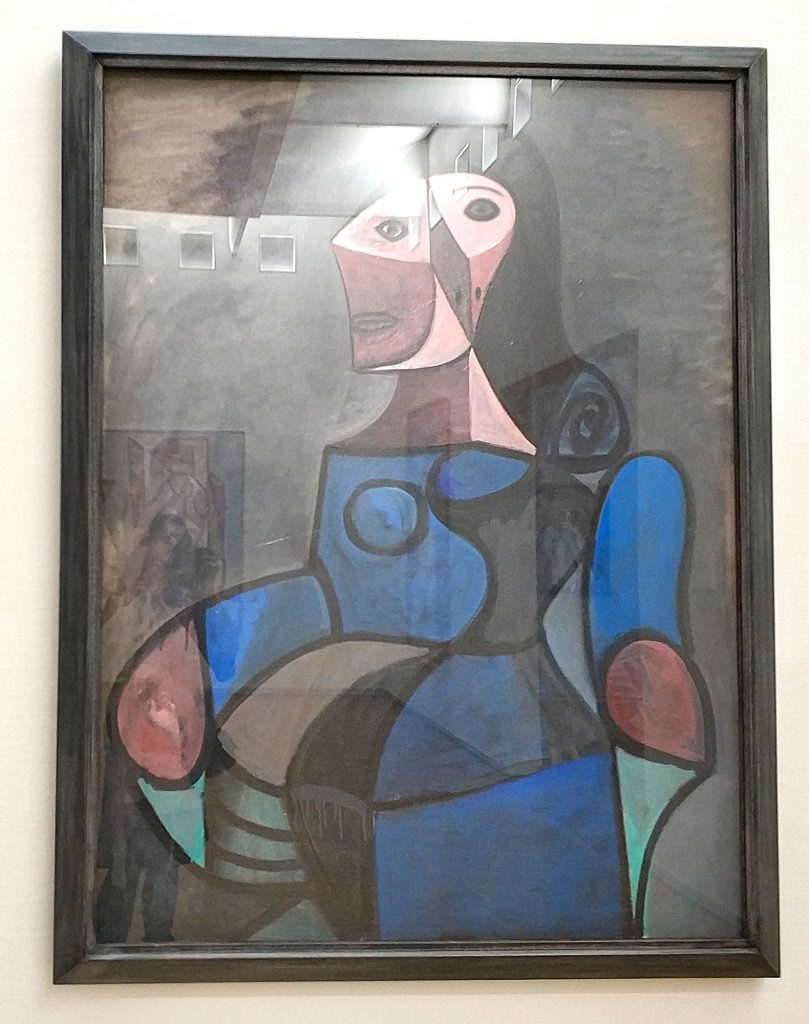
Picasso’s Portrait of a Woman was painted in May 1938 and depicts Picasso’s muse and partner, the Surrealist photographer Dora Maar, rendered during a period of intense personal and political turmoil in Europe. Picasso deconstructs the figure into overlapping architectural planes, presenting a simultaneous profile and frontal view of the face with sharp, almond-shaped eyes and stylized features. Dominated by cool cerulean blues, muted grays, and soft rose tones, the canvas pairs bold structural lines with a somber, reflective atmosphere characteristic of Picasso’s late 1930s portraiture. I loved its intense, geometric poise and striking cool color palette.
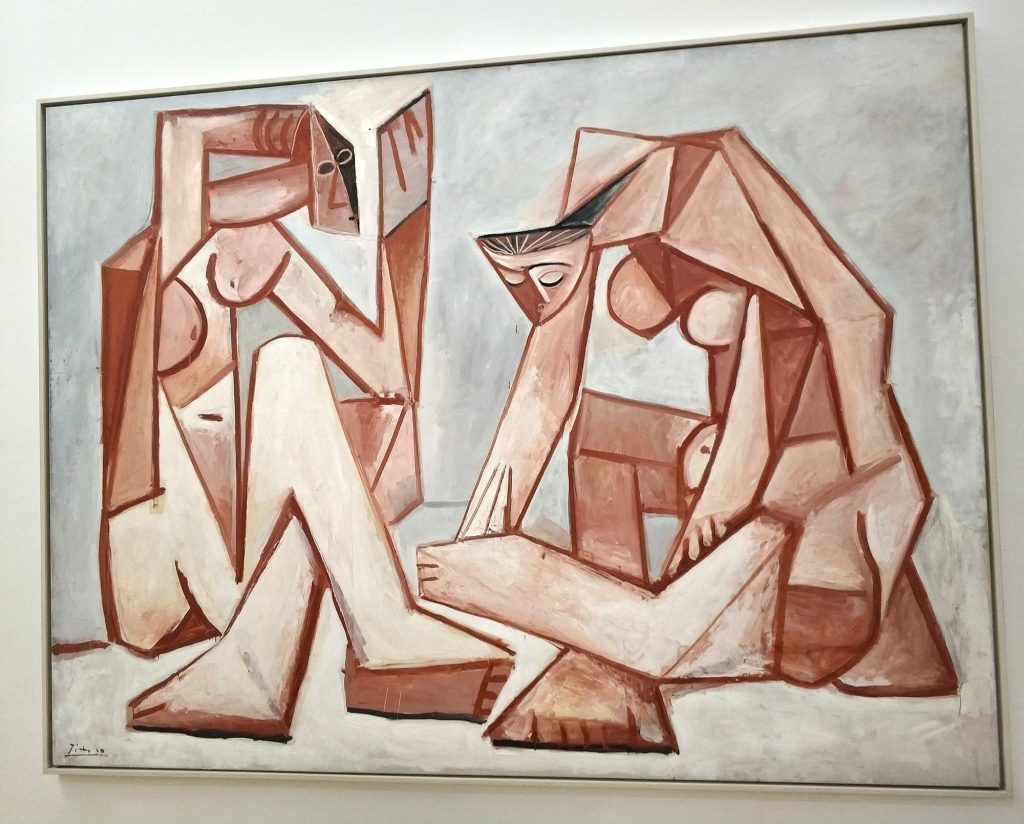
Pablo Picasso’s monumental Two Nudes was my favourite among all his paintings. Created in 1920–1921, this large-scale canvas reflects Picasso’s Neoclassical phase following World War I. Picasso renders two seated female figures with exaggerated, blocky proportions and heavy outlines. Their raw, angular limbs and bone-white geometry make them feel less like painted canvas and more like ancient, sculpted monuments resting in the quiet space. Utilizing a sparse, earthy palette of warm terracotta brown, ochre, grey and off-white, the composition relies on radical simplified planes and stark light-and-shadow to convey massive physical presence. I guess the sculpture -like quality of the painting made it one of my favourites.
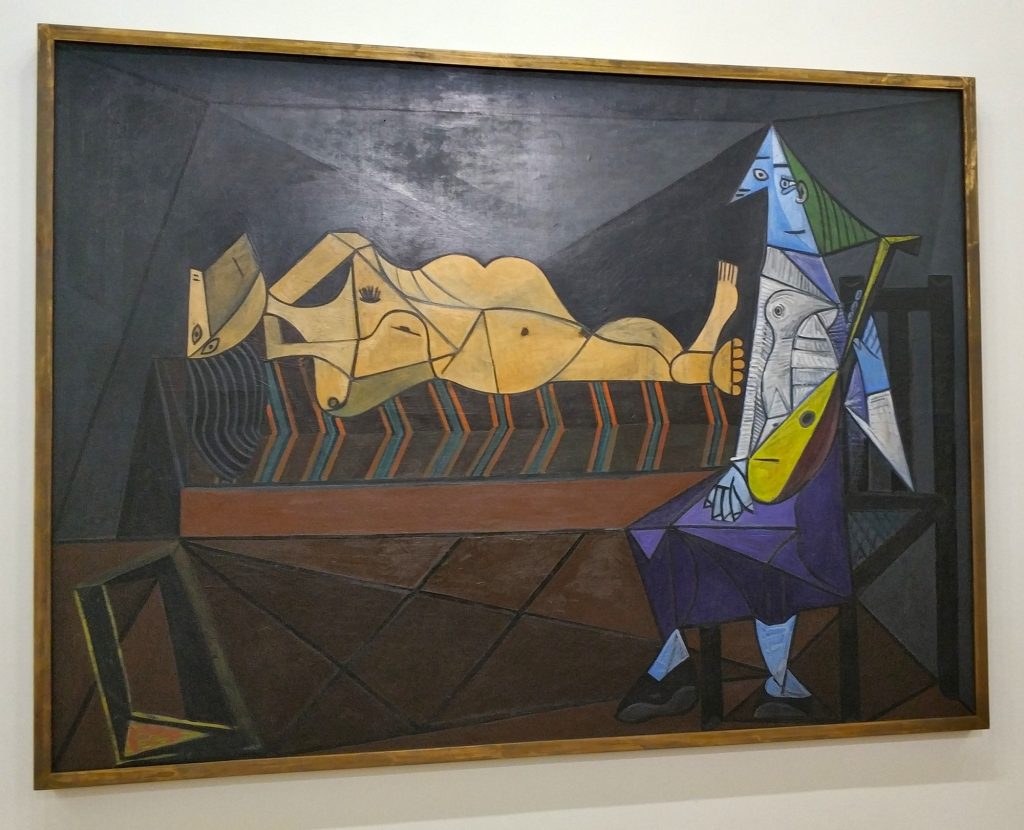
In L’Aubade, Picasso ditches bright colors and uses a muted palette of dark slates, murky browns and sickly yellows, relying on angular geometry and sharp lines to express psychological restriction. Completed on May 4, 1942, during the Nazi occupation of Paris, this canvas subverts the traditional art theme of a morning love song (aubade) played for a resting lover. Rather than romantic, the atmosphere is suffocating and tense; the sharp, spiky bed and tomb-like figures of the musician and the reclining woman against claustrophobic grey walls evoke a palpable sense of confinement, reflecting the anxiety, isolation and dark reality of wartime existence. I was completely gripped by its stark, brooding tension.
Other Modern Artists :
But there were other artists who I experienced for the first time. Here are some of their paintings from the Pompidou Centre :
Andre Derain
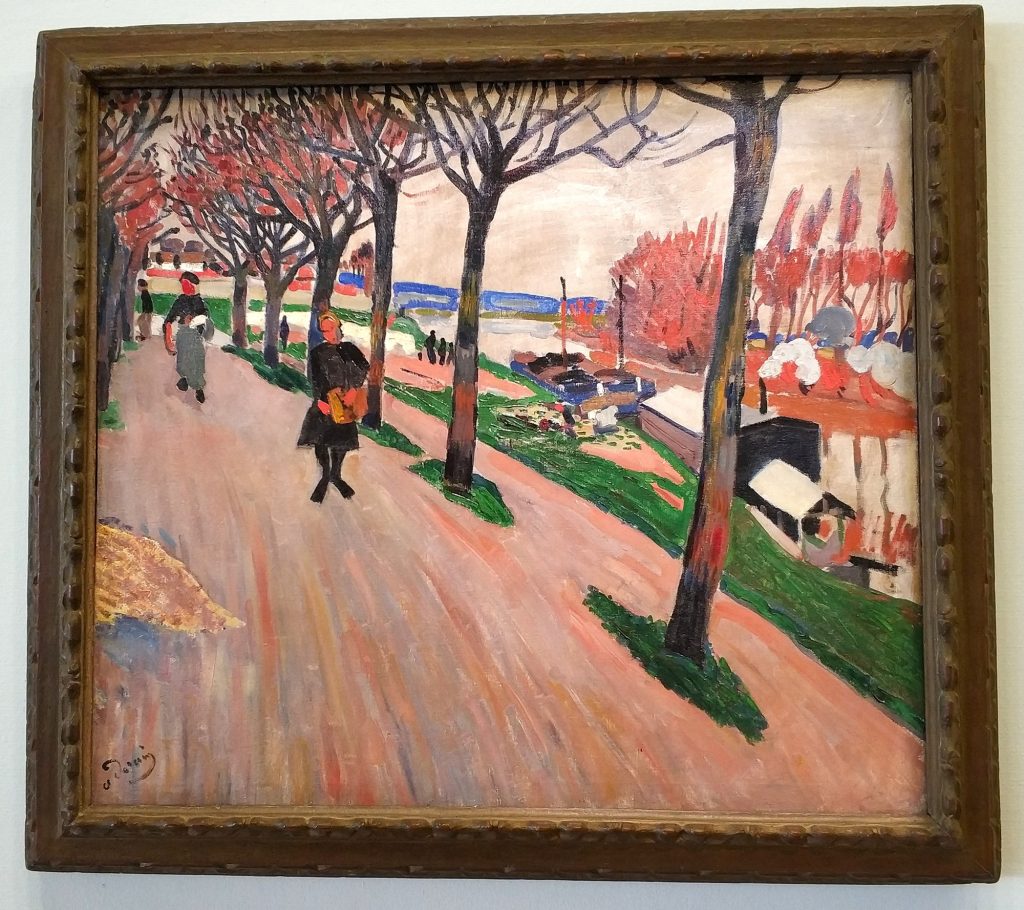
Painted in 1906, Andre Derain’s The Seine at Chatou captures peaceful riverside life through bold Fauvist colours and expressive brushstrokes. With its vivid turquoise water, red foliage and pink pathways, the painting evokes the crisp air and quiet charm of the Parisian suburbs.
Georges Rouault
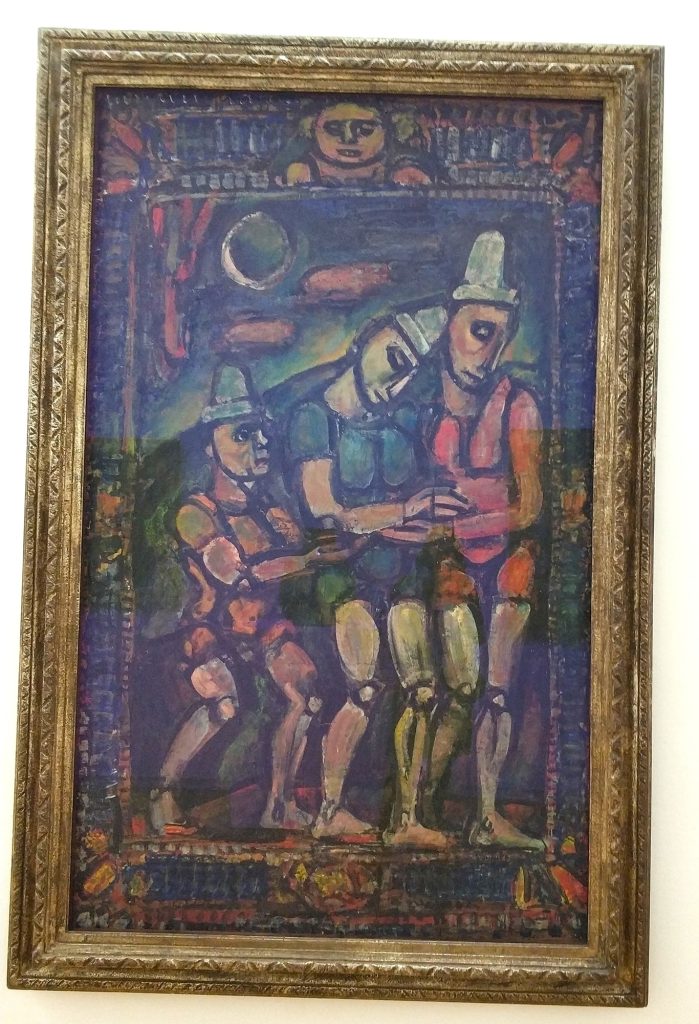
Rouault’s The Wounded Clown depicts an injured performer tenderly supported by two companions. With glowing jewel tones and thick black outlines reminiscent of stained glass, Rouault transforms a simple circus scene into a deeply moving expression of human suffering, compassion and dignity.
Eugène Zak
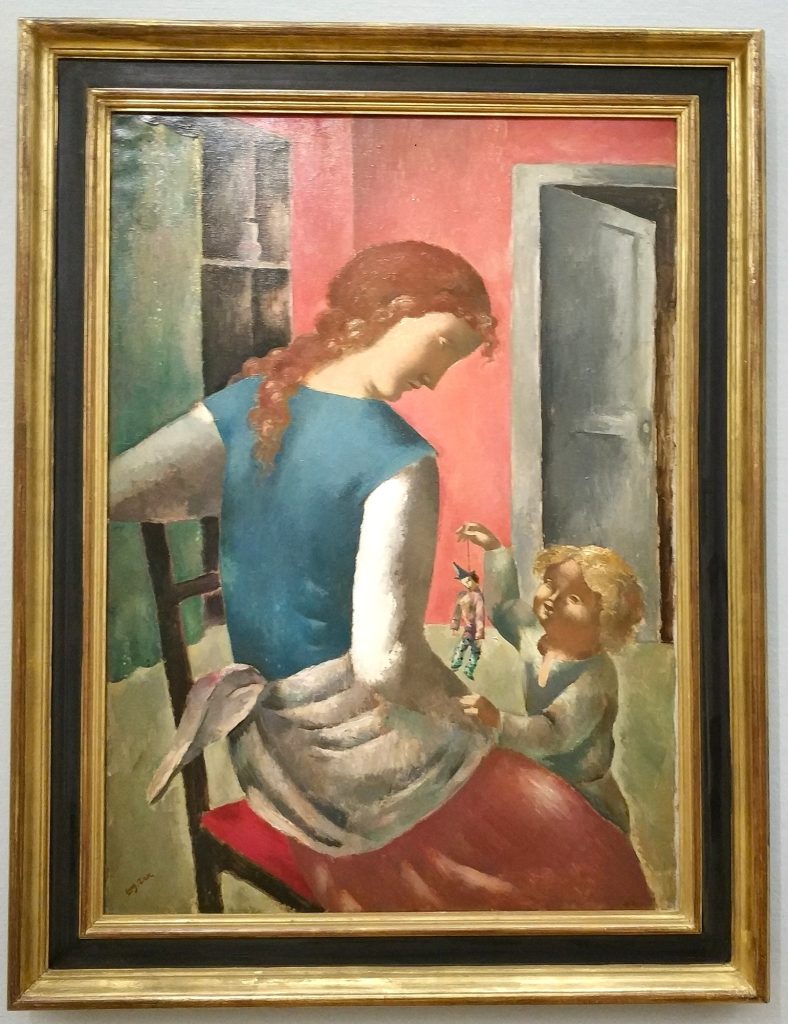
Eugène Zak’s Mère et enfant , radiates a tender, quiet warmth as the mother gazes gently down at her young child holding up a toy. The soft coral background, delicate lines and nostalgic atmosphere immediately wrapped me in a moment of tranquil intimacy.
Tamara de Lempicka
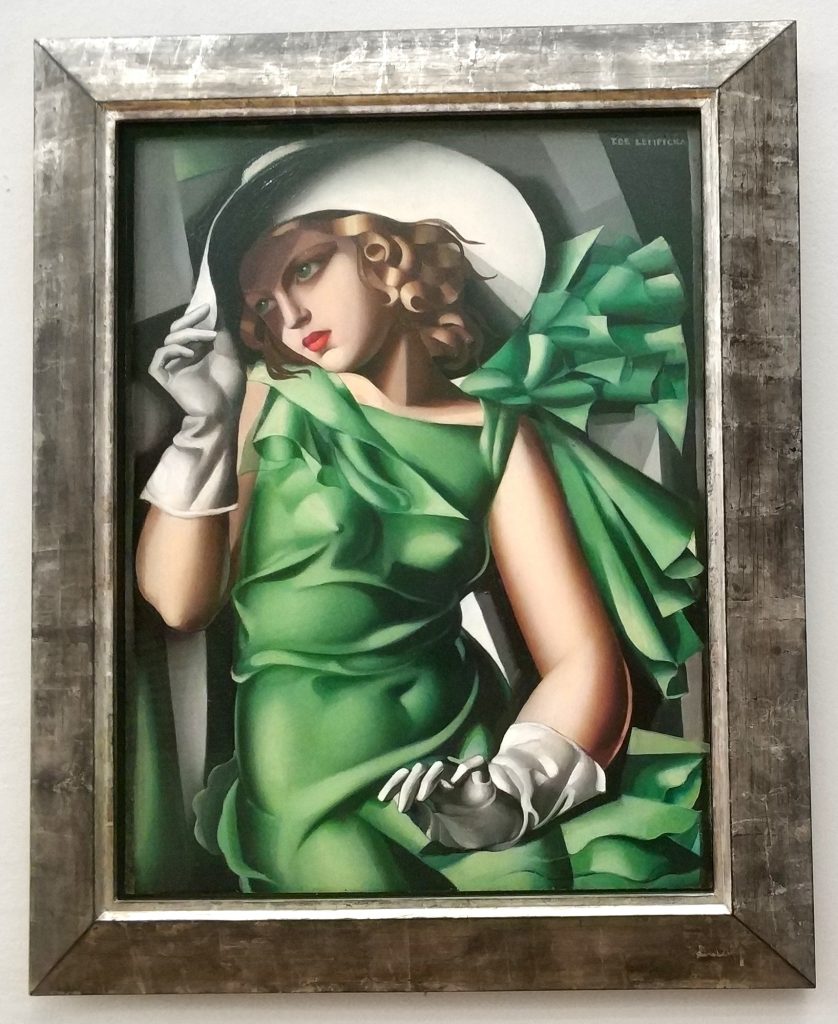
Tamara Lempicka’s Young Lady in Green captures the glamour and independence of the Roaring Twenties. Its emerald-green drapery, set against sharp white accessories ( crisp white gloves and sculpted, windswept brim of a hat,)and metallic grays ,sculpted features and glossy, geometric forms create a striking blend of soft Cubism and Art Deco elegance(a decorative art and design movement popular in the 1920s and 1930s, characterised by geometric shapes, sleek lines, rich colours, symmetry and luxurious finishes). I was captivated by its sleek, statue-like beauty.
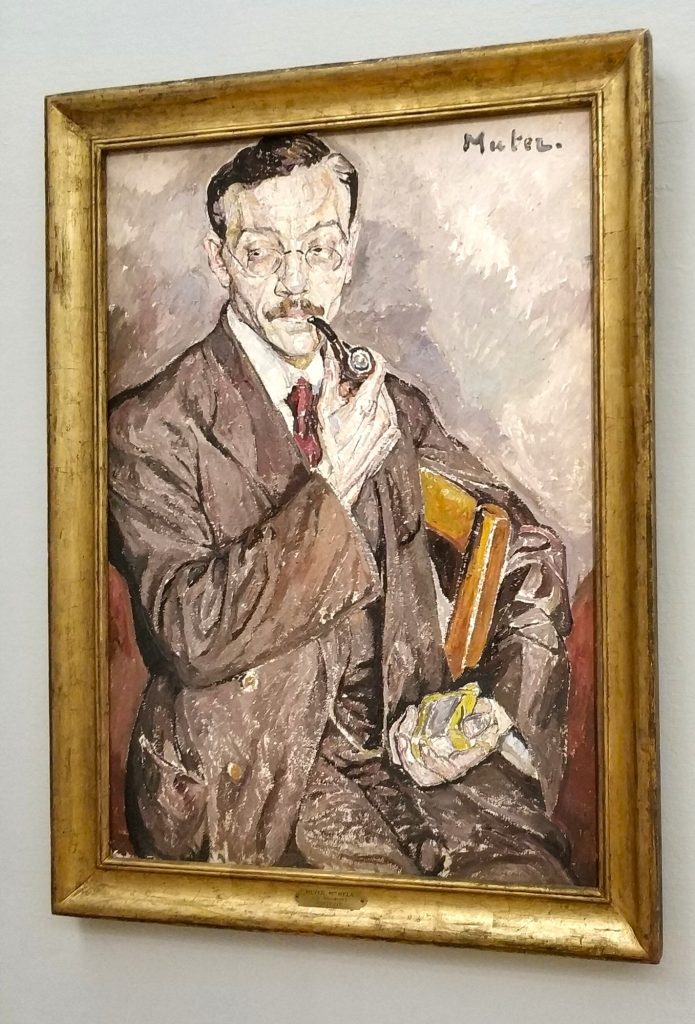
There were works of many more artists like Mane-Katz , Mario Tozzi, Kees Van Dongen , Pevsner, Albert Marquet, Sonia Delaunay , Mela Muter ,Natalia Goncharova ,Frans Masereel ,Alberto Magnelli , Alberto Savinio , Alfred Lombard, Bram van Velde ,Albert Gleize, and Chaim Soutine .
Here are some of their paintings :
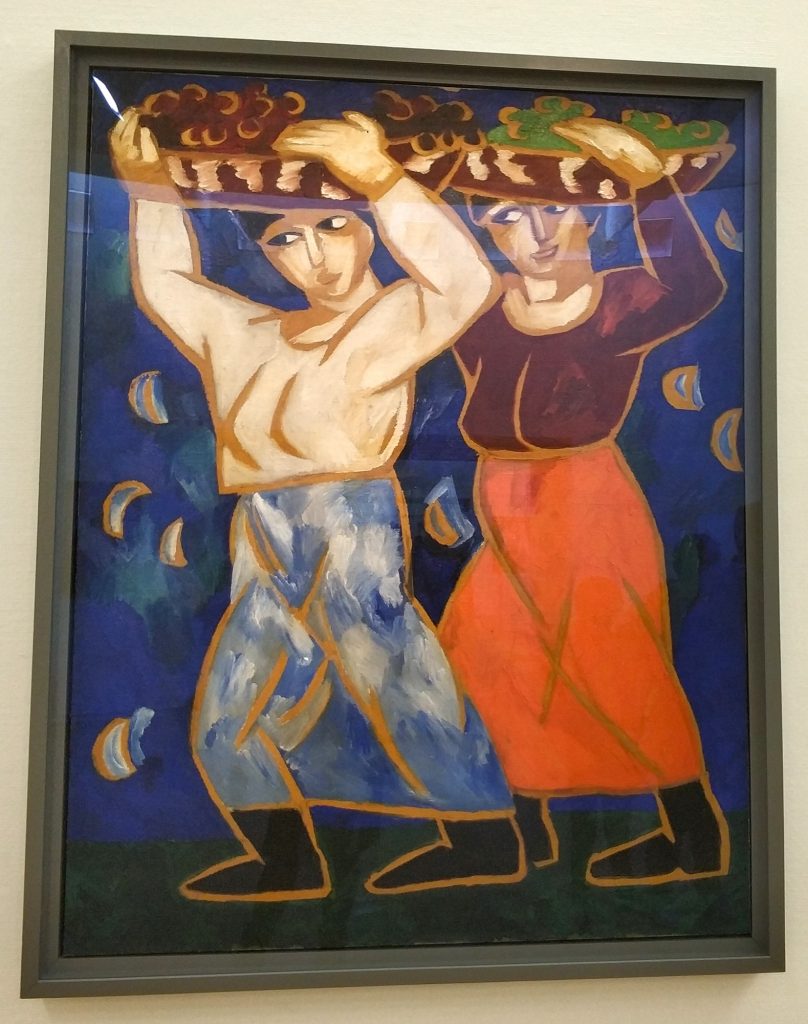
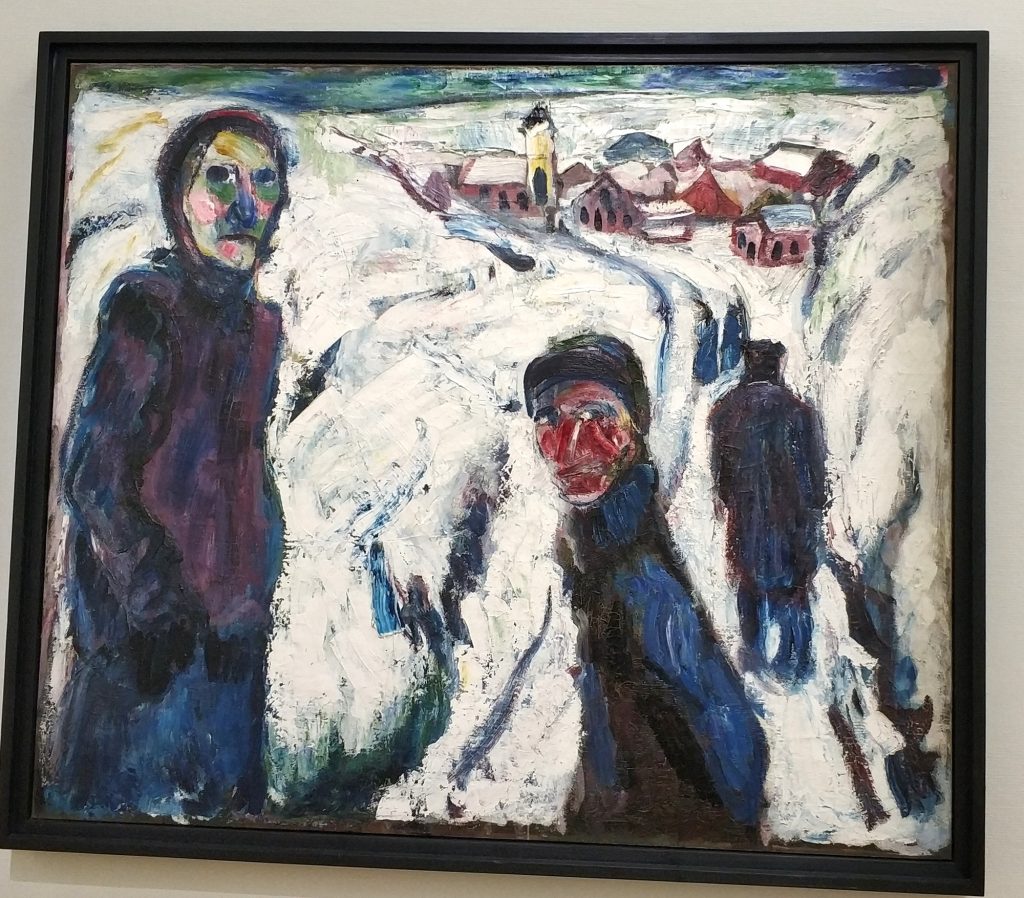
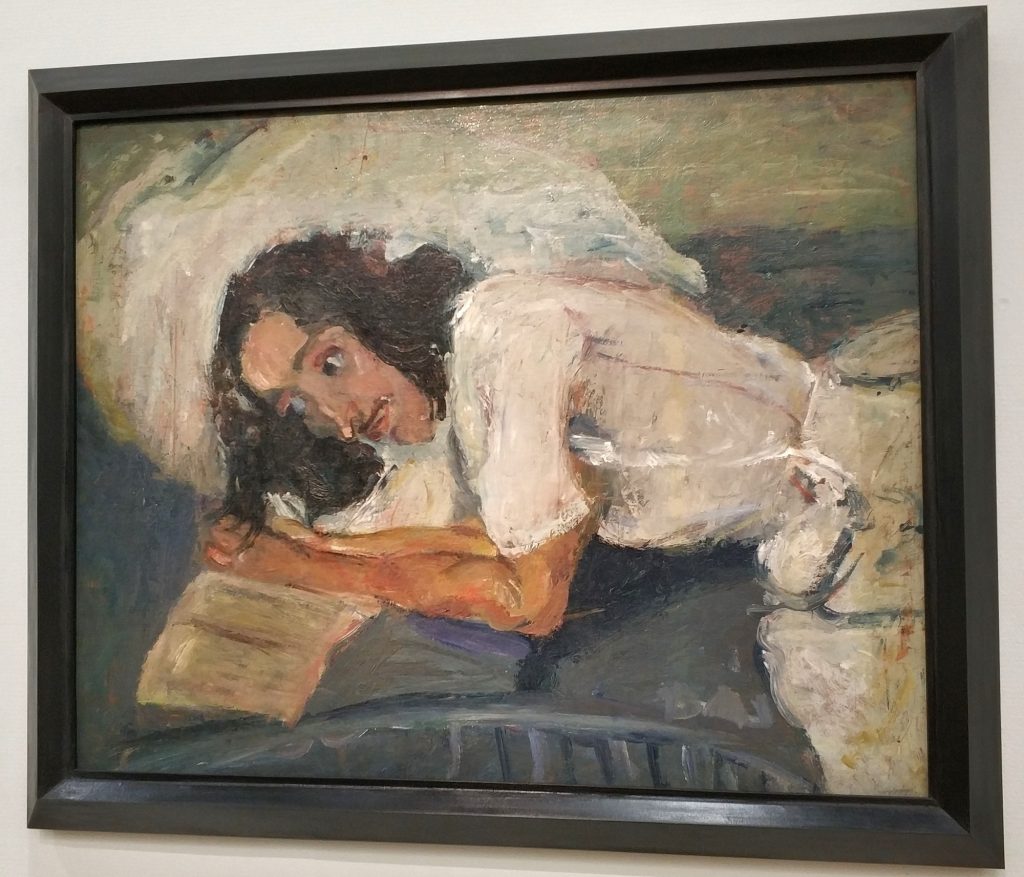
After a barrage of modern art it was time to go through the abstract contemporary art section.
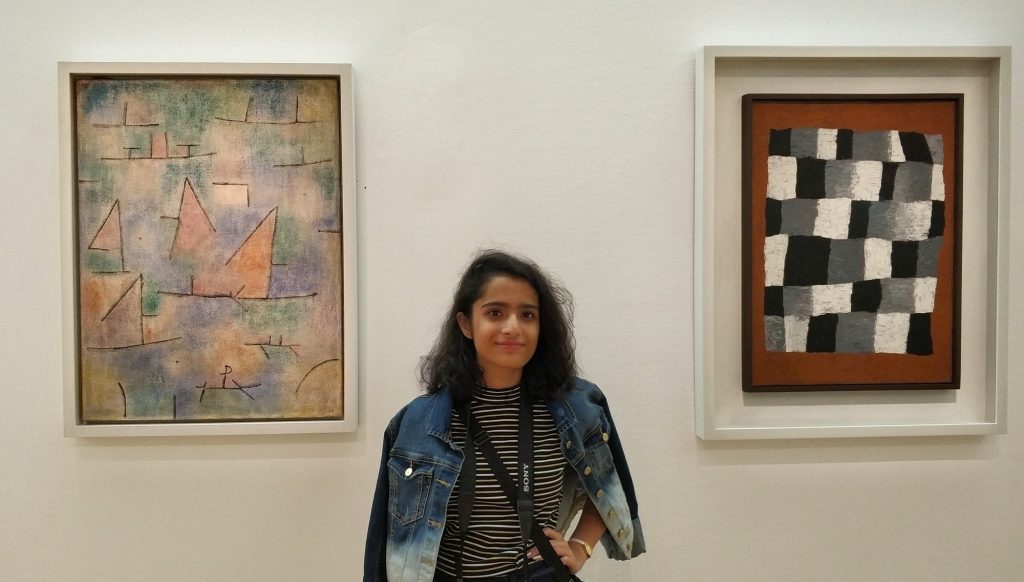
Standing before the paintings of Kandinsky, Klee, Pollock ,Mondrian and Rothko I was puzzled over what to make of them. I’ve grown up appreciating art where you can recognize what the artist is showing you. I look at a Leonardo da Vinci painting and see people, their expressions, their clothing, the landscapes behind some of them. There is extraordinary skill, beauty, perspective and human observation in each painting. Then I look at Van Gogh‘s paintings, I see a starry night, a field of wheat, sunflowers. His paintings are still recognizable. You see his emotional state through the unusual colours, restless brushstrokes and movement.
And then I walk into a gallery and encounter Kandinsky, Klee, Pollock, Rothko or Mondrian. I find myself asking what exactly am I looking at? Why is this considered great art? Anybody could have painted these shapes. What am I supposed to feel or appreciate here? It was really difficult. But these are considered great art for a reason. Many people still don’t appreciate Van Gogh or Gauguin ,considering their work lacking skill. But to me they show a vibrant world of atmosphere, colour, light ,imagination and emotion which is more appealing than technical perfection alone.
In Classical art the achievement is observation, anatomy, perspective and technique; in Impressionism and Post-impressionism the achievement is translating the external world into personal emotion and in Modern art the achievement is using colour, line and shape as an independent visual language.
Kandinsky believed that colours and shapes could communicate emotions in much the same way as music. Klee‘s paintings often contain recognizable suggestions of houses, gardens, cities, faces and landscapes, but they are transformed into playful arrangements of lines, symbols and colours. Pollock‘s dripping, pouring and splattering splashes on the floor record movement, physical energy, spontaneity and the process of creation. Mondrian reduced painting to vertical and horizontal lines, rectangles and a limited palette of colours creating beauty in proportion, balance and structure. These artists represented art through beauty of colour, freedom of imagination innovation of technique ,personal interpretation and emotional expression through form. The biggest shift was this: artists moved away from representing the world realistically and began exploring ideas, emotions, shapes and materials. So you have to appreciate their art with a different mindset altogether.
Wassily Kandinsky (1866–1944)
I was highly impressed by the paintings of the Russian painter Wassily Kandinsky, a pioneer of modern abstract art who sought to express inner spirituality rather than the physical world. After his influential years at the Bauhaus (a German school of art, architecture and design emphasizing that that art should combine beauty, simplicity and functionality), he spent his final decade in Paris, developing a style blending geometric forms with organic, nature-inspired abstraction. Influenced by Synesthesia (the idea of expressing music through colours, shapes and rhythms). He treated colours and shapes like musical notes, rhythms and chords, creating visual compositions that echoed music.
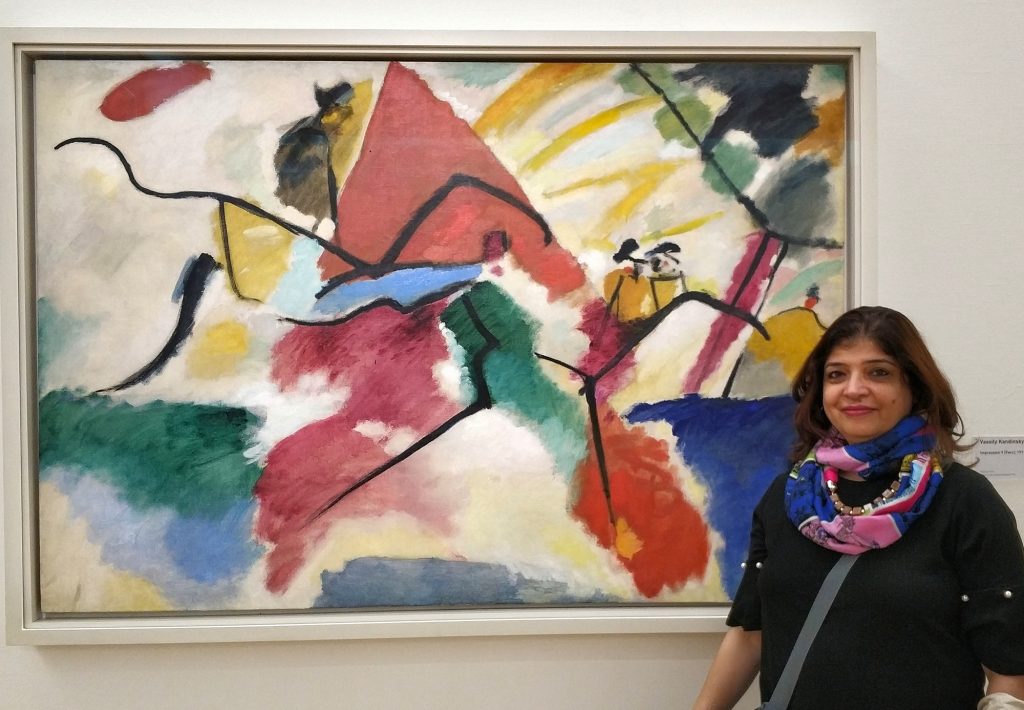
Wassily Kandinsky’s Painting with Red Spot (Bild mit rotem Fleck) was created in 1914 just before the outbreak of World War I. This landmark canvas belongs to Kandinsky’s iconic Munich period, marking a pivotal transition toward pure, non-objective abstraction. The composition is anchored by a prominent central red triangle and dynamic crimson wash, surrounded by clashing planes of deep blue, vivid yellow and sharp, zig-zagging black vector lines. True to Kandinsky’s theories, the painting functions like a visual orchestral score, where color harmonies and expressive line weights directly communicate emotional and spiritual tension.
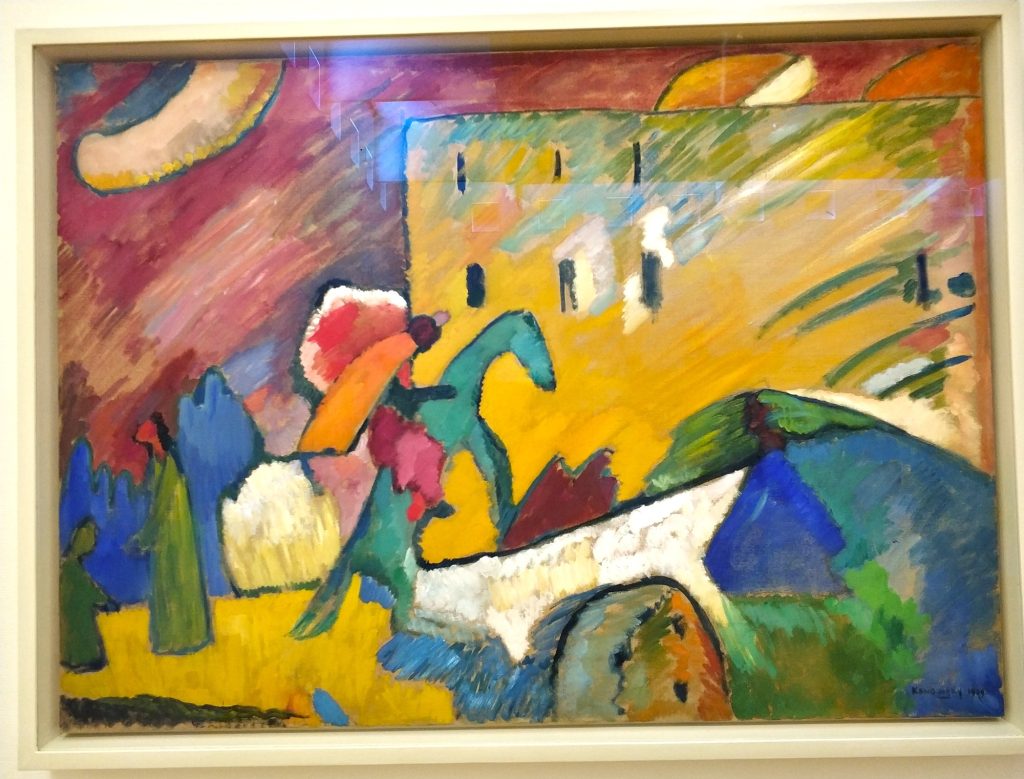
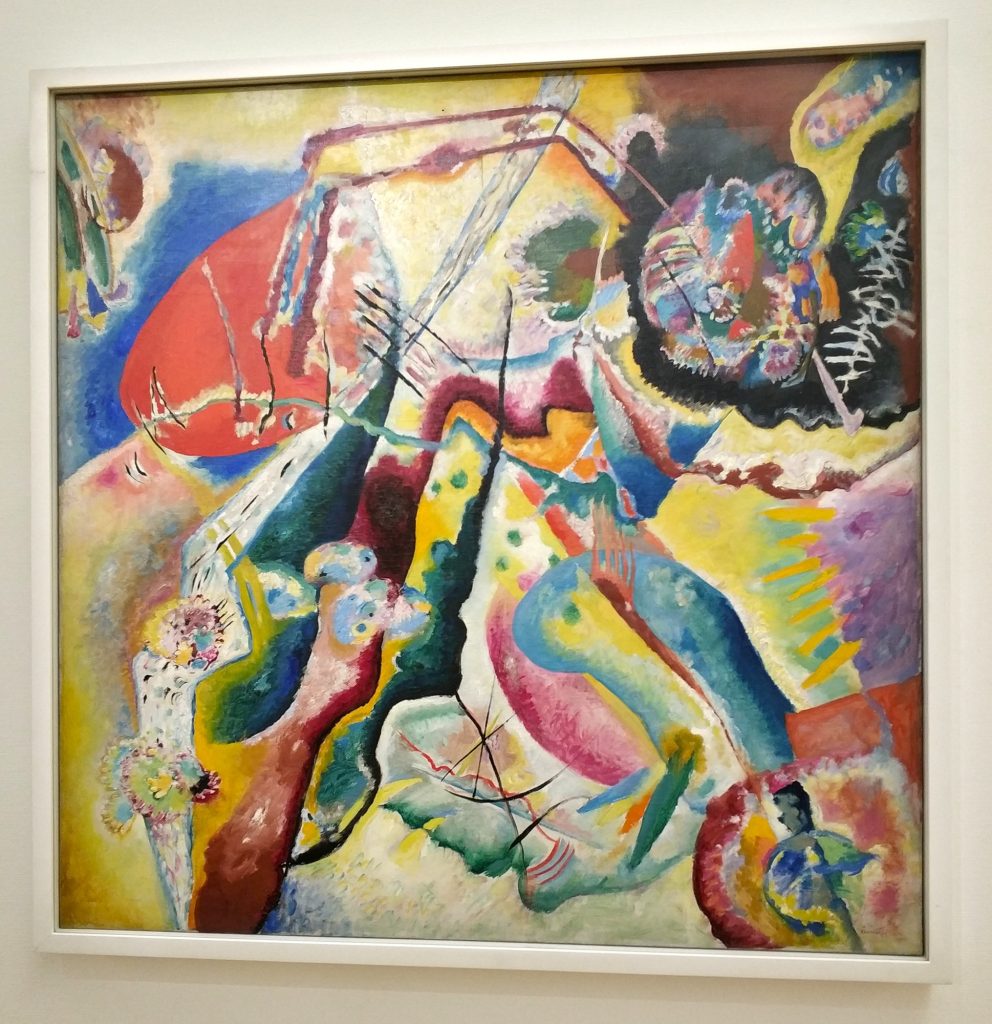
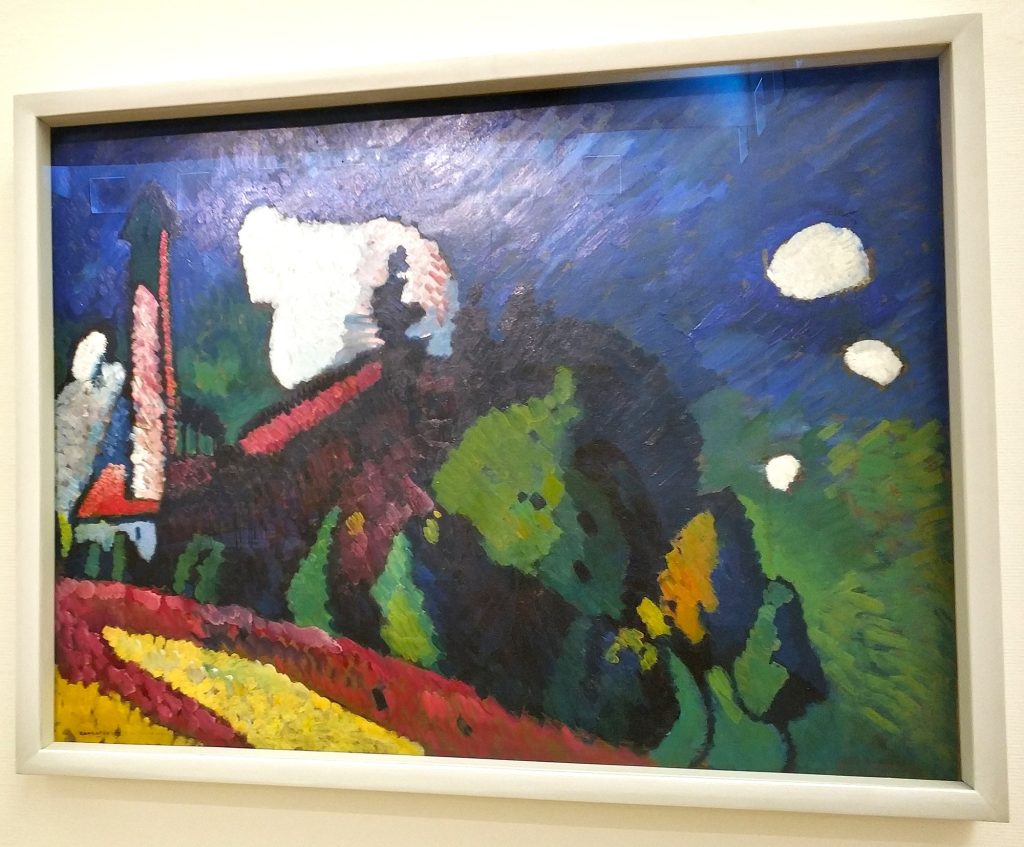
Other paintings by Kandinsky:
Paul Klee
Paul Klee was a distinctive modern artist whose work blended Expressionism, Cubism, Surrealism and Bauhaus influences. A gifted violinist from a musical family, he often composed paintings like music, using colour, rhythm and symbolism.
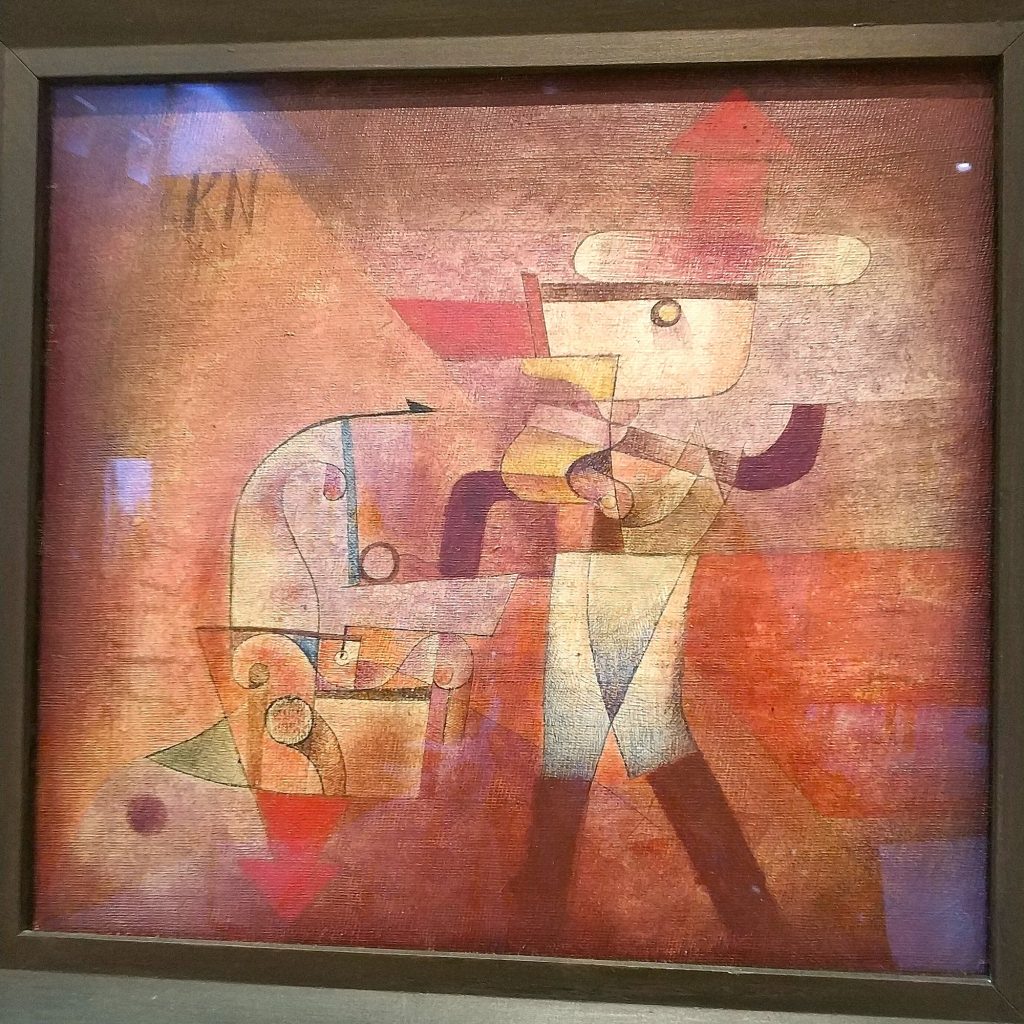
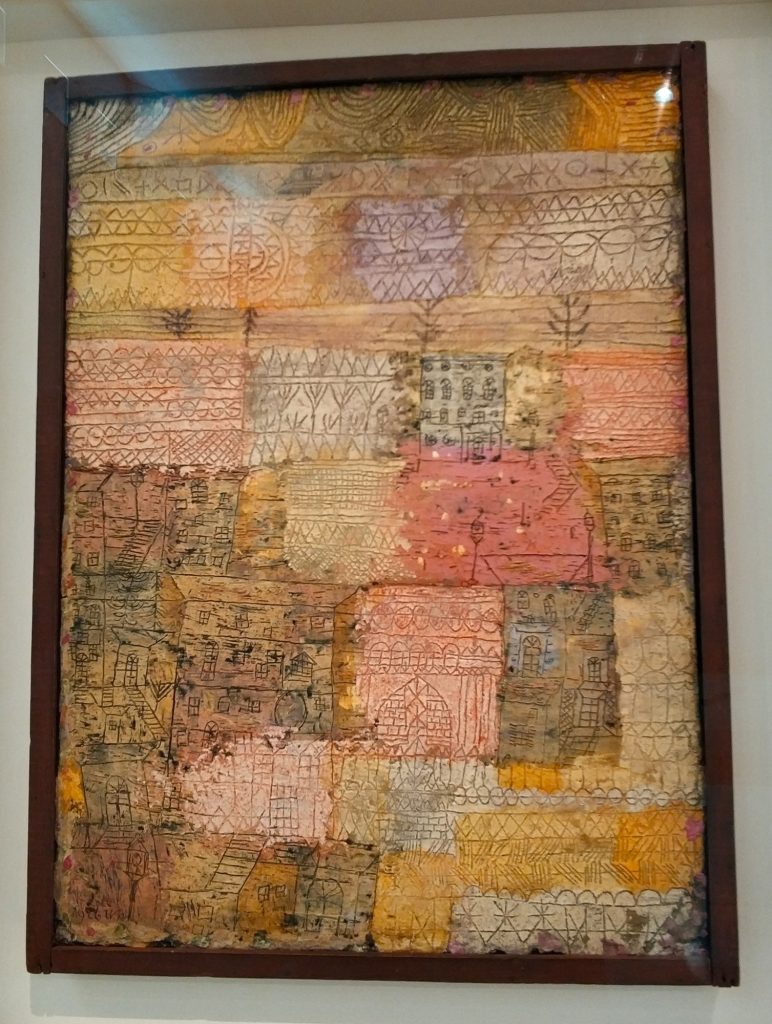
Paul Klee’s Florentine Villa Quartet ,was created in 1921 during Klee’s early Bauhaus period. This piece reflects his artistic impression of Florence‘s historic architecture, combining architectural motifs with rhythmic abstract structure. Klee executed this piece using oil and watercolor on paper, which was then mounted onto gauze and board, creating a delicate, woven, relic-like surface quality. Divided into horizontal bands and grid-like blocks, the artwork incorporates schematic drawings of villa facades, windows, arcades and stylized trees, translating spatial architecture into a visual musical score. Then his KN the Smith depicts a stylized blacksmith figure composed of angular geometric forms, overlapping planes and directional arrows. The arrow is one of Klee‘s most famous recurring motifs, symbolizing physical direction, human thought and spiritual yearning beyond the material world.
Robert Delaunay (1885–1941)
Wanted to mention Robert Delaunay because with his wife Sonia, he was the co-founder of Orphism, an art form which pioneered vibrant abstract art based on colour and light. He explored how contrasting colours create rhythm and movement, becoming renowned for his Eiffel Tower, circular disc and rhythm series.
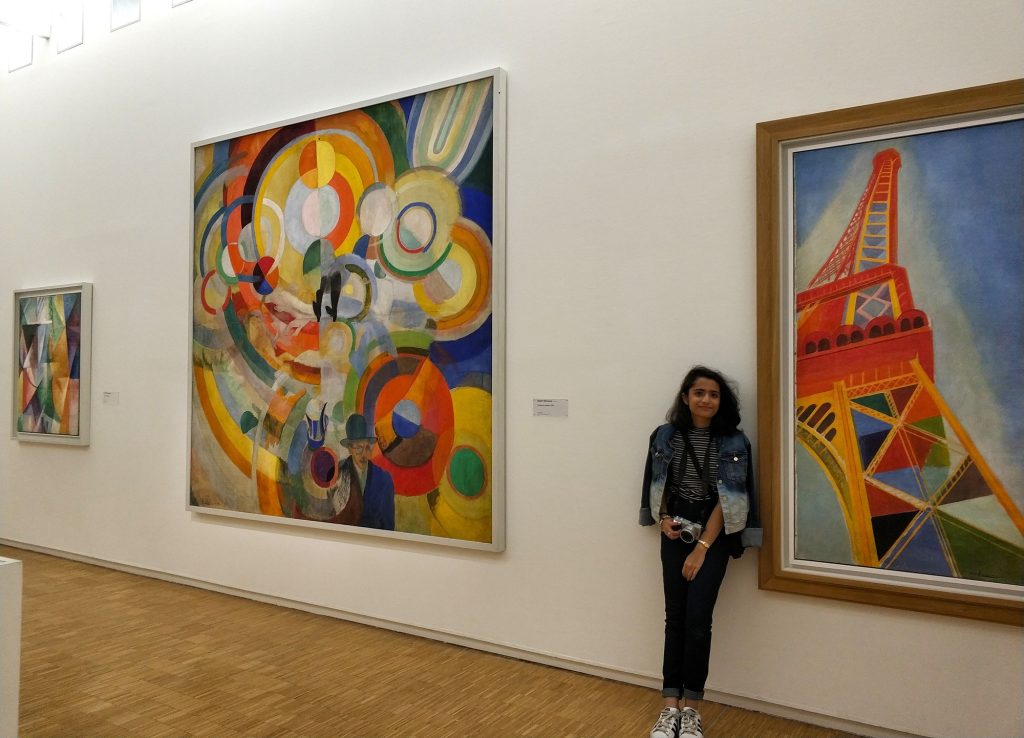
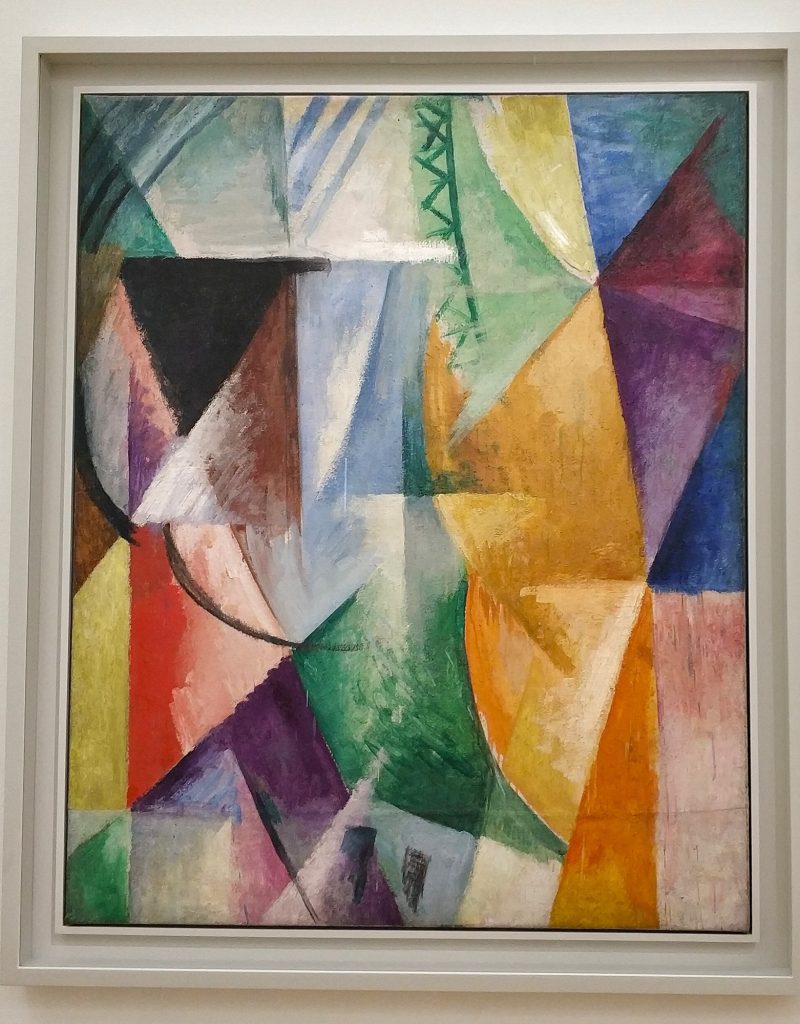
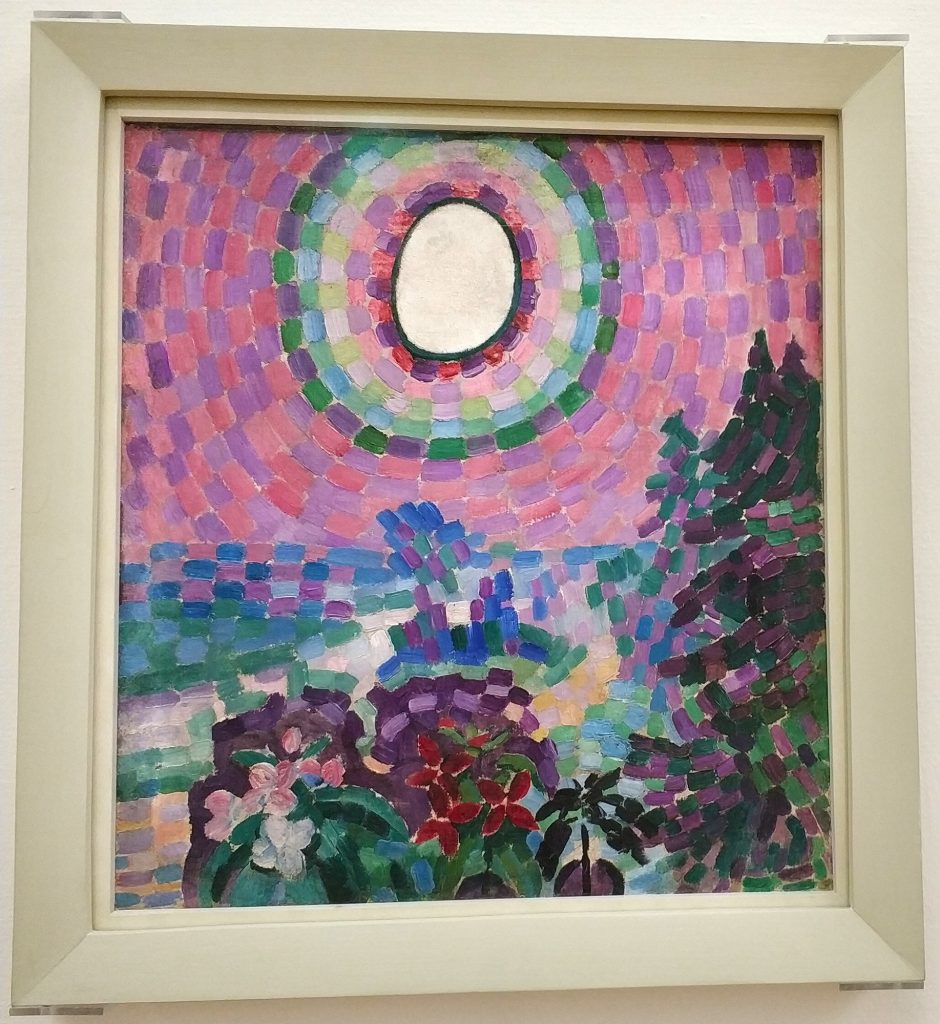
Delaunay’s Landscape with Disc was captivating with its glowing sun and vibrant mosaic of colours, while Une fenêtre transformed a Paris cityscape into a shimmering play of translucent greens, ambers and violets. In both, he uses contrasting colours and radiant light to create rhythm, depth and movement, gradually moving towards pure abstraction.
Installation art
Then there were the post war modern and contemporary art and installation arts. I won’t go into too much details of these since they were too many but I will give just a few examples.
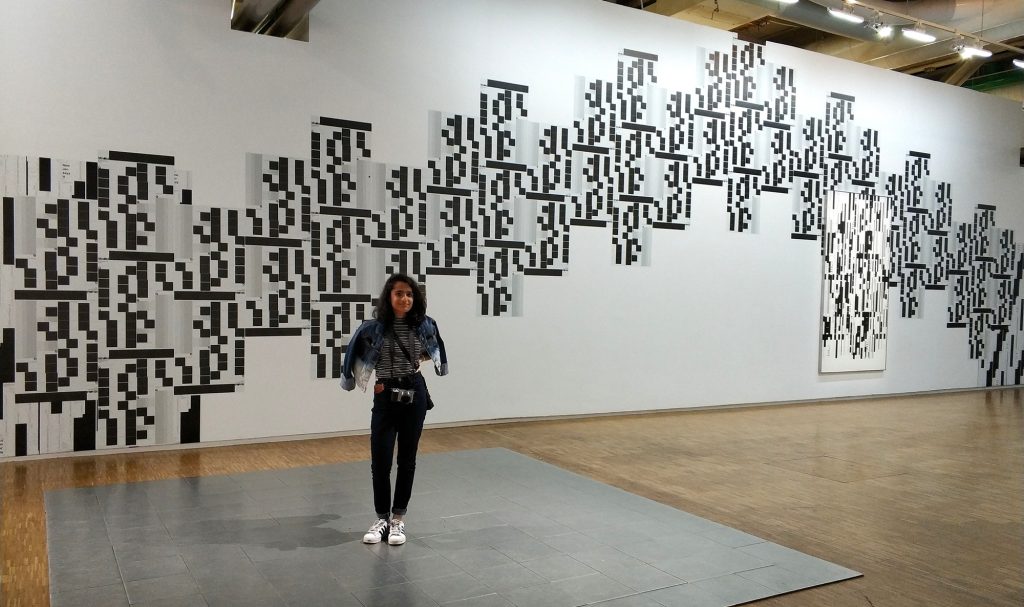
This large-scale, site-specific work is a conceptual/typographic installation art piece created using modular elements like printed or pixelated letterforms, symbols spanning across a main gallery wall alongside floor-embedded metal panels , designed to interact directly with the architectural space, turn the viewing experience into an immersive spatial interaction.
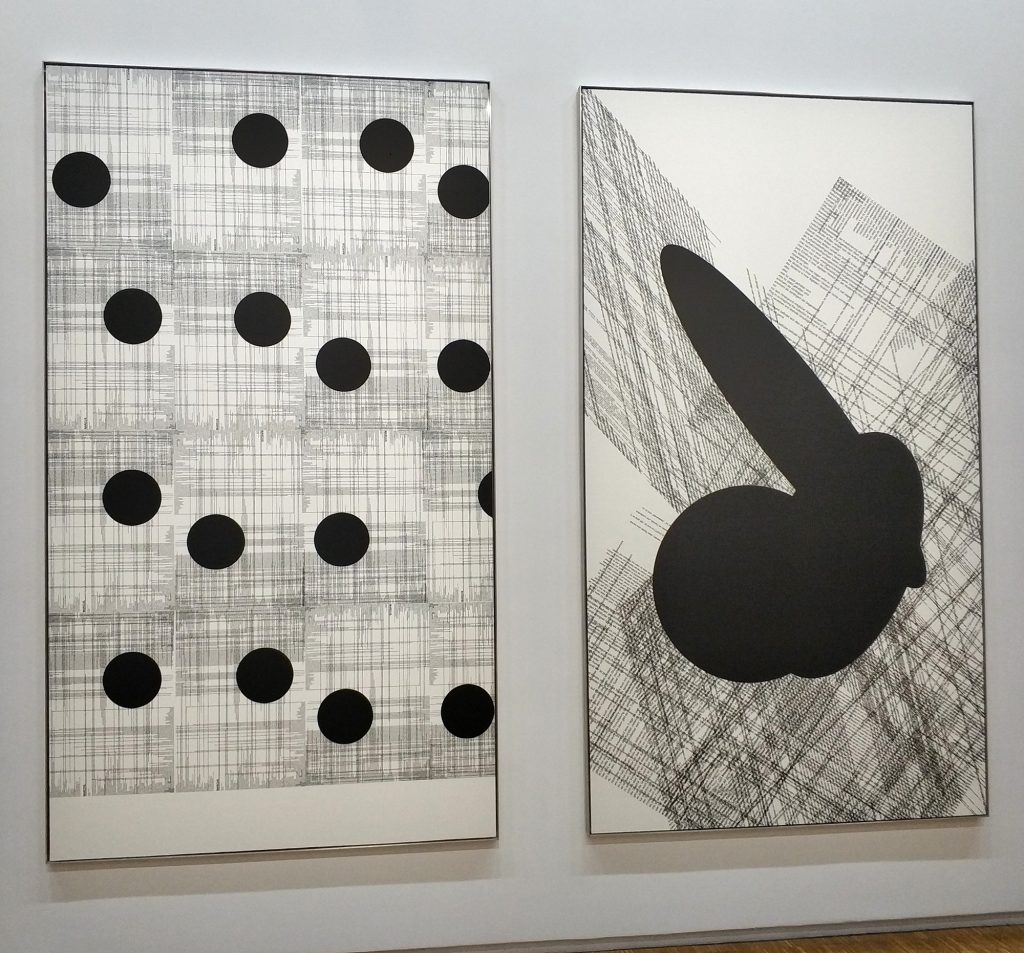
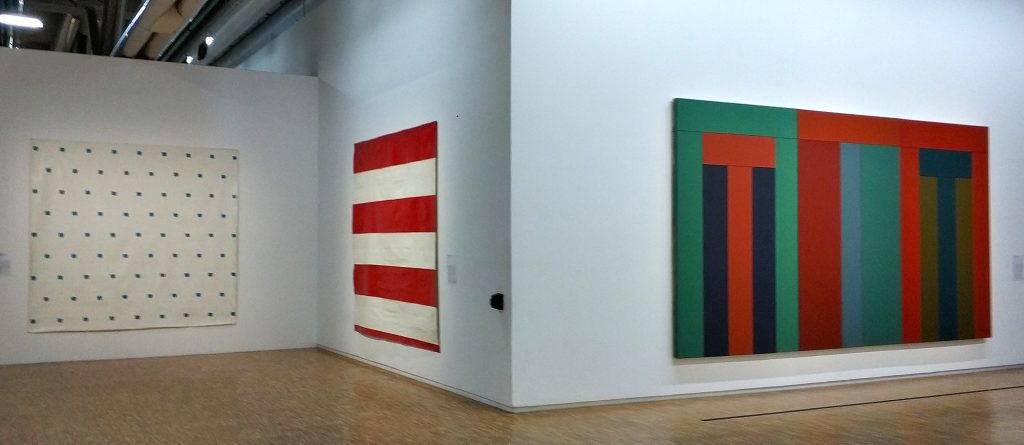
This is a monumental geometric and graphic diptych featuring stark black-and-white abstract compositions created through layered grid structures, fine cross-hatching, solid silhouettes and bold dot shapes. Mixed media such as silkscreen print, ink and acrylic on large vertical paper panels have been used. The pairing explores the tension between structural order (grids, systematic hatching) and organic, bold graphic forms (dots, solid silhouettes) using an unyielding monochrome palette.
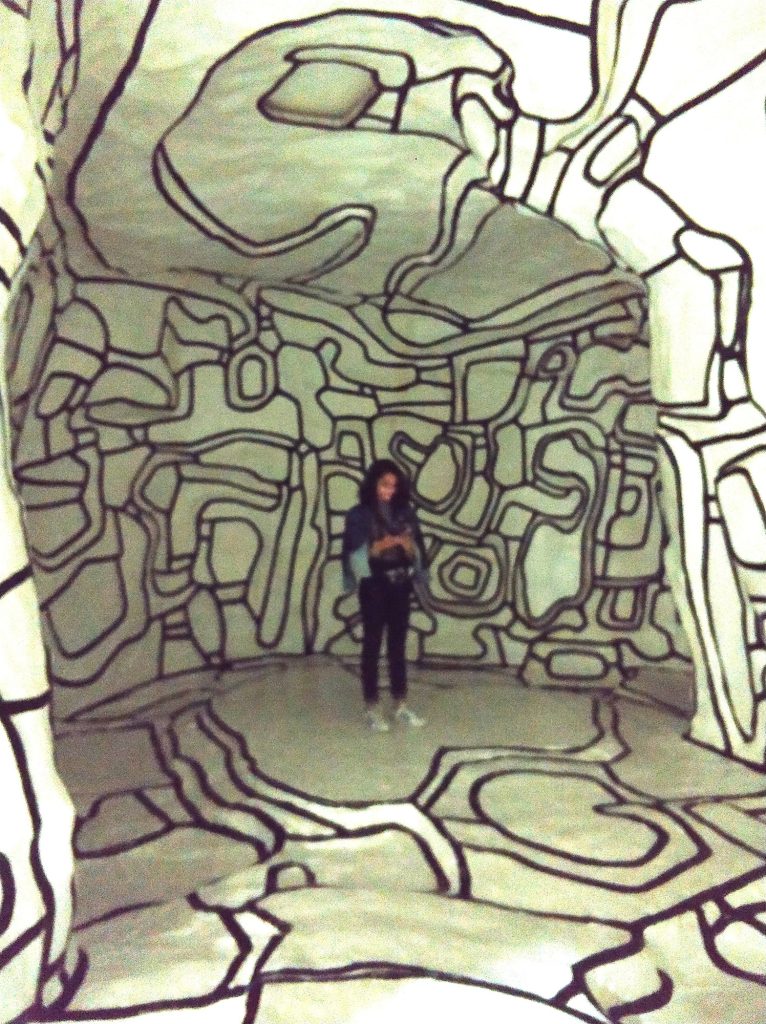
Soon we stepped into Jean Dubuffet’s Jardin d’émail, an immersive architectural artwork that felt like entering a giant three-dimensional doodle. Its winding black outlines and white, maze-like forms transformed the space into a playful, dreamlike world, blurring the boundaries between painting, sculpture and architecture.
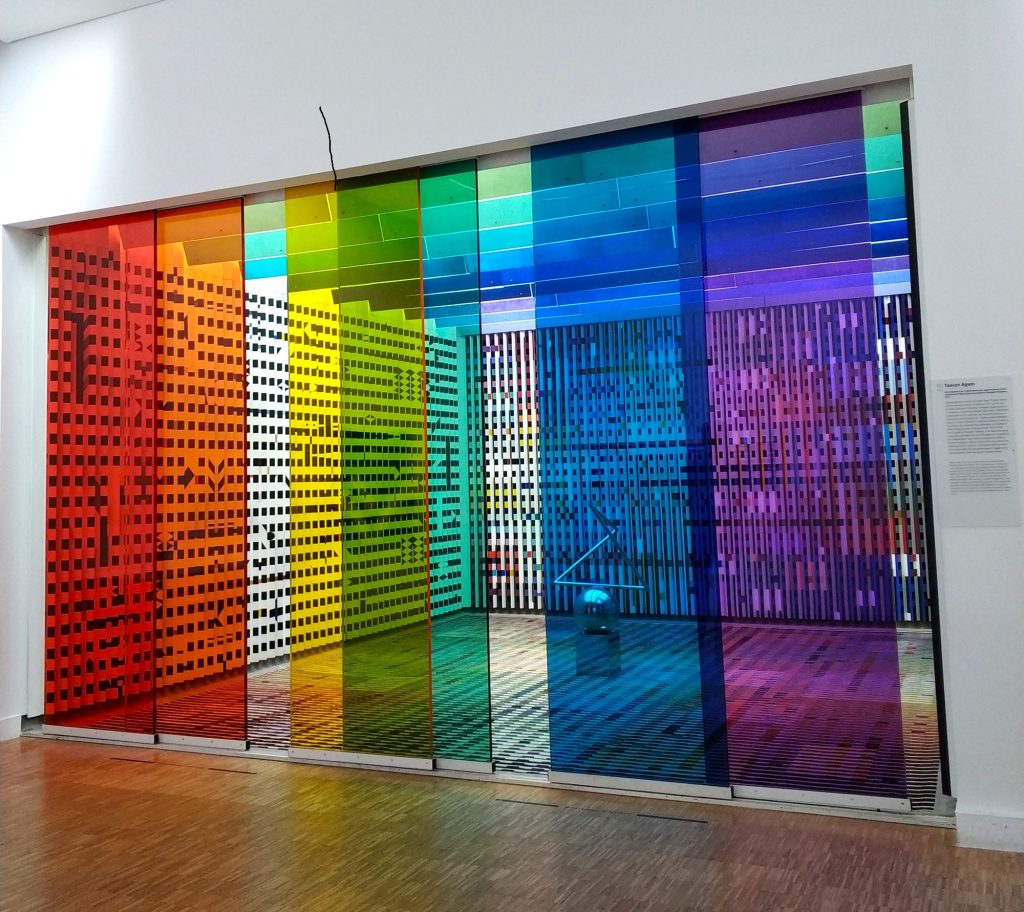
Chromosaturation is an immersive light installation, associated with kinetic artist Carlos Cruz-Diez which transforms a gallery into a spectrum of colour using translucent panels and light. As visitors move around, overlapping colours create shifting optical effects, turning the space itself into an interactive artwork.
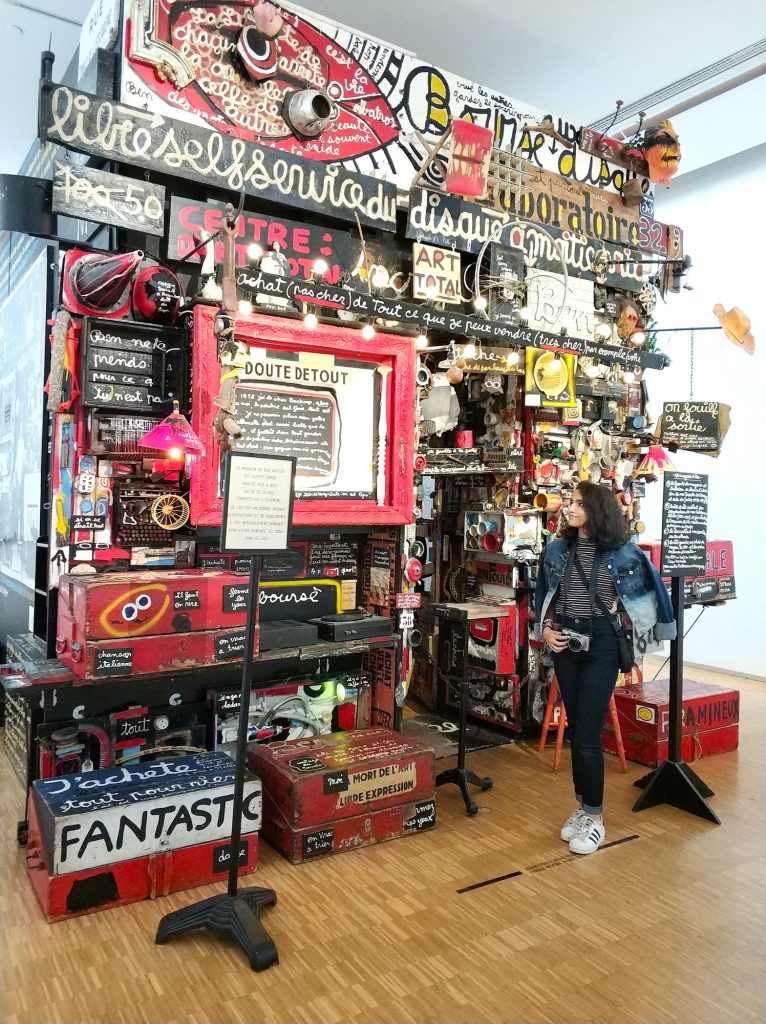
Then there was Le Magasin de Ben (Ben’s Store, 1958–1973) by French artist Ben Vautier, known simply as Ben. this was one of the most fascinating installations at the Pompidou. A wonderfully chaotic assemblage of old objects, boxes, signs , handwritten messages and found materials, Ben originally created this as a real shop in Nice in 1958, where he sold and collected objects. He gradually transformed it into an artistic space, reflecting his belief that ‘everything is art‘. It later became part of the Centre Pompidou collection.
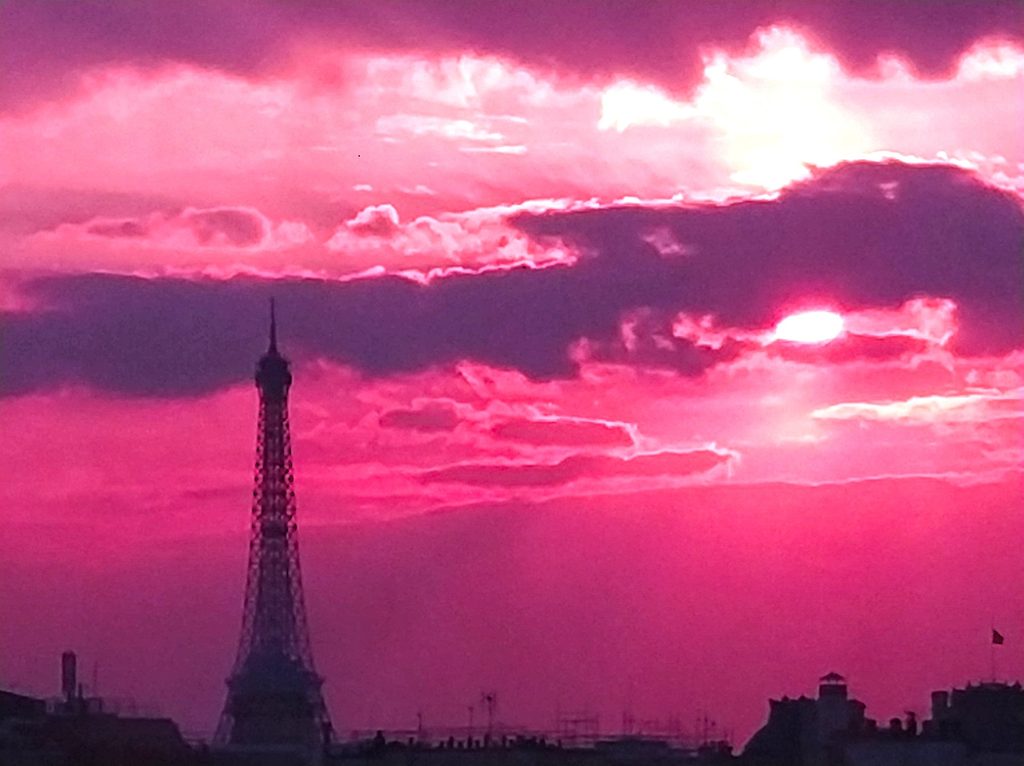
Sunset from the Open Deck
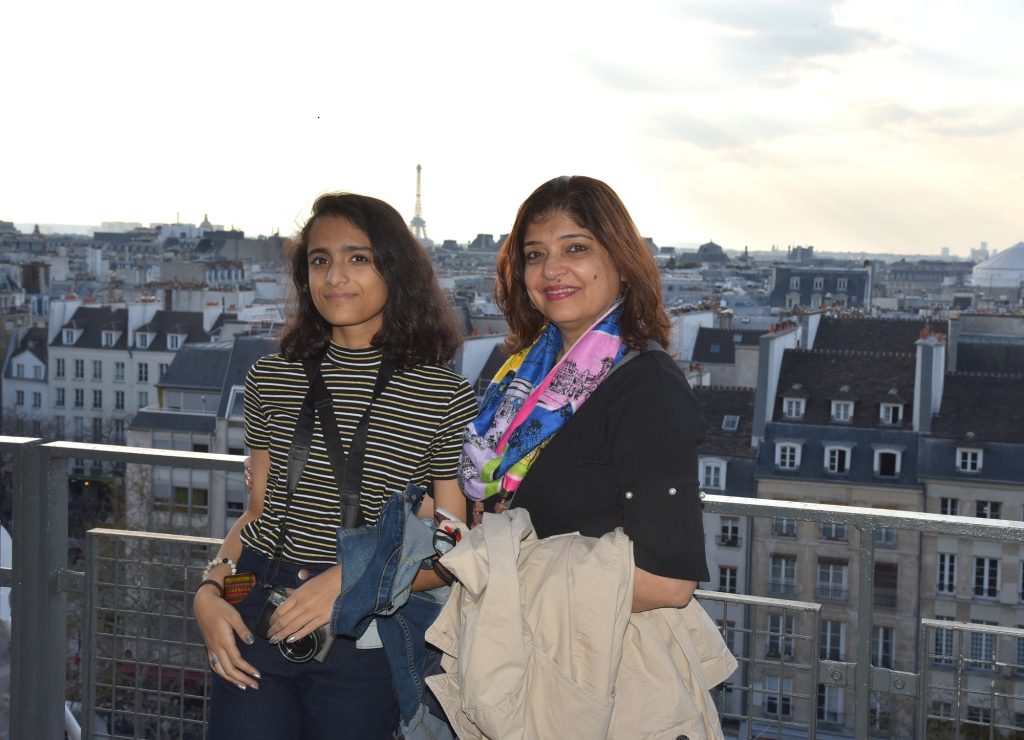
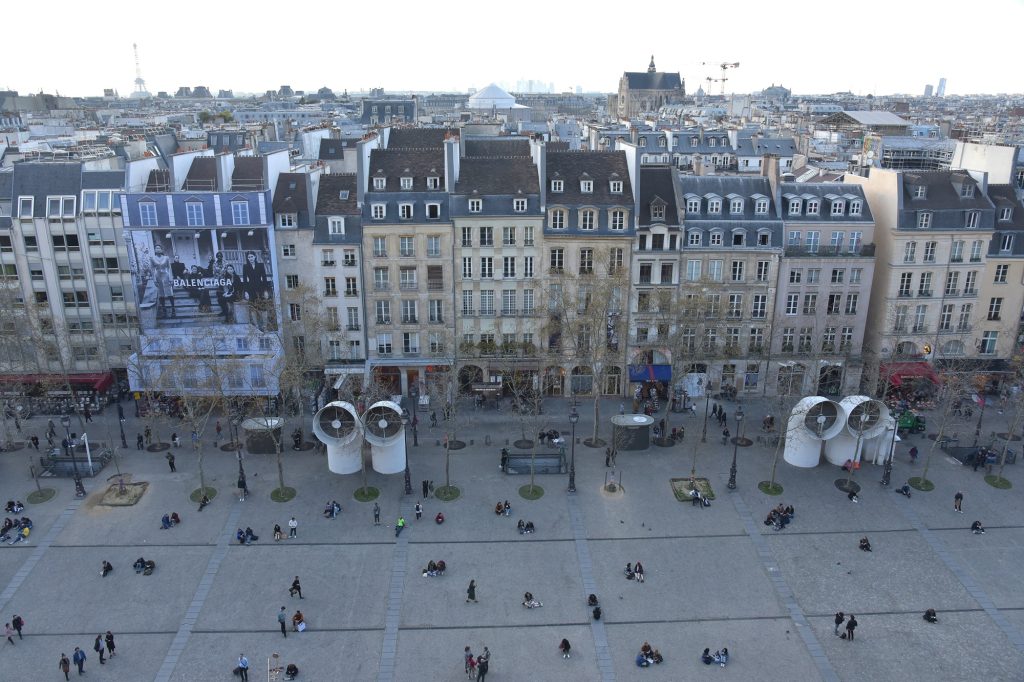
After a tour of the museum, we went to the outside open deck to view a spectacular sunset across a Parisian horizon. Below like tiny ants we could see street performers entertaining spectators with a variety of performances – miming, juggling, hip-hopping, singing with guitars, singing with organs, singing with their bands, and street vendors selling Crepes – the famous national street food of Paris. The Eiffel Tower was on the left and the Sacre Coeur on the right , both of which were visible from there. What a magnificent view it was with a regal , purple sky tinted in multiple shades of mauve by the dying sun!
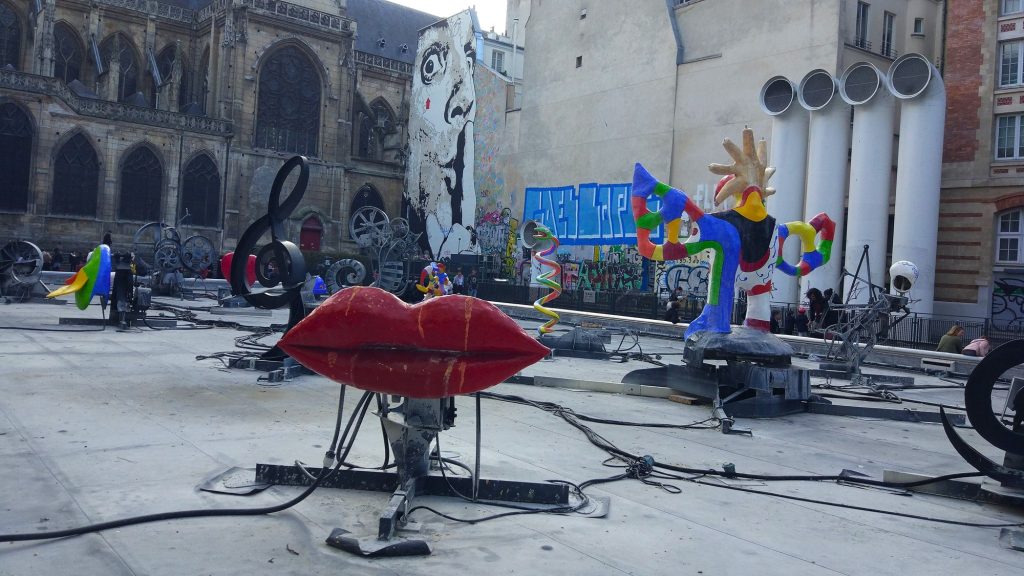
We went down to enjoy some more of the performances and landed in front of the nearby Stravinsky Fountain , another landmark not to miss. Sixteen unusual looking, moving and water-spraying sculptures by Jean Tinguely and Niki de Saint-Phalle are its highlight. This fountain is a tribute to composer Igor Stravinsky and represents themes and works by him. There was no water in the fountain for reasons unknown to us but the art work was enjoyable.